See a water damage restoration invoice sample line by line, copy-ready line item wording, and a free blank template with claim, equipment and payment fields.

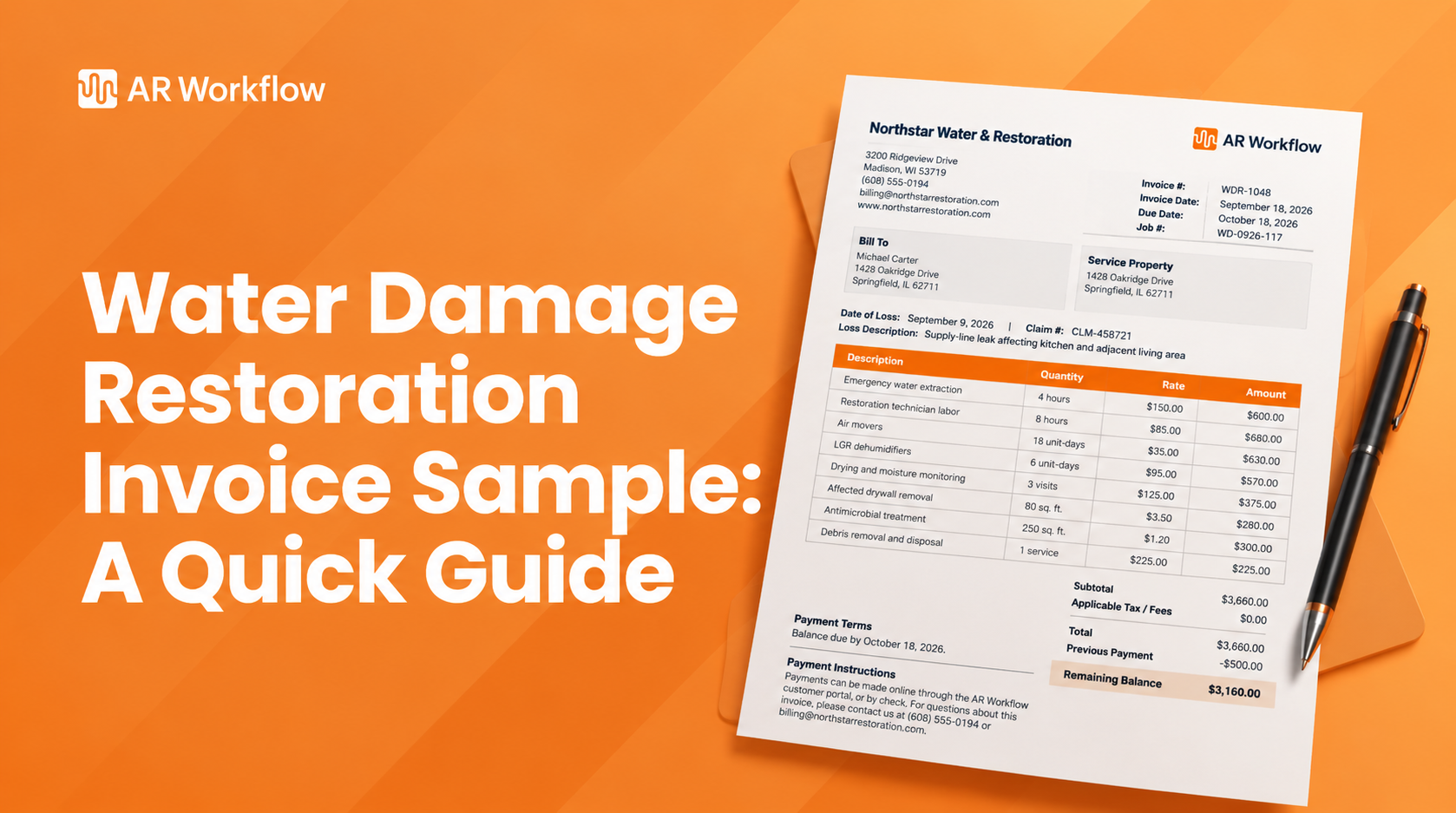
If you work in the restoration industry, you know that a water damage restoration invoice is one of the final steps between completing a job and collecting payment for it. A good water damage restoration invoice sample shows you exactly what that bill should look like, line by line, before you build your own.
Because the invoice can significantly impact your company's cash flow, getting it right the first time is essential. To help you do that, this guide includes a water damage restoration invoice sample, copy-ready line item wording, a free blank water damage invoice template, and everything you need to know when creating or completing one.
KEY TAKEAWAYS
You need a water damage restoration invoice when you are ready to bill for completed work.
The timing can vary depending on the work involved. If your team completes water extraction and cleanup in one visit, you may have everything you need to prepare the invoice shortly afterward.
But a job that requires several days of structural drying and dehumidification may take longer because you will still need the final equipment usage and labor hours.
Take drying equipment as an example. If six air movers stay on the property for three days, you need those final usage details to maintain accuracy during the billing process.
Once you have the final job information, the invoice brings it together. It shows what your team completed, what each charge covers, and how much the customer or payer owes.
Who you send invoices to depends on who is responsible for payment.
For direct-pay clients, the recipient may simply be the property owner, while insurance-related work can involve an insurer or insurance adjuster reviewing the invoice as part of the claim as well. Some restoration companies bill the insurance company directly under a signed work authorization, while others bill the homeowner and let them handle the claim.
This is why the invoice should clearly identify the job it belongs to. The property address and date of loss help establish that connection. If the job involves an insurance claim, including the claim number can make it easier for the reviewer to match the invoice to the correct file.
Clear service descriptions help for the same reason. The person reviewing the invoice may not have seen the restoration work firsthand, so each line item should tell them what your company actually did.
An invoice tells the recipient what you are charging for, but supporting documents provide more information about the work behind those charges.
What you include depends on the job and who is reviewing it, including whether a water damage estimate template was used earlier in the job.
For example, an insurance-related water mitigation job may have photos, moisture readings, drying logs, equipment records, notes, or signed work authorizations in the job file.
These records can add context to specific charges. If the invoice shows six air movers used for three days, the equipment records can document when your team placed and removed them. Our guide to bulletproof documentation covers what to capture.
You do not need to fit every job detail onto the invoice itself. Just keep the invoice focused on what you are billing, then provide supporting records when the payer or circumstances call for more documentation.
Here is an example of how those details can look once you put them together on a completed invoice.
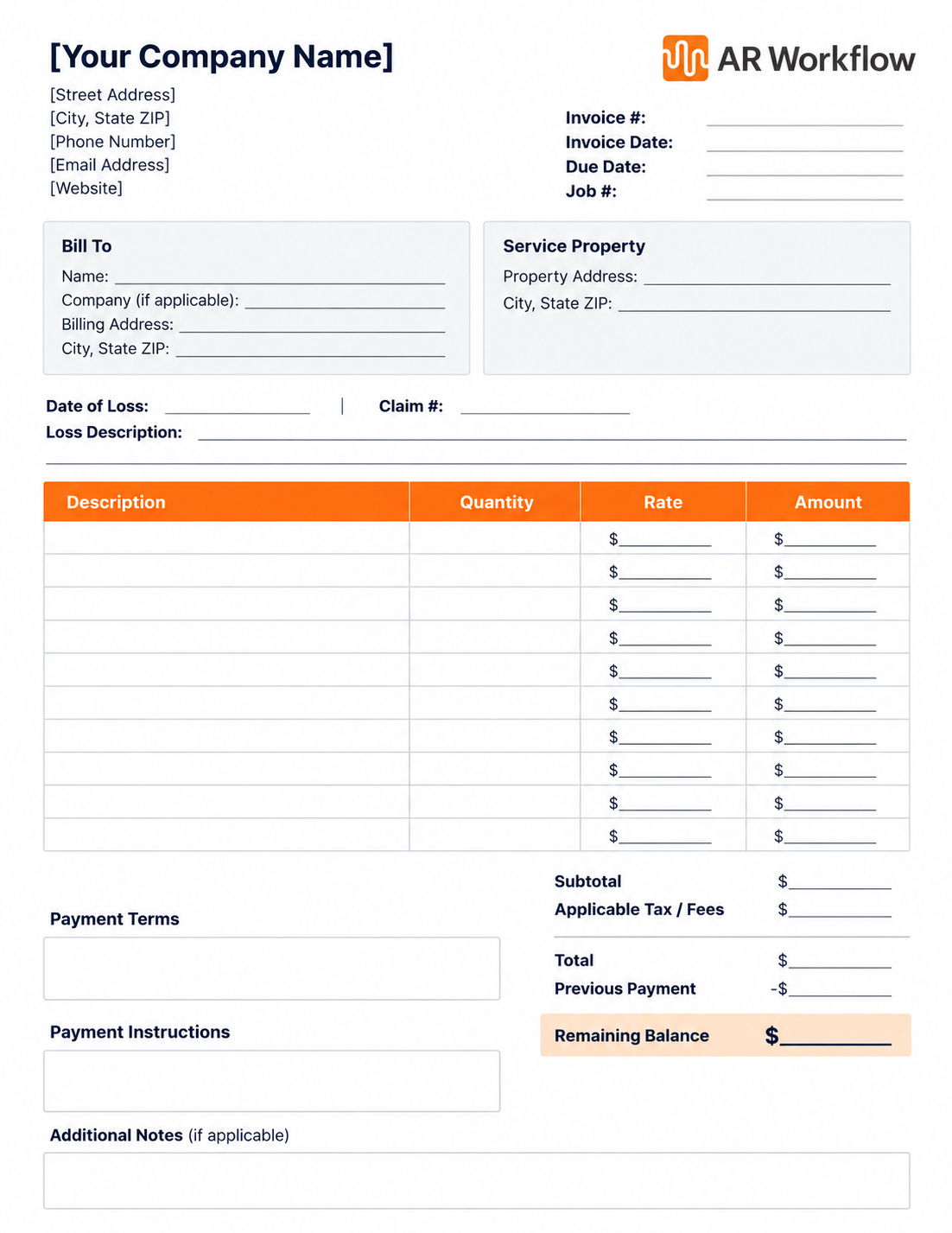
A water damage invoice example with job, claim, itemized services and remaining balance.
Bring one overdue invoice.
We'll show you how AR Workflow would follow up on it once it goes out.
The sample above tells a fairly simple story, and each part of the invoice contributes to that story. Here is what the main sections are doing and why you need to include them in your own invoices.
| Invoice section | What it does |
|---|---|
| Company and customer information | Shows who sent the invoice, who receives it, and where the work happened |
| Job and claim details | Connects the invoice to a specific water loss and claim |
| Itemized services | Lists each service so the reader sees how the total came together |
| Labor, materials and equipment | Shows quantities, units and rates behind each charge |
| Total and remaining balance | Shows the original total, previous payments and what remains |
| Payment terms and instructions | Tells the payer when and how to pay |
Start by making it clear who sent the invoice and who needs to receive it.
The sample lists the restoration company's name and contact information at the top. It then identifies the customer in the bill-to section.
Notice that the service property has its own field. That distinction helps when the customer's billing address differs from the site where your team performed the work.
Keeping these details together can also save time when you need to identify the invoice later. If the customer calls with a question or your team needs to find the invoice again, they can quickly connect it to the right person and property.
Once you have identified the customer and property, connect the invoice to the specific water loss.
The sample includes a job number, date of loss, claim number, and a short description of what happened. Those details help distinguish the invoice from other jobs you may have completed for the same customer or property.
The claim number becomes particularly relevant when insurance is involved because it gives the reviewer another way to match the invoice to the correct claim.
You will not need the exact same fields on every job. Include the identifiers that help the customer, payer, and your own team understand exactly which project the invoice covers.
Next comes the part the recipient will probably spend the most time reviewing: what you are charging them for.
The sample lists water extraction separately from drywall removal and drying work. It also gives monitoring, antimicrobial treatment, and disposal their own lines.
That level of detail lets the reader see how the total came together. A single line that says "Water damage restoration: $3,660" would give them far less information about what the charge actually covers.
Your line items should reflect the work your team completed, including any other tools or services, such as mold growth treatment, that were actually performed. For mold jobs, see our mold remediation invoice guide.
Once you decide which services to list, you also need to show how you calculated the costs behind each charge.
That calculation may look different depending on the category of work you are billing.
Labor may use hours, while material removal may use square footage. Drying equipment often needs another layer of detail because the charge can depend on how many units your team used and how long they stayed at the property.
The sample shows this clearly. Six air movers used for three days equal 18 unit-days. Two dehumidifiers used for three days equal six unit-days.
Listing the quantity and rate alongside the final charge gives the recipient a detailed breakdown of the calculation without having to guess what sits behind the number.
After the individual charges, show exactly what the recipient still needs to pay.
In the sample, the service charges total $3,660. The customer has already paid $500, so the invoice subtracts that amount and shows a remaining balance of $3,160.
Keeping the previous payment visible makes the balance easier to understand. The customer can see the original total, what they already paid, and what remains.
If taxes or other fees apply to your invoice, show those separately as well. The rules can vary by location and by the work involved, so the sample does not assume a particular tax applies to every restoration job.
The remaining balance tells the customer how much they owe. The payment terms tell them when you expect it.
In the sample, the invoice gives a specific due date of October 18, 2026. Your own due date should follow the payment terms agreed on for the job.
Then make the next step clear. If you accept online payments, checks, or another payment method, include the instructions the customer needs to use those options.
The goal here is simple: once someone finishes reviewing the invoice, they should not have to contact your office just to figure out when or how to pay it.
Tip: On insurance jobs, send the carrier the invoice with its claim number and supporting documents. Payment links go to the homeowner for their portion, never to the adjuster or carrier.
The most useful part of any water damage invoice example is the wording on each line. Descriptions that name the service, the area and the unit are easier to review than short internal codes. Use the examples below as a starting point and replace the quantities with what your team actually did.
| Service | Typical billing unit | Sample line item wording |
|---|---|---|
| Water extraction | Square feet or hours | Extract standing water, carpet and pad, living room and hallway (SF) |
| Air movers | Unit-days | Air mover, 6 units x 3 days (unit-days) |
| Dehumidifiers | Unit-days | LGR dehumidifier, 2 units x 3 days (unit-days) |
| Moisture monitoring | Per visit | Daily moisture readings and drying log, 3 visits |
| Drywall removal (flood cut) | Linear or square feet | Remove wet drywall 2 ft flood cut, bedroom and hall (LF) |
| Antimicrobial treatment | Square feet | Apply antimicrobial to exposed framing and subfloor (SF) |
| Contents manipulation | Hours | Move and block furniture for drying access (HR) |
| Debris haul-off and disposal | Per load | Bag, haul and dispose of wet materials, 1 load |
If your estimates are written in Xactimate or another estimating platform, keep the invoice descriptions consistent with the approved estimate so the reviewer can match each line. Any line that was not on the estimate should carry a short note explaining why it was added.
The same job can produce a slightly different invoice depending on who is paying. Here is how to adjust the sample:
If you want to turn this sample invoice for water damage into your own, copy or print this blank version and use it as a starting point. For other job types, see our restoration invoice template and fire and smoke restoration invoice template.
TEMPLATE
[Your Company Name]
[Street Address]
[City, State ZIP]
[Phone Number]
[Email Address]
[Website]
Invoice #: _________________
Invoice Date: _________________
Due Date: _________________
Job #: _________________
| Bill To | Service Property |
|---|---|
| Name: ________________ Company (if applicable): ________________ Billing Address: ________________ City, State ZIP: ________________ | Property Address: ________________ City, State ZIP: ________________ |
Date of Loss: ______________ | Claim #: ______________
Loss Description: ______________________________________
| Description | Quantity | Rate | Amount |
|---|---|---|---|
| $________ | $________ | ||
| $________ | $________ | ||
| $________ | $________ | ||
| $________ | $________ | ||
| $________ | $________ | ||
| $________ | $________ | ||
| $________ | $________ | ||
| $________ | $________ | ||
| $________ | $________ | ||
| $________ | $________ | ||
| Subtotal | $________ | ||
| Applicable Tax / Fees | $________ | ||
| Total | $________ | ||
| Previous Payment | $________ | ||
| Remaining Balance | $________ | ||
Payment Terms: ______________________________
Payment Instructions: ______________________________
Additional Notes (if applicable): ______________________________
Use the completed sample as a guide when filling in the blank template.
Treat the template as a framework you can modify, not a fixed list of what every invoice needs. Feel free to edit the service lines and other fields to match the job you actually completed.
Once you send the invoice, the next part depends on whether payment actually arrives.
If the due date passes without payment, your team now has an outstanding invoice to manage. Someone needs to see that it is overdue, check whether anyone has already contacted the payer, and determine what follow-up should happen next. Our guide to unpaid invoices walks through that sequence.
Doing that for one invoice is manageable. The workload grows when your team has many unpaid restoration invoices sitting at different stages of aging, and each one has its own collection history.
An invoice can reach 60 or 90 days outstanding while your team continues billing new jobs. Without a clear collection process, keeping track of which accounts need attention can require a lot of manual checking. An AR aging report helps you see which ones are slipping.
Once several invoices are overdue at the same time, the real issue is no longer whether your team knows how to send a reminder.
It is whether they can keep track of which accounts need attention, what has already been communicated, and when each payer should hear from them again.
AR Workflow is automated software that gives restoration teams a more structured way to manage that work.
It gives your team easier access to outstanding balances and collection activity, while scheduled email and SMS follow-ups from a dedicated number can handle appropriate routine communication without requiring someone to start every reminder manually.
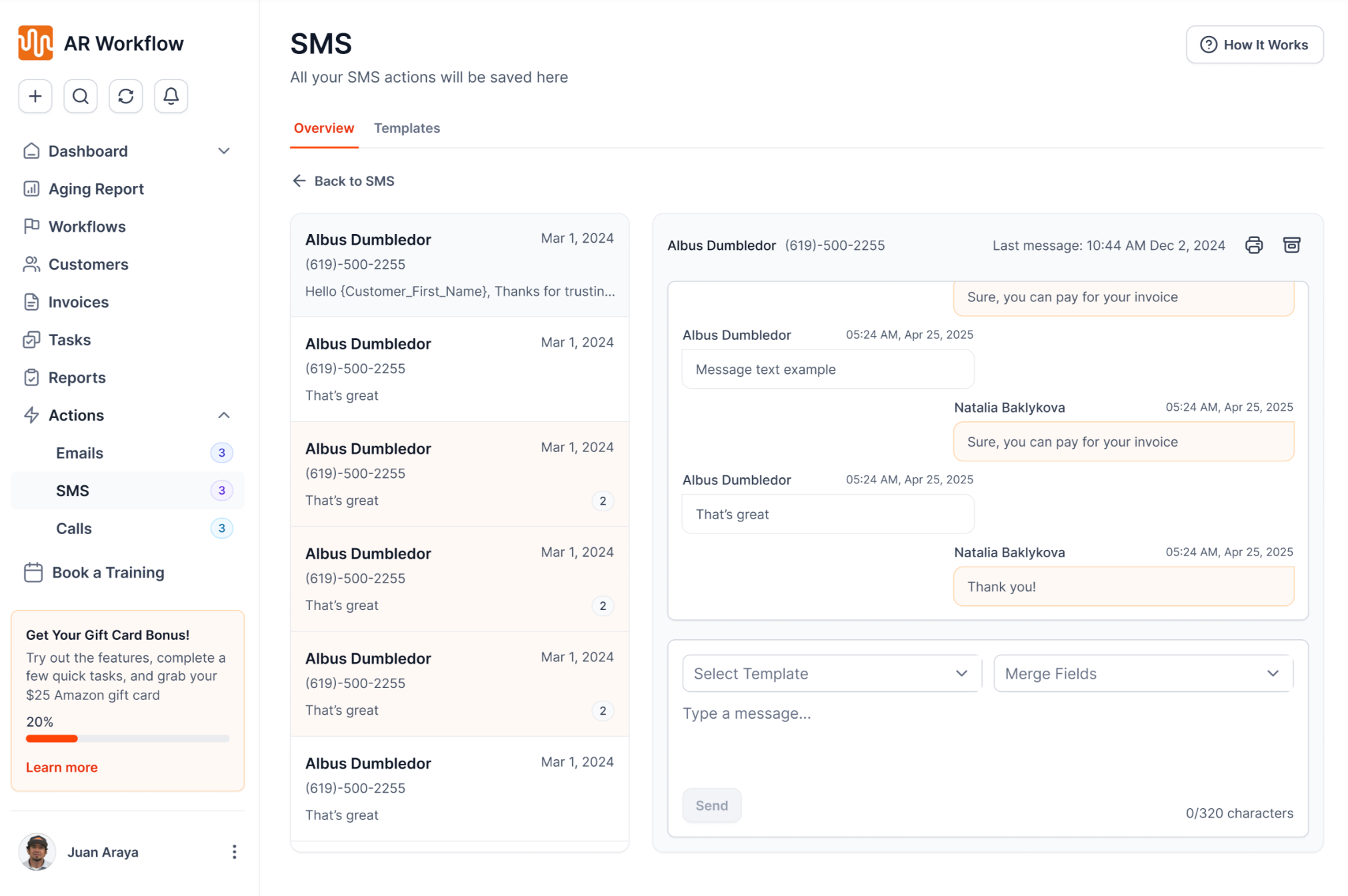
Scheduled email and SMS follow-ups handle routine reminders.
AR Workflow also brings the collection history for each invoice into one process, so the team can track payment status, assign next actions, and keep follow-up moving without piecing everything together.
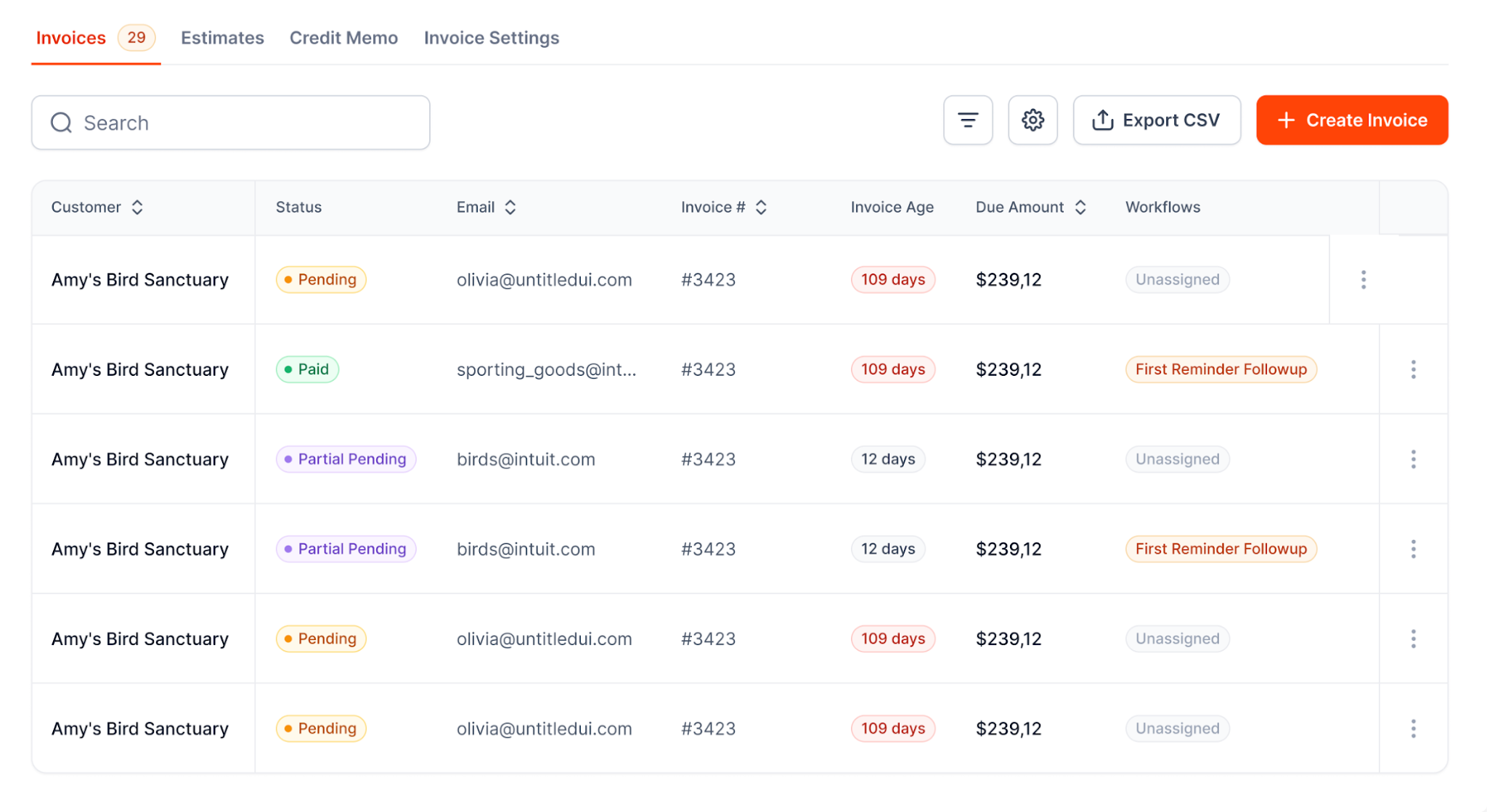
Each invoice's collection history and next action stay in one place.
Payments are also made easier by giving customers several ways to pay once they are ready. They can pay online through AR Workflow's customer portal using a credit card or ACH bank transfer, or pay directly from an email or text reminder.
Credit card payments can then be recorded in QuickBooks automatically, so your team does not have to manually update the payment there as well. Read more in our QuickBooks accounts receivable automation guide.
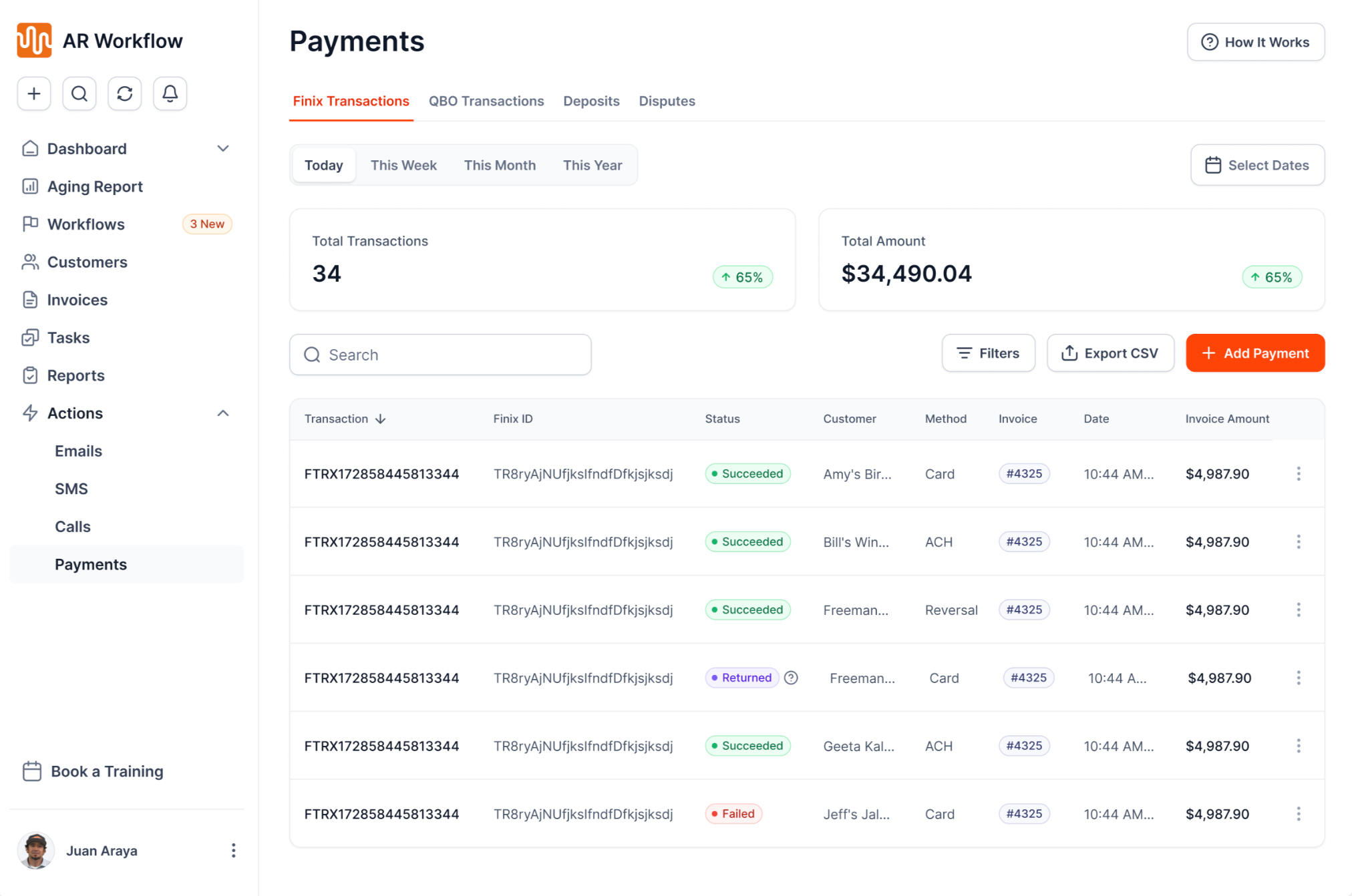
Customers can pay by card or ACH from the portal or straight from a reminder.
Preparing a clear water damage restoration invoice sample gives you a better reference for billing the work your company has already completed. Once you adapt it to the actual job, the customer or payer can see what you are charging and how much remains due.
Next, stay on top of that balance until you collect it. AR Workflow helps streamline that process by giving your restoration team a more organized way to manage outstanding invoices and maintain collection follow-up after the bill goes out.
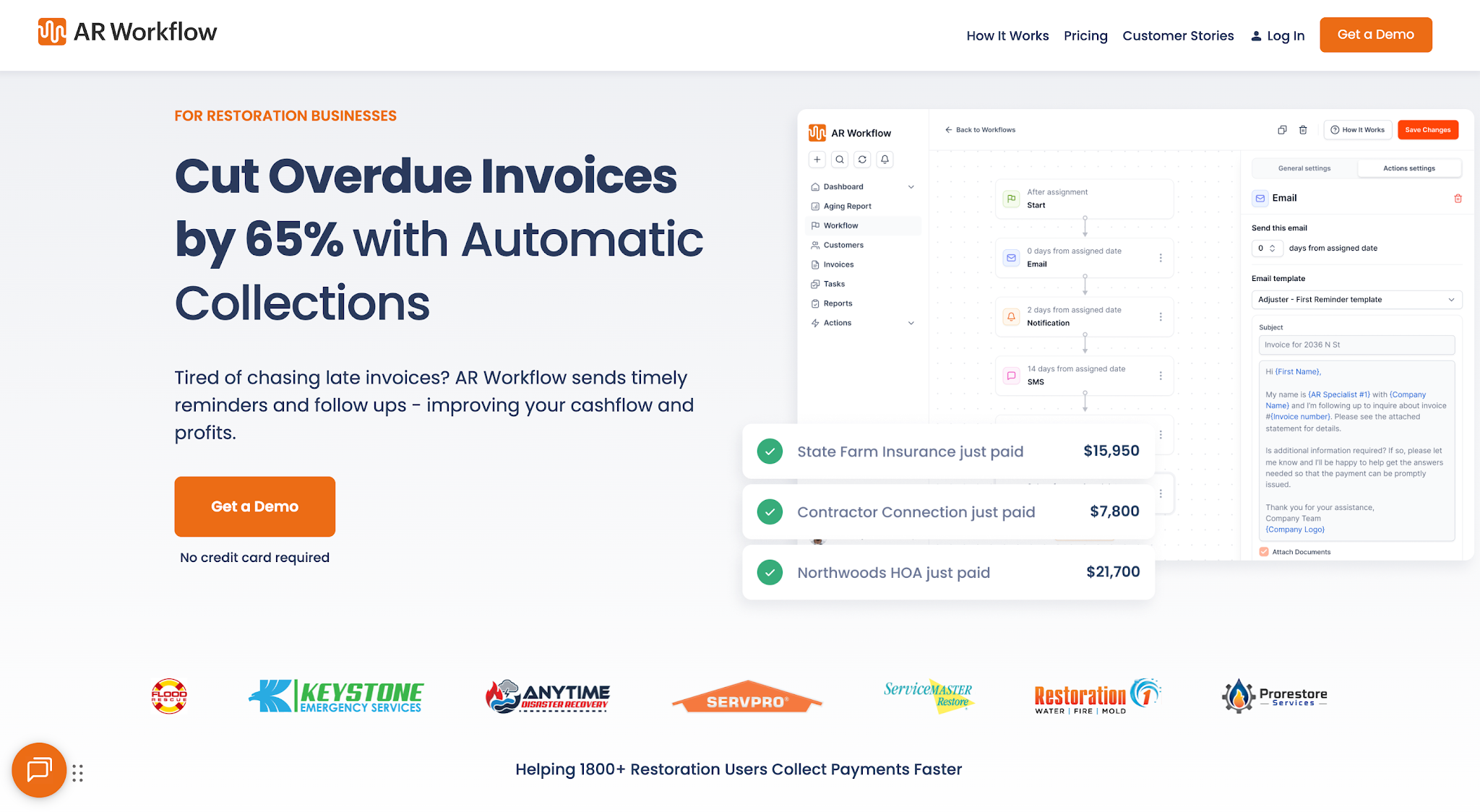
AR Workflow organizes outstanding invoices and follow-up after the bill goes out.
With a clearer invoicing process and a better way to manage collections, your team can spend less time chasing down what needs attention and stay focused on collecting the revenue your company has already earned.
Document what caused the water damage, the affected areas, the conditions your team found, and the restoration work completed. Add relevant photos, moisture readings, and equipment records when needed to support the report.
To make an invoice for repairs, you need to include your business and customer information, identify the property or job, and itemize the repairs with their quantities, rates, and charges.
Then complete the invoice by including the total amount, any previous payments, the remaining balance, the due date, and payment instructions.
Water damage restoration that occurs after leaks or floods often includes standing water extraction, structural drying, moisture monitoring, cleaning and sanitizing, mold remediation, and removal of damaged materials.
However, the exact services that will take place will still depend on the type and extent of water damage at the property.
Bill drying equipment by unit and by day. Multiply the number of units by the days they stayed on site, then by the daily rate. In the sample, six air movers for three days equal 18 unit-days.
Yes. The blank template on this page is free to copy or print. It includes fields for the service property, date of loss, claim number, itemized services with quantity and rate, previous payments and remaining balance.
On insurance jobs, yes. Showing the deductible on its own line tells the homeowner exactly what they owe you and keeps it separate from the amount billed to the claim. Collect the deductible from the homeowner, and send the carrier documentation for the rest.
Related reading
Your invoice, not a feature tour.
Bring one overdue invoice to a demo and see what AR Workflow would send, when, and how your customer would pay.
Sam owned and ran three restoration companies for more than 14 years and collected over $100 million in receivables. He built AR Workflow in 2020 to give contractors the collections system he wished he'd had.

AI writes the emails, sends the texts, and leaves the voicemails. Your team handles the conversations that matter, and your cash keeps moving.
 Keep QuickBooksStart with one invoiceStay in control

 Log in