How long does an insurance claim take to pay a restoration contractor? See each stage, how the insurance payout works and how to speed up your claim.


How long does an insurance claim take to pay a restoration contractor? The honest answer is anywhere from a few weeks to several months, and one thing shapes your insurance claim payout time more than anything else.
It's not your customers or the quality of your work (we know you're a professional).
It's how you work with your insurance adjuster.
These fine folk are the claim-approving gatekeepers who often slow down or stop your hard-earned payments. That said, these guys don't have to be a constant source of frustration. Instead of adopting an adversarial stance, what would it be to understand and collaborate with your insurance adjuster?

If it meant faster payments, more business, and smoother processes, would you be game? If so, read on.
This article will walk you through the psychology of adjusters; how to address their pain points; leveling up your professional communication; thinking lifetime for long-term benefits; and how to handle disputes should they arise. If you've ever asked how long does insurance take to pay, you'll see that a big part of the answer is in your hands.
Become the kind of contractor they want to work with. Once you shift your approach, you'll find that claims move faster, disputes shrink, and those checks hit your bank account before you can blink. There is a way to play their games, and here's how you win them.
It's time to supercharge your bank account and accelerate your business with faster cash flow.
KEY TAKEAWAYS
| 1 | Understand your adjuster |
| 2 | Anticipate their pain points |
| 3 | Build trust with clear communication |
| 4 | Think lifetime: win with adjusters as allies |
| 5 | Handle disputes like a pro |
Most property claims move through the same six stages. Each stage has its own clock, and the total time is the sum of all of them plus any time a file sits waiting for something from you. A straightforward water loss with clean documentation can move quickly. A large loss with supplements, a disputed scope or a mortgage company on the check can take months. Here is where the time goes and what you can do at each step.
| Claim stage | What controls the clock | What you can do |
|---|---|---|
| 1. First notice of loss | How quickly the homeowner reports the loss and the carrier opens a claim number. | Help the homeowner report the same day and get the claim number and adjuster contact on your work authorization. |
| 2. Inspection | Adjuster workload, catastrophe events in the area, and access to the property. | Offer two or three inspection windows, meet the adjuster on site, and have moisture readings and photos ready. |
| 3. Estimate review | How closely your estimate matches the carrier's pricing and scope. | Write line items the way the adjuster expects to see them and explain every unusual charge in a note. |
| 4. Supplements | Hidden damage found after demo, and how well it is documented. | Photograph before you open walls, send the supplement with photos and readings in one package, and log the date sent. |
| 5. Approval and payment | Internal approval limits, payment method and who the check is made out to. | Confirm the payee, mailing address and any assignment of benefits before the check is cut. |
| 6. Endorsement and release | Mortgage company endorsement and any held-back depreciation. | Know the lender's endorsement process and send completion paperwork the day the job is done. |
Many states set deadlines for how fast an insurer must acknowledge, decide and pay a claim, often called prompt-payment or fair claims settlement rules. These rules protect the policyholder, so as a contractor you usually benefit from them through your customer or an assignment where your state allows one. The examples below are summaries for context only. Rules vary by state, change over time and have exceptions, so check your state insurance department or an attorney before relying on a specific deadline.
| Source | What it says (summary) |
|---|---|
| NAIC Unfair Claims Settlement Practices Model Act | A model law many states have adopted in some form. It treats failing to acknowledge claims promptly, failing to adopt reasonable standards for prompt investigation, and failing to affirm or deny coverage within a reasonable time as unfair practices. |
| Texas Insurance Code, Chapter 542 (Prompt Payment of Claims) | Generally requires the insurer to acknowledge a claim and begin its investigation within 15 days, accept or reject within 15 business days after receiving all requested items, and pay within 5 business days after accepting, with some exceptions and extensions. |
| California Code of Regulations, Title 10, Section 2695.5 and 2695.7 | Generally requires acknowledgment within 15 days of notice, a decision to accept or deny within 40 days of receiving proof of claim, and payment within 30 days of acceptance. |
 Tip: Most state clocks start when the insurer has everything it asked for. A complete file on day one is the fastest way to start the clock. For the full picture of who pays what on a claim, read how restoration contractors collect from carriers, adjusters and homeowners.
Notice that most of the stages above run through one person. That is why the rest of this guide focuses on the adjuster.
An insurance payout is the money the carrier pays once it approves a claim. On a property loss it rarely arrives as one check for the full invoice. How the payout is split depends on the policy, so read the declarations page with the homeowner early. A typical replacement cost policy pays in pieces:
Checks are usually made out to the policyholder, and often to the mortgage lender as well. Unless your state allows an assignment of benefits or a direction to pay and you have one signed, the payout goes to your customer and your invoice goes to your customer. That is why the homeowner side of follow-up matters as much as the adjuster side. Send the homeowner a clear balance, a way to pay by card or ACH, and a payment plan if they need one for the deductible. Our contractor payments page shows how AR Workflow handles that part.

If you want to influence someone, you need to understand them. Your insurance adjuster is no different. They also just happen to be your payment gatekeeper. Because they hold the power to approve or deny your claim, how you interact with them determines whether your payment is delayed or delivered. So let's get started by understanding what their job actually entails.
Adjusters wear many hats. They evaluate the damage, determine what's covered under a policy, and figure out what work should be paid. To wit, their job is to protect the insurance company from overpaying, and, as a result, they are meticulous. Here's the full list of their responsibilities:
| Adjuster responsibility | What it means for you |
|---|---|
| Damage assessment | They inspect the damage; verify if it's covered by the policy; and determine how much the insurance company should pay for repairs. This assessment determines the scope of your job and what of your work will be covered by the insurance or the individual. |
| Cost estimation | Adjusters also make sure that the repairs you're charging for are priced in accordance with the industry standard. They then compare your estimates with their own research to ensure that you don't overcharge. |
| Fraud prevention | Adjusters are on high alert for anything that seems inflated or unnecessary. They're trained to spot potential fraud, so they'll question anything that doesn't seem right. Make sure you communicate frequently and stay honest in your work. |
| Approving or denying claims | Ultimately, your adjuster is the one who says, "Yes, this claim is approved," or "No, we're not paying for that." It's their job to be the bottom line in terms of claim approval. Your job is to help them get to "yes" as quickly as possible. The rest of this article tells you how. |
Tip: Label and tape off all damaged areas or items that need work to ensure the adjuster doesn't overlook anything. Clear markings help highlight the scope of work, improving the accuracy of the estimate.
Tip: In your estimates, tell the story behind every charge. Adjusters are often moving quickly, so explaining the "why" behind each line item ensures everything is justified and nothing gets overlooked. Our insurance adjuster invoice guide shows how.

The first way to accelerate your adjuster to a yes is to understand your adjuster's pain points. Despite the power they wield, adjusters are human, just like you. They've got deadlines, quotas, and a high-pressure job. They're dealing with dozens, sometimes even hundreds, of claims. If you're the contractor who can make their job easier, you're the contractor who's going to get paid faster.
Here are the constant points of friction in their day-to-day:
Reminder: they're not just handling your claim; they've got a stack of others to get through too. If your paperwork is incomplete or your communication is spotty, it slows your adjuster down. And if you slow them down, they won't hesitate to put your claim on the back burner.

Insurance companies set strict deadlines, and adjusters have to meet them. Like you, your adjuster doesn't have time for delays, and if you're slow to provide information, you're making it difficult for the adjuster to support you and meet their deadlines. This damages your social capital with them and slows down your payment timeline. Again, the more difficult you are to work with, the more frustrating the process is for everyone.
To further complicate matters, adjusters have to balance the needs of three different power players: the policyholder (your customer), the insurance company, and you (the contractor). This balancing act can create tension, especially when interests are at odds.
Tip: Build social capital by signaling that you understand these three dynamics. Respond promptly. Have thorough documentation. Extend and articulate empathy to diffuse tension. All of these tactics will start building a connection that will serve you in the long run.

When an adjuster trusts you, things move faster. If they're confident that your estimates are fair, your work is top-notch, and you're a professional, they'll be more likely to approve your claim quickly.
So how do you build that trust? Assuming excellent work,* focus on how you communicate.
*To understand how to set your work a notch above the rest, read Outsmart the Mortgage Companies Controlling Your Payments, in which we talk about how excellent work can ensure easy processes and fast payment.
In your communications, be consistent, transparent, and professional. Here's how:
Trust is built through consistency. Every claim you submit, every piece of documentation you provide, needs to be accurate, detailed, and professional.
When an adjuster sees that your invoices are always clear, your estimates are realistic, and your documentation is flawless, they'll start to trust that you know what you're doing. And when they trust you, they'll stop questioning every little thing.
When this consistency continues across project after project, you begin to build your reputation. Imagine being the contractor adjusters recommend because they know you're reliable, professional, and fair. That's the kind of reputation that not only gets you paid faster but brings more business your way.
Transparency is another trust pillar. If there's an issue, whether it's a delay in materials or an unexpected challenge on the job, communicate it immediately. Adjusters hate surprises. If you keep them in the loop and explain why something is happening, they're much more likely to work with you to find a mutually amenable solution.
Tip: Transparency 101: overcharging. Let's talk about overcharging. Don't do it. Ever. You might think you can get away with inflating your prices a little, but adjusters are trained to spot this immediately. (Remember what we said about fraud? Their fraud-meter is always set to incredibly high and intensely paranoid.) Be fair, be transparent, and they'll respect (and trust) you for it. See also how to submit bills that get paid without price reductions.
Every interaction with an adjuster is a chance to prove your professionalism. That means show up on time; keep your documentation organized; and maintain a positive attitude, even when things get tough. You want the adjuster to walk away from every interaction thinking, "This is someone I want to work with again."
This professionalism translates into faster payments because they'll begin to extend more and more trust that you're getting the job done right, on time, within budget, and with excellent documentation.
Beyond that, if they do have a difficult issue to broach with you, they won't procrastinate in calling you because they know you'll be a professional, even in the more difficult of conversations.
Professionalism wins, every time.
Bring one overdue invoice.
Bring an insurance job that is stuck and we'll show you how AR Workflow keeps its follow-up and documents together.

Building strong relationships with adjusters can transform your business. Instead of thinking of each claim as a one-time transaction, think of the lifespan of this relationship and the potential bigger-picture benefits. The more social capital you accrue, the stronger your relationship and potential earnings.
Also, adjusters talk to each other. They also work on multiple claims with multiple insurance companies. If you become a go-to contractor because adjusters and insurance companies know you're reliable, you'll find yourself at the top of their list (and that of their colleagues) for future work. Our guide to collaborating with insurance adjusters goes deeper.
Here are some of the big-picture long-term benefits we've found when you've adjusted your relationship with adjusters:
Some insurance companies have preferred contractor lists: contractors they recommend to policyholders. When adjusters trust you, you're more likely to land on that list, and that's a huge win for your business. Think about it. Every time a policyholder asks, "Who do you recommend?" your name comes up. Imagine that potential growth and shift in how you do business with your adjusters.
As mentioned, adjusters often work with the same contractors over and over. If you build a reputation for delivering high-quality work, meeting deadlines, and communicating clearly, you'll become a favorite. This means more jobs, more payouts, and more opportunities to grow your business.
Complex claims can be a nightmare for adjusters. They involve more paperwork, more scrutiny, and more chances for something to go wrong. If you have a strong relationship with the adjuster, they're more likely to work with you (and that working together will go more easily) to find a mutually amenable solution. And when you can help them navigate those rough waters, they'll remember you as the contractor who made their job easier.

Let's face it: disputes happen. How you handle them can make or break your relationship with the adjuster. When a disagreement arises, your goal is to stay calm, stay professional, and focus on finding a solution. We guarantee you that no matter what happens, it could (and will) be a lot worse if you don't keep a handle on the situation (and your temper). Here's how to manage yourself, and your documentation, and push toward solutions.
It's easy to get frustrated when an adjuster questions your work or denies part of your claim. But getting defensive doesn't help anyone. Stay calm, listen to their concerns, and respond professionally. Remember, your goal is to get paid, not to win the argument. Here are a few quick tips to keep you and your project in the zone:
Focus on the outcome. Always direct the conversation toward resolving the issue rather than dwelling on the disagreement. You don't have to agree on everything to reach a solution that 80% works for both of you.
A response like, "What can we do to ensure the homeowner gets the necessary repairs while keeping this within the budget?" shows that you're focused on problem-solving, which is the adjuster's goal as well.
Be flexible with timing. Being flexible on one vector may offer you gains in another. Sometimes, an adjuster may need additional time to review or approve a claim. Be patient but firm, and offer to provide any additional information they may need to expedite the process.
If the adjuster challenges your claim, be prepared to provide additional evidence. This could be more photos, a letter of explanation, or more detailed invoices. The more evidence you can provide, the stronger your case. Offer such documentation proactively to build social capital and accelerate your dispute process.
Read our article The Power of Bulletproof Documentation to level up your documentation game.
Sometimes, you'll need to negotiate. Maybe the adjuster can't approve the full amount, but they're willing to compromise. Be open to these discussions. You don't want to burn bridges over a small disagreement. Find a middle ground that works for both parties and keeps the relationship strong.
When an insurance claim is taking too long, the cause is usually one of a handful of fixable problems. Run through this list before you escalate.
| Holdup | Why it slows the claim | The fix |
|---|---|---|
| Missing photos or readings | The adjuster cannot approve what they cannot see. | Shoot before, during and after photos and log daily moisture readings from day one. |
| Unexplained line items | Anything unusual gets flagged for review. | Add a one-line reason to every line item that is not routine. |
| Late supplements | A supplement sent weeks after demo restarts the review. | Send supplements as soon as hidden damage is found, with photos. |
| No proof of loss | Some carriers will not pay until the policyholder signs one. | Ask the adjuster early whether a proof of loss form is required and help the homeowner return it. |
| Wrong payee or address | Checks get reissued or mailed to the wrong place. | Confirm payee names, the mortgage company and the mailing address before approval. |
| Silence | Files with no activity drift to the bottom of the pile. | Follow up on a set schedule and log every call and email. |
| Mortgage company endorsement | Two-party checks need the lender to sign off. | Learn each lender's process. See how to deal with mortgage companies holding insurance checks. |
CHECKLIST
A supplement is a request to add scope or cost to an approved estimate, usually because hidden damage appears once work starts. Supplements are normal, but each one sends the file back for review. Clear photos, readings and a short explanation get them approved faster. Our guide to water mitigation adjuster billing covers how to present them.
The timeline at the top of this guide shows what controls the clock. This is the other half: a claim timeline by stage from the contractor's side, with the one action at each step that most often decides whether the file moves or waits. Use it as the playbook for how to speed up an insurance claim on every job.
| When | Your action | Why it speeds the payout |
|---|---|---|
| Day of the loss | Get the claim number, adjuster contact, policyholder signature on the work authorization, and the mortgage lender's name. | Every later document can reference the claim, and you know early who will be on the check. |
| First 24 to 48 hours | Photograph everything before work starts and begin daily moisture logs. | Proof that exists from day one never has to be recreated later. |
| Inspection | Meet the adjuster on site and send a same-day recap of what was agreed. | A written recap prevents a second round of questions on scope. |
| Estimate submitted | Send one complete package: estimate, photos, readings and notes on non-routine items. | Many state clocks start only when the insurer has what it asked for. |
| During the job | Send supplements the day hidden damage is found, with photos. | Supplements reviewed during the job do not delay the final payout. |
| Job complete | Send the certificate of completion and final invoice the same day, and invoice the homeowner for the deductible. | Held-back depreciation is usually released only after completion is documented. |
| Waiting on payment | Follow up on a fixed schedule: claim status requests to the adjuster, balance reminders to the homeowner. | Files with recent activity stay near the top of the pile. |
| Check issued | Help the homeowner get the lender's endorsement and collect the balance they owe you. | The payout is not your payment until the money moves from the homeowner to you. |
The last two rows are where many restoration companies lose weeks. The adjuster has approved the claim, the check is in the homeowner's hands, and nobody is following up. A steady schedule of automated payment reminders to the homeowner, by email, text and ringless voicemail, keeps that last step moving. An AR report that splits balances by carrier, homeowner and lender shows you which claims are stuck and where.

While the above may all sound well and good, how are you going to work this advice into already existing workflows and project processes? We know you're already overworked, exhausted, and pushed to your limit.
Being professional, organized, and befriending your adjuster can be easy. We like to use all of the above with AR Workflow. While there's plenty of project management tools out there, we designed AR Workflow for restoration professionals like you.
Consolidated documentation
Remember what we said about thorough documentation and transparent communication? That can start with AR Workflow. With AR Workflow you're always ready for questions or conversations. Keep all photos, notes, communications, and status updates in one place. Save time, while you level up the quality of your project management. Build comprehensive dossiers for each project to accelerate project completion, easy communication, and your payment timeline.
Customized analytics and insights
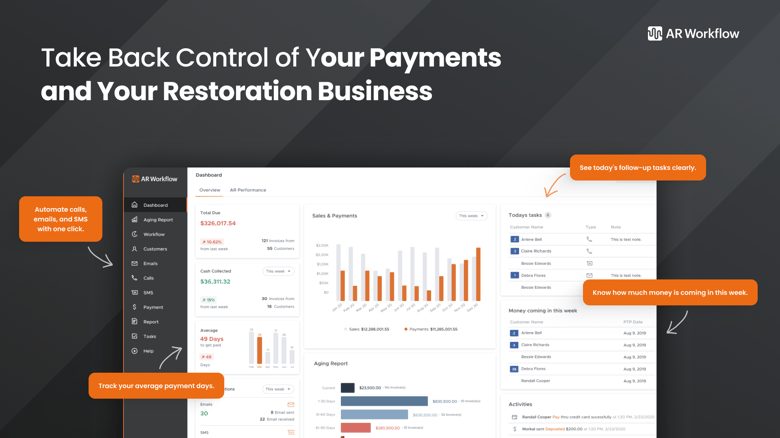
AR Workflow helps you keep your own stress low and your head clear with easy-to-understand, real-time insights and analytics on your project. By knowing what's going on, you'll be able to successfully communicate and negotiate skillfully with your adjuster. Make data-driven decisions, standardize operating procedures, and refine your process. Success starts with these real-time AR Workflow insights.
Automated email and SMS reminders
Lastly, AR Workflow keeps your communication with your adjuster consistent and professional with reminders, automation, and customizable email and SMS templates, with texts sent from a dedicated number. Communicate clearly to accelerate your project, and always be ready and prepared for a successful encounter with your adjuster.
Sound like the kind of business you'd like to be running? We think so.
Tip: Reminders to an adjuster should ask for claim status and offer documentation. Save payment links for the homeowner's portion, such as the deductible. Never send a payment link to an adjuster or carrier.
The restoration business is tough, but when you master the art of working with insurance adjusters, you unlock the door to faster payments, repeat business, and long-term success.
Understand their challenges, build trust through professionalism and consistency, and document everything with precision. When you do this, you're not just another contractor. You're the contractor they trust and want to work with. And use this article to guide your success to becoming "that contractor."
By leveraging tools like AR Workflow to streamline your documentation, communication, and project management, you make it even easier for adjusters to say "yes" to your claims. And the more "yeses" you get, the faster you'll get paid and the stronger your relationship with your adjuster.
This is your time. Step up and become the contractor who makes adjusters' lives easier. It's time for your business to take off. Faster payments, stronger relationships, and endless opportunities are all within your reach. Go after them by adjusting your relationship with your adjuster. That change starts today!
You cannot set the carrier's deadlines, but you control the part of the timeline that depends on your file. Complete documentation, fast supplements, a confirmed payee and steady follow-up remove most of the waiting. Do that on every job and the question of how long an insurance claim takes gets a shorter answer each time.
There is no single number. Insurance claim payout time depends on the carrier, your state's claim-handling rules, the size of the claim and how complete your paperwork is. A simple, well-documented claim can pay in a few weeks, while a disputed or complex claim can take months. Complete documentation and quick replies to the adjuster are the parts you control.
An insurance payout is the money a carrier pays on an approved claim. On a replacement cost policy it often comes in parts: an actual cash value payment first, recoverable depreciation after the work is finished, and extra payments for approved supplements. The deductible is not included; the homeowner pays it to you directly.
It depends on your state. Texas Insurance Code Chapter 542, for example, generally requires payment within 5 business days after the insurer accepts a claim, while California's fair claims regulations generally require payment within 30 days of acceptance. Rules vary by state and have exceptions, so check with your state insurance department.
Make the adjuster's job easy: submit complete paperwork, explain every line item, respond promptly, communicate issues early, and keep thorough documentation ready. For billing specifics, see our restoration insurance billing guide.
Stay calm, ask what is in question, and respond with additional documentation such as photos, a letter of explanation or more detailed invoices. Focus on the outcome and be open to negotiating a middle ground.
No. Send adjusters status requests and supporting documentation. Payment links belong in messages to the homeowner for their portion. Read more in speeding up payments from insurance adjusters.
Related reading
Your invoice, not a feature tour.
Bring one overdue invoice to a demo and see what AR Workflow would send, when, and how your customer would pay.
Sam owned and ran three restoration companies for more than 14 years and collected over $100 million in receivables. He built AR Workflow in 2020 to give contractors the collections system he wished he'd had.

AI writes the emails, sends the texts, and leaves the voicemails. Your team handles the conversations that matter, and your cash keeps moving.
 Keep QuickBooksStart with one invoiceStay in control

 Log in