Learn how to improve cash flow with collections in five easy steps. Discover how AR Workflow can improve your collections process.


Your restoration company may be completing more jobs and making steady sales, but that doesn't necessarily mean you have enough cash available to cover your expenses.
When customers take weeks or months to pay, a significant portion of that revenue remains tied up in outstanding invoices.
One way to address this problem is to improve cash flow with collections by examining how your team manages unpaid invoices and follows up on outstanding payments.
Book a demo with AR Workflow and find out how it improves your accounts receivable process.
Every restoration job comes with expenses that your business needs to cover, whether that's paying employees, purchasing materials, or maintaining equipment.
However, when customers delay payment after you complete the work, you still need to cover those expenses while waiting for the money to arrive.
The longer those invoices remain unpaid, the less cash your business has available to fund ongoing operations.
Improving your collections process helps address these cash flow challenges by making sure your team regularly monitors outstanding invoices and takes action when payments become overdue.
For example, if an invoice reaches its due date without payment, your team should already know when to contact the customer and what to do if the first reminder doesn't receive a response.
Without a defined process, employees may overlook overdue accounts or delay follow-ups while handling other responsibilities. Those delays can extend the time it takes your business to collect payments for services delivered.
By managing collections more consistently and offering incentives like early payment discounts when appropriate, your company can encourage faster payments and make incoming cash easier to plan around.
However, before changing how your team handles collections, you first need to understand how well your current process is working.
If your outstanding invoices keep piling up and causing cash flow problems, it's important to understand what's causing the problem before making changes. Here are a few ways to do that.
Your accounts receivable aging report shows the total money owed to your business and how long each invoice has remained outstanding.
The report groups invoices based on how long they've remained outstanding, separating those that aren't due yet from those that are 1–30 days, 31–60 days, 61–90 days, or more than 90 days overdue.
Pay particular attention to the older categories, as these can help you identify where payments are taking longer than expected.
For example, if your restoration company has $400,000 in accounts receivable and $150,000 comes from invoices that are more than 60 days overdue, you'll need to investigate what's holding up those payments.
Identify which customers have overdue balances and whether your team has already contacted them. Then, determine if unresolved disputes or missing documentation are contributing to the delays.
This will help you understand which accounts need immediate attention and what your team needs to do to collect those payments.
Next, examine payment trends to understand how long customers typically take to pay after your company issues an invoice.
You can start by comparing the invoice dates, payment due dates, and actual payment dates for recently completed jobs, including any progress payments your company agreed to collect during the project.
For example, if your payment terms require customers to pay within 30 days, but many invoices remain outstanding for 60 days or longer, you need to investigate what's causing these payment delays.
Are customers receiving reminders after their invoices become overdue? Are they waiting for answers to billing questions? Do insurance-related payments require additional documentation or communication?
Understanding the reasons behind these late payments can help you determine which problems your collections team can address and which require action from another party.
You can also use days sales outstanding (DSO) to monitor your average collection period, which we'll discuss later.
Even when your company has clear payment terms, your collections process can fall behind if employees don't have enough time to manage outstanding invoices.
Review how your team handles payment follow-ups, including how many accounts each employee manages and how much time they spend making phone calls to customers about payments.
You should also check whether employees regularly miss scheduled follow-ups or struggle to keep their collection records updated.
For example, an office manager who handles invoicing alongside several other administrative responsibilities may have limited time to contact every customer with an overdue balance.
If that's happening, determine whether the employee needs additional support or whether you can reduce the manual work involved.
Hiring another person or working with a collections agency may make sense when your current team cannot reasonably handle the workload.
However, if employees spend most of their time sending repetitive reminders or updating spreadsheets, improving the process may be the better first step.
Once you've identified what's slowing down your collections, you can start making changes to help your team manage outstanding payments more effectively.
The following five practical strategies focus on improving collection efficiency while making better use of your existing employees and resources.
Start by identifying which delinquent accounts require your team's attention.
Your aging report provides a starting point, but you should also consider the amount owed and any payment issues that could delay collection.
For example, a $25,000 restoration invoice that's already 75 days overdue may require more immediate attention than a smaller invoice that only recently passed its due date.
However, your team shouldn't ignore newer overdue invoices while concentrating on older balances. Consistent early follow-ups can help resolve payment issues before they become harder to manage.
Create a system for assigning collection priorities based on the invoice's age, outstanding balance, and payment status.
For each priority account, determine the next action your team needs to take. That might involve sending a reminder, contacting the customer directly, or resolving a question about the invoice.
This gives employees a clearer plan for managing outstanding payments instead of deciding what to do each time they review their accounts.
After identifying which accounts need attention, make sure your team knows who will handle them.
When several employees share collection responsibilities without clear assignments, they may contact the same customer more than once or assume someone else has already sent a reminder.
You can prevent this by establishing specific responsibilities within your collections process.
For example, one employee may handle routine payment reminders while another manages accounts that require more detailed communication or dispute resolution.
If your company has a smaller office team, you don't necessarily need separate employees for every task. You can assign responsibilities based on the staff you already have.
The important thing is that each employee understands which accounts they're responsible for and when they need to take action.
Your team should also know when to escalate past-due accounts when customers haven't responded to previous reminders, including when to consider legal action as a last resort.
With clear responsibilities, employees can coordinate their collection efforts and reduce the chances of outstanding invoices going without attention.
As your restoration company grows, manually managing every collection activity can become a complicated process that takes up a considerable amount of your team's time.
Employees may need to check payment statuses, send individual reminders, update spreadsheets, and review previous customer communications, even when their company already uses electronic invoicing.
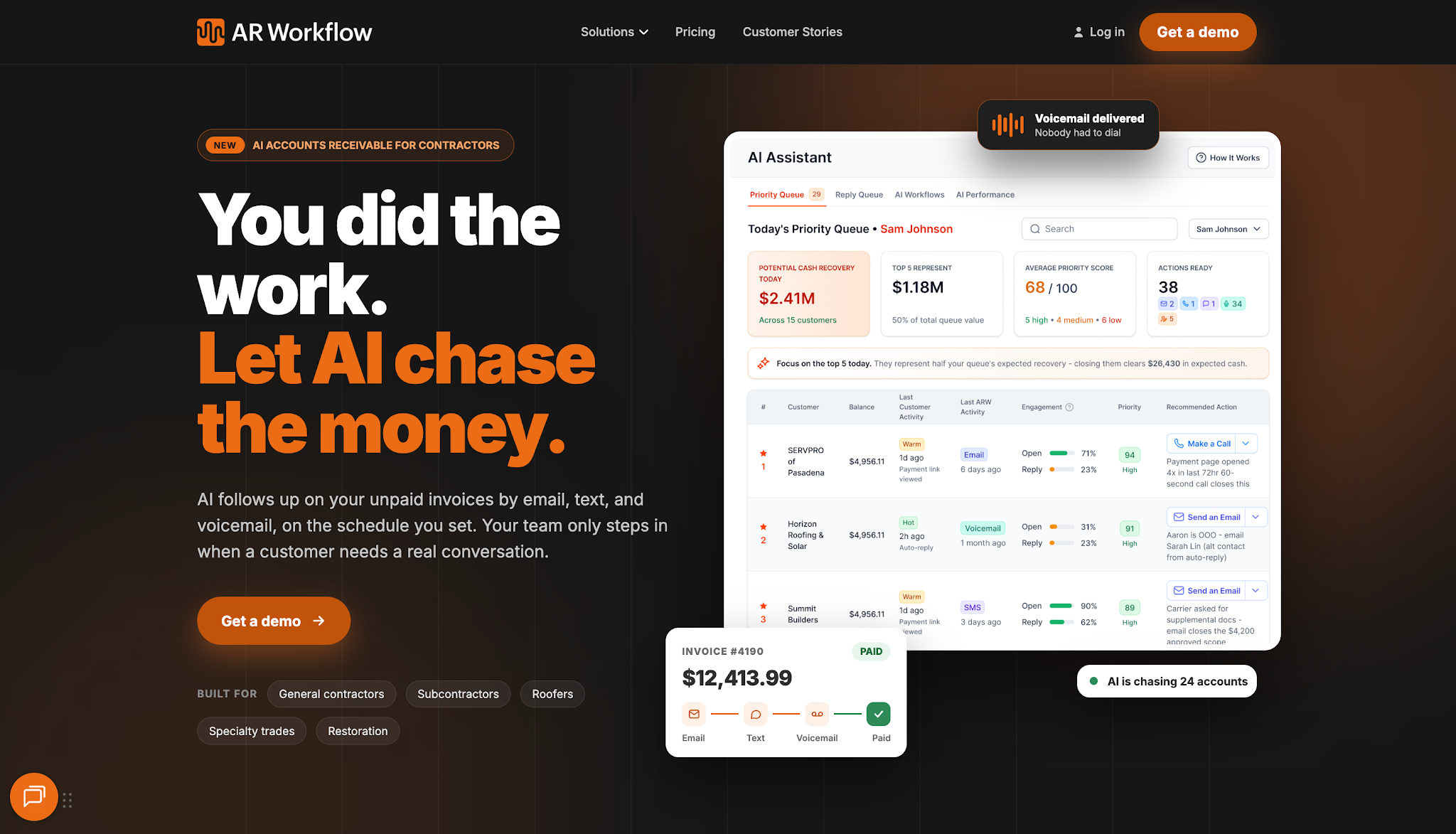
You can reduce much of this repetitive work by investing in accounts receivable management and automation software like AR Workflow.

The platform helps your team maintain consistent payment follow-ups through automated reminders sent by email and SMS.
It also provides customizable collections workflows that help employees manage outstanding accounts, while its AR dashboards and reports give them a clearer view of unpaid invoices and collection activity.
With these tasks easier to manage, your employees can spend more time addressing payment disputes and other issues that may need their help.
Technology can help your employees manage routine collections activities, but your team still needs the skills to handle customers who require additional attention.
For example, a customer may question a charge on a restoration invoice or ask about available payment plans before making payment.
If your employee doesn't know how to address the issue, the invoice may remain outstanding while they look for someone who can help.
Provide training that prepares your team to handle these situations confidently.
Focus on practical skills such as explaining invoice charges, knowing when to offer payment plans, and resolving billing concerns involving inaccurate invoices.
Employees should also understand your company's collection policies, including when to send reminders, whether late fees apply, and when to escalate unresolved accounts.
You can reinforce these practices through regular reviews of collection activity.
If certain payment issues repeatedly delay collections, discuss those situations with your team and establish a clearer way to handle them.
This helps employees resolve problems more efficiently while maintaining professional customer relationships.
Even employees with clear responsibilities and proper training can struggle when their collections workload becomes unmanageable.
If one team member handles significantly more overdue accounts than everyone else, they may begin missing follow-ups or spending less time addressing complex payment issues.
Review how your team distributes collections work and whether employees have enough capacity to complete their assigned tasks.
Rather than simply dividing accounts equally, consider the work each account requires.
For example, an employee managing several disputed insurance-related invoices may need more time than someone handling routine reminders for smaller balances.
Adjust assignments when necessary so employees can give their accounts appropriate attention.
Regularly reviewing workloads also helps you identify when your team needs additional support.
If the workload continues to grow despite improvements to your collections process, you can consider hiring additional staff.
The goal is to give your team enough capacity to maintain consistent follow-ups and prevent avoidable delays in collecting outstanding payments.
After making changes to your collections process, you need to determine whether your business is collecting accounts receivable more quickly.
Use the information from your initial assessment as a starting point. Then, monitor the same collection metrics regularly to see whether payment timelines and overdue balances are improving.
Here are three metrics to start with.
DSO shows how long, on average, your business waits to receive payments from customers after making a sale on credit.
You can calculate it using this formula:
DSO = (Average Accounts Receivable ÷ Net Credit Sales) × Number of Days
For example, if your average accounts receivable balance for a 90-day period is $300,000 and your net credit sales total $900,000, your DSO is 30 days.
That means your company takes approximately 30 days to collect payment on average during that period.
Track this metric over time to understand whether your collection period is getting shorter or longer.
If DSO decreases after you improve your follow-up process, it may indicate that your company is collecting payments more quickly.
However, remember that changes in sales volume and customer payment terms can also affect DSO. Review those factors before attributing every change to your collections team.
Your aging report can also help you measure whether your collections process is improving.
Instead of reviewing it only when you identify a problem, check it regularly to monitor changes in past-due receivables.
Pay particular attention to invoices that remain outstanding for more than 60 or 90 days.
For example, if your company previously had $150,000 in invoices more than 60 days overdue and that balance decreases to $100,000, investigate what contributed to the improvement.
Did customers settle older invoices? Did your team resolve outstanding disputes? Or did your company write off certain balances?
Reviewing these details helps you understand whether your collections efforts are bringing more cash into the business.
You should also monitor newly overdue accounts to ensure your team continues addressing payment issues before they become older balances.
Your collection rate helps you understand how much of the money your company attempts to collect is successfully collected.
For a straightforward period-based measure, you can calculate the percentage of eligible invoices your team collected during a particular period.
For example, if your team collected $80,000 from a defined group of invoices totaling $100,000, the collection rate for that group would be 80%.
Collection Rate = (Amount Collected ÷ Amount Due for the Same Group of Invoices) × 100
Use a consistent measurement period and invoice group when comparing results.
You can also review collection rates by invoice age to identify whether your team has more difficulty collecting older balances.
If your collection rate improves while overdue receivables decrease, that's a positive indication that your collections process is becoming more effective.
Continue comparing these results with the actual payments entering your business to understand how your efforts affect business cash flow.
Improving your collections process requires consistent follow-ups and a clear understanding of which invoices still need attention.
However, maintaining that consistency can become difficult when your restoration company constantly handles a growing number of outstanding accounts with employees relying only on manual reminders to keep everything organized.
AR Workflow helps you manage this growing workload without putting additional pressure on your team. By making collections easier to manage, the platform helps your business stay on top of outstanding invoices and get paid faster.
So, if you're looking to improve your cash flow without planning to hire more administrative staff anytime soon, investing in a reliable platform like AR Workflow can help keep your payment collection process running smoothly.
Schedule a demo with AR Workflow and start improving your payment collection process today!
One way to improve cash flow is to collect outstanding invoices sooner. Review your accounts receivable aging report to identify overdue payments, establish consistent follow-up schedules, and give customers multiple payment options to make timely payments.
For restoration companies, these improvements can support financial stability by bringing in cash sooner to cover payroll and ongoing project expenses.
The 10% cash flow test helps businesses determine whether changes to an existing debt agreement qualify as a substantial modification.
It compares the present value of cash flows under the new debt terms with those under the original terms. A difference of at least 10% generally indicates a substantial modification under the applicable accounting rules.
An effective collections strategy involves contacting customers early, following up consistently, and prioritizing overdue accounts.
Your team should also track previous communications and address payment disputes promptly to prevent unnecessary delays. Automating routine reminders can help employees maintain this process while focusing on accounts that require personal attention.
Send your first payment reminder shortly after an invoice becomes overdue, then follow up at regular intervals until the customer pays or you resolve the issue delaying payment.
For restoration companies, the right follow-up schedule depends on your payment terms and the customer's situation. A consistent schedule helps your team address overdue invoices promptly without overwhelming customers with repeated messages.
Sam owned and ran three restoration companies for more than 14 years and collected over $100 million in receivables. He built AR Workflow in 2020 to give contractors the collections system he wished he'd had.

AI writes the emails, sends the texts, and leaves the voicemails. Your team handles the conversations that matter, and your cash keeps moving.
 Keep QuickBooksStart with one invoiceStay in control

 Log in