How to get paid faster: 5 payment strategies contractors can start this week, plus a reminder timeline, payment options table and insurance job tips.


If you want to know how to get paid faster, start with one question: how easy is it for your customer to pay you right now? The right payment strategies improve cash flow without adding more work for your team, because they remove the small obstacles that turn a 10-day payment into a 45-day one.
The way your restoration or contracting business handles payments is not just about collecting money. It is an experience your customer has with your company, and it should be built from their point of view.
Think about it. When was the last time you went out of your way to deal with a business that made things complicated? Probably never. We all choose the path of least resistance because our time is valuable, and your customers feel the same. The easier you make it to pay, the faster you get paid and the better customers feel about you, the process and your business.
KEY TAKEAWAYS

When you use the power of convenience, you see faster payments, more repeat business and stronger customer loyalty. Here are five cash flow strategies that build trust, respect your customer's time and put simplicity first.
| 1 | Make payment convenience your non-negotiable |
| 2 | Offer payment options for every customer |
| 3 | Simplify your invoicing process |
| 4 | Address concerns before they become problems |
| 5 | Continuously improve your payment process |

People are busy. Your customers have a thousand things going on, and the last thing they want is to struggle through a clunky payment process.
Every obstacle you put in front of them, whether a difficult payment portal, limited options or a confusing interface, is a reason to delay. And they will. When they delay, your cash flow suffers. But when paying is so easy they do not have to think, they pay on time, without hesitation.
Build your process around simplicity. Count the steps between "I got the invoice" and "I paid it." If the customer has to find a phone number, call during office hours, read a card number aloud or mail a check, each step adds days. The goal is one tap from the message to a payment page.
Payment tools like AR Workflow help here without adding labor. They automate reminders, offer flexible contractor payment options, and remove manual steps, so payments come in without you having to chase them. Convenience is not a luxury. It is a strategic advantage.

Once your payment process puts simplicity first, diversify your payment options for customers. If you only offer one way to pay, you are leaving money on the table. Offer options in both when and how customers pay.
People want choices. Some customers prefer credit cards. Others want the simplicity of an ACH transfer, and some use mobile wallets. How many times have you been ready to buy something online, only to stop at checkout because the payment options did not work for you? Do not let that happen in your business.
| Payment option | Best for | Watch out for |
|---|---|---|
| Credit or debit card | Deductibles, small balances, homeowners who want to pay now | Processing fees on large invoices |
| ACH bank transfer | Larger balances and commercial customers | A few business days to settle |
| Payment plan | Customers who cannot pay the full balance at once | Needs written terms and a reminder for each installment |
| Recurring payment | Maintenance agreements and ongoing service | Clear cancellation terms |
| Paper check | Insurance and mortgage company checks | Mail time, endorsements and deposit delays |
The more choices you give customers, the fewer reasons they have to delay. More payment options means more chances to get paid faster. If bank transfers are new for your business, our guide to the ACH payment method for contractors covers how ACH works and the invoice wording to use.
Tip: Tools like AR Workflow bring card and ACH payments together in one streamlined system, with payments posting back to QuickBooks.
But do not stop at single payments. Offer recurring payments for customers who need ongoing services, and let them set it and forget it. Automatic payments make your cash flow more predictable.

Clarity equals action. If your invoices are complicated or unclear about what is owed and when, that is a recipe for delayed payments. Your invoices should be clear, simple and direct. Here is how:

Most late invoices are not refusals. They are forgotten, misplaced or waiting on a question. A consistent reminder schedule fixes most of them. Here is a starting cadence you can adjust to your terms:
| When | What to send | Tone |
|---|---|---|
| Day the job closes | Invoice with payment link and due date | Thank you |
| 3 days before due | Friendly text or email reminder | Helpful |
| Due date | "Due today" with the link | Direct |
| 7 days late | Reminder plus an offer to answer questions | Firm and polite |
| 14 to 30 days late | Phone call, then a written past due notice | Firm |
You can run this by hand from a spreadsheet, or set it once with automated payment reminders so nobody has to remember. Whatever you use, bring clarity to the invoice itself. Our restoration invoice template is a good starting point.
TEMPLATE
Friendly pre-due reminder (text from a dedicated number)
Hi [First name], this is [Your name] at [Company]. Quick reminder that invoice #[Number] for $[Amount] is due on [Date]. You can pay securely here: [Payment link]. Reply to this text if you have any questions. Thank you!
Tip: On insurance jobs, send payment links to the homeowner for their deductible or balance. Never send a payment link to an adjuster or carrier. They need documentation and status updates instead.

If a customer has a question about an invoice and it goes unanswered, they are not going to pay. Would you? So get back to them and resolve their concern.
To get paid on time, address customer concerns proactively. If a charge is unclear or the invoice has a discrepancy, make it easy for customers to reach out and get answers quickly. The quicker you answer, the quicker you get paid.
This is a place where AR Workflow shines. It tracks customer inquiries and full account history in one place, so no issue slips through the cracks. You can text (from a dedicated number) or email right from the program to communicate the way that works best for your customer. Centralized, organized customer communication removes one of the biggest efficiency blockers in our industry.

Payment plans in AR Workflow let customers settle a balance over time.
You know the phrase "the fortune is in the follow-up"? It is true for collections too. When you handle concerns proactively, potential delays become chances for fast resolution. We are biased toward AR Workflow, but find the platform that best fits your business.
Bring one overdue invoice.
We'll show you how your customer would get reminded and pay it in AR Workflow.

Industry leaders are always looking for ways to improve. Here is how to apply a growth mindset to your payment process:
For a broader look at the process behind these habits, read how to improve your collections process.
The five strategies above speed up payment once an invoice exists. Some of the best ways to improve cash flow happen earlier, when you set up the job:
Restoration work adds a third party to every payment: the carrier. The same strategies apply, with a few adjustments:
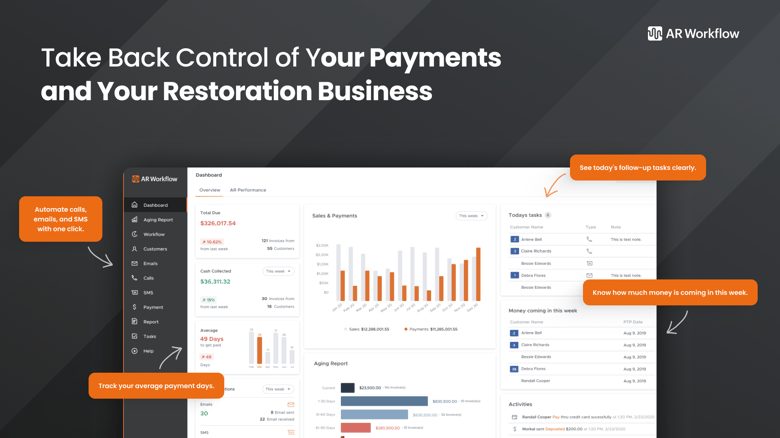
AR Workflow brings reminders, communication and payments together for restoration teams.

Putting convenience first in your payment process does more than improve cash flow. It builds trust, improves loyalty and strengthens the entire customer experience. When people enjoy doing business with you, they stick around and they tell their friends.
These are payment strategies for small business owners, so you do not need a big office team to use them. Payment roadblocks are inevitable, but they are not insurmountable. With the right strategies, systems and mindset, you can take control of your cash flow and cut payment delays.

The time for reactive collections is over. Make paying easier, faster and better for your customers, follow up on a schedule, and commit to continuous improvement. Start collecting on it today.
Invoice right after the work is done, state clear payment terms, include a payment link, remind customers before the due date, and follow up the day an invoice goes late. Most of the gain comes from doing these steps every time, not from any single trick.
The most effective are making payment easy, offering several payment methods, sending clear invoices with a payment link, automating reminders, answering invoice questions quickly, and offering payment plans when a customer cannot pay in full. Deposits and progress billing help on larger jobs.
At minimum, credit card and ACH bank transfer. Many customers also expect to pay online from a link in the invoice or reminder. Offer what your customers actually use, and keep the checkout simple.
Yes, when a customer genuinely cannot pay the full amount at once. Put the plan in writing with amounts and due dates, automate reminders for each installment, and follow up quickly if one is missed.
Be specific and helpful. Name the invoice, the amount and the due date, include the payment link, and offer to answer questions. A friendly reminder before the due date feels like good service, not pressure.
A common cadence is a few days before the due date, on the due date, and about a week after. After that, switch to a phone call and a written past due notice. Automating the schedule keeps it consistent.
Related reading
Your invoice, not a feature tour.
Bring one overdue invoice to a demo and see what AR Workflow would send, when, and how your customer would pay.
Sam owned and ran three restoration companies for more than 14 years and collected over $100 million in receivables. He built AR Workflow in 2020 to give contractors the collections system he wished he'd had.

AI writes the emails, sends the texts, and leaves the voicemails. Your team handles the conversations that matter, and your cash keeps moving.
 Keep QuickBooksStart with one invoiceStay in control

 Log in