Contractor payment terms explained: definition, Net 30, Net 15 and due on receipt wording, deposits, progress billing and contract examples to copy.

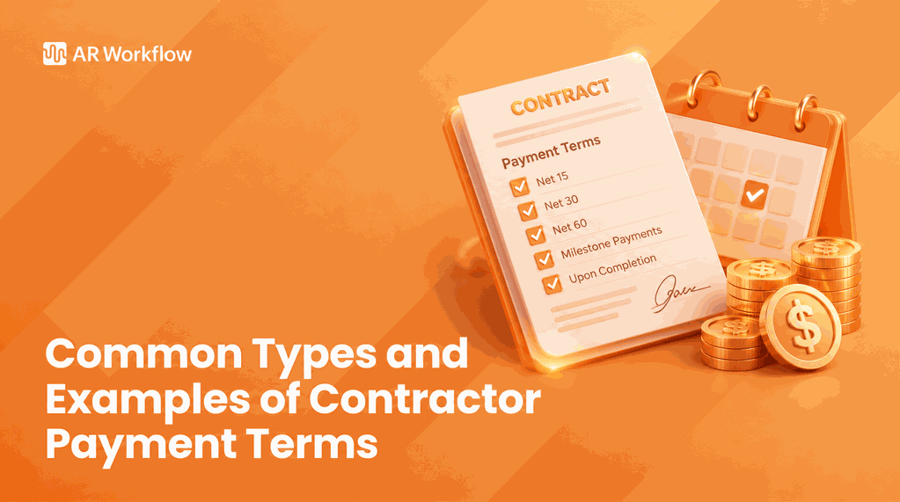
Restoration contractors have several ways to structure customer payments. They can request an upfront deposit or collect the full amount after completing the job. They can also arrange payments at different stages of the project. Each option affects when money comes into the business, so choosing the right contractor payment terms deserves some thought.
The terms should work for the type of projects you handle while giving customers clear expectations about when they need to pay. To help you decide, we will go through the most common payment terms contractors use and examples of how they work in practice.
KEY TAKEAWAYS
Contractor payment terms are the conditions that explain when a customer must pay for the services a contractor provides. They also establish how the customer should pay and what happens if they miss an agreed deadline.
For example, a contractor might require payment within 15 days of sending an invoice. Another contractor might collect a deposit before starting work and request the remaining balance after completing the project. Both arrangements set payment expectations, although they follow different payment schedules.
The terms you choose will depend on the project type and your agreement with the customer. A smaller water mitigation job may need a different payment structure from a reconstruction project that takes several months to complete.
Whatever arrangement you choose, your contract should explain it clearly. That way, both parties understand their responsibilities before the first payment becomes due.
Here is a plain payment terms definition: payment terms are the agreed rules for when a customer pays, how much they pay at each step, how they can pay and what happens if they pay late. They live in two places. The signed contract sets them, and every invoice repeats them so the customer sees the due date at the moment they are asked to pay.
Most of the confusion around payment terms comes from shorthand. A homeowner who has never seen "2/10 Net 30" or "retainage" will not ask what it means; they will just pay when they think it is due. This glossary covers the terms contractors use most often.
| Term | What it means |
|---|---|
| Due on receipt | Payment is due the day the customer receives the invoice. |
| Net 15 / Net 30 | The full ("net") amount is due within 15 or 30 calendar days of a start date, usually the invoice date. |
| 2/10 Net 30 | The customer may take a 2% discount if they pay within 10 days; otherwise the full amount is due in 30 days. |
| Net 30 EOM | Payment is due 30 days after the end of the month in which the invoice was issued. |
| Deposit | An amount paid before work starts, credited against the contract price. |
| Progress payment | A partial payment due when a defined stage of work is complete or on a set billing date. |
| Retainage | A percentage of each progress payment held back until the end of the project. Limits and release rules vary by state. |
| Pay-when-paid / pay-if-paid | Clauses that tie a subcontractor's payment to the general contractor being paid. Some states restrict or refuse to enforce them. |
| Late charge | A fee or interest the contract allows once an invoice is past due, subject to state limits. |
Because retainage, pay-when-paid clauses and late charges are governed by state law, rules vary by state. If you plan to rely on any of them, have a construction attorney review your contract language.
Contractors use different payment structures depending on the work they perform and when they expect to receive payment. Here are the most common contractor payment terms, with examples of how they work.
Here is a quick comparison of the payment arrangements covered below and what to consider before using them.
| Payment term | When payment is due | What to consider |
|---|---|---|
| Due on receipt | As soon as the customer receives the invoice | Customers need to prepare for immediate payment |
| Net 7 | Within 7 days | Short payment window |
| Net 15 | Within 15 days | Gives customers limited time to arrange payment |
| Net 30 | Within 30 days | Your business waits longer to collect payment |
| Net 60 / Net 90 | Within 60 or 90 days | Requires enough cash to cover expenses while waiting |
| Upfront deposit | Before work begins | Helps cover initial project expenses |
| Progress payments | At agreed project milestones | Requires clear milestones and payment amounts |
| Payment upon completion | After the agreed work is completed | May require covering expenses until the project ends |
| Early payment discount | Before the regular deadline | Encourages customers to pay early but reduces the amount collected |
Due on receipt means the customer must pay as soon as they receive the invoice. For example, if you finish a small restoration job and send the final invoice on June 10, the customer must pay on June 10.
This arrangement works best for smaller jobs where you have already agreed with the customer that you will be paid promptly after completion. Since there is no additional payment window, you have a better chance of getting paid quickly.
Just make sure the customer understands this arrangement from the very beginning. Otherwise, they might expect more time to pay, which could lead to disagreements when you send the invoice.
Net payment terms give customers a specific number of days to pay an invoice. The number tells you how long they have before payment becomes overdue. Here is how the most common arrangements work:
For example, if you send a $12,000 invoice on June 1 with Net 30 payment terms starting from the invoice date, the customer must pay by July 1.
These arrangements give customers time to prepare their payments while setting a clear deadline that helps your business plan for more predictable cash flow. Whichever window you pick, print the invoice payment terms on every invoice so the due date is never a surprise.
The length of that payment window deserves consideration, though. Giving customers 30 days to pay also means your company may need to cover project expenses for another month before collecting the money.
Tip: State in your contract when the payment period starts (invoice date, completion date or receipt). Otherwise, the customer might calculate the due date differently from your company.
Net 60 and Net 90 work like shorter net payment terms, except customers have 60 or 90 days to settle their invoices. Contractors sometimes see these longer payment periods when working with commercial clients that follow extended invoice approval processes.
For example, a commercial property owner might request Net 60 terms because its finance department needs more time to approve contractor payments. While this gives the customer more time, it also means your business waits longer to collect the money.
If you complete a $40,000 restoration project under Net 90 terms, you could wait three months after invoicing to receive payment, even if the customer pays on time.
Before agreeing to an extended deadline, consider whether your company can cover its expenses during that period. The longer you wait for payment, the more cash you need available to keep other jobs running.
An upfront deposit requires customers to pay a certain percentage of the project cost before work begins. Many contractors use this arrangement when they need money to cover initial expenses, particularly when paying material suppliers before a larger job begins.
For example, you might request a 20% down payment on a $30,000 reconstruction project. The customer would pay $6,000 before work begins and settle the remaining $24,000 according to your agreed payment schedule. Collecting that initial amount means your business will not have to cover the entire project cost with its own funds. Deposits are also standard for flooring contractors and painting contractors, who often buy materials days before the job starts.
However, you also need to consider the rules governing upfront deposits. Some states limit how much contractors can collect before starting residential projects. Check the applicable requirements before setting your deposit amount, then explain how the deposit affects the customer's remaining balance.
Progress billing lets contractors invoice customers for portions of the total project cost as they complete different stages of work. This arrangement is especially relevant for larger restoration projects that require significant time and resources. Rather than waiting until the entire job is complete, you collect payments throughout the project.
For example, here is how a milestone-based payment schedule for a $60,000 fire restoration project might look:
| Project milestone | Payment |
|---|---|
| Initial project mobilization | $12,000 |
| Completion of the first agreed phase | $18,000 |
| Completion of the second agreed phase | $18,000 |
| Final project completion | $12,000 |
| Total | $60,000 |
This hypothetical schedule shows how you can divide the total amount into smaller payments. To make this arrangement work, each milestone needs a clear definition. The customer should understand what work your team must complete before the next payment becomes due.
Payment upon completion means the customer pays the full amount or remaining balance after you finish the agreed work. For example, you might complete a mold remediation job and send the final invoice once your team finishes.
This arrangement can work for shorter projects because the customer only needs to pay after your company completes the job. However, the longer a project takes, the more expenses your company may need to cover before receiving payment. That is why it is important to consider the project's duration before choosing this arrangement.
Your contract should also clearly define what counts as completion. If the customer needs to inspect or approve the finished work, explain how that process affects the payment deadline.
Early payment discounts encourage prompt payment by giving customers an incentive to settle invoices before the regular deadline. For example, you might offer 2/10 Net 30 terms. Under this arrangement, the customer receives a 2% discount if they pay within 10 days. If they do not take the discount, they must pay the full amount within 30 days.
For a $10,000 invoice, the customer would pay $9,800 if they qualify for the discount. Your business receives the payment sooner, but you also collect $200 less than the original invoice amount.
Before offering this arrangement, consider whether receiving payment earlier is worth the discount. Make sure the terms clearly explain when the customer qualifies for the reduced amount.
The right contractor payment schedule depends on how long the job runs and when your biggest costs land. The examples below are starting points, not rules. Adjust them to your contract, your state's requirements and how the customer is funding the work.
| Job type | Common payment terms | Why it fits |
|---|---|---|
| Emergency water mitigation | Due on receipt or Net 15 after drying is complete | Short job, so a single invoice with a short window keeps the account from drifting |
| Mold remediation | Deposit at signing, balance due when clearance is passed | Ties the final payment to a clear, documented finish line |
| Fire and smoke reconstruction | Deposit plus milestone payments (demo, rough-in, drywall, final) | Months of labor and materials should not sit on your balance sheet until the end |
| Roof replacement | Deposit when materials are ordered, balance on completion | Covers the supplier bill, which is the largest early cost |
| Commercial restoration | Monthly progress billing on Net 30 or Net 60 | Matches how commercial accounts payable teams approve invoices |
On larger projects, a construction payment schedule usually combines a deposit, progress billing at each milestone and a final payment. If you run several of these jobs at once, construction accounts receivable software helps you see which milestone invoices are open and which are late.
Tip: Tie each milestone to something both sides can verify, such as a passed inspection, a signed walkthrough or dated photos. "Halfway done" invites an argument. "Drywall hung and inspected" does not.
Your contract sets the terms, but the invoice is what the customer actually reads when it is time to pay. Clear invoice payment terms remove the most common excuse for paying late: "I didn't know when it was due." Every invoice should show:
Here is sample wording you can adapt. Have it checked against your own contract and state law before you use it, because late fee and deposit rules vary by state.
SAMPLE INVOICE TERMS
Payment terms: Net 15. Invoice date: June 1. Payment due: June 16.
How to pay: Pay online using the link in this invoice, by ACH, or by check payable to [Company Name].
Late payments: Balances not paid by the due date are subject to the late charge stated in Section [X] of your signed agreement.
Questions about this invoice? Contact [Name] at [phone/email] before the due date so we can resolve it quickly.
SAMPLE CONTRACT CLAUSE
Customer agrees to pay a deposit of [amount or %] before work begins. Progress payments of [amount] are due within [X] days of each milestone listed in Schedule A. The final balance is due within [X] days of substantial completion.
Customer remains responsible for payment by the due dates above whether or not insurance proceeds have been received. Approved change orders adjust the contract price and payment schedule in writing.
Once the terms are on the invoice, the follow-up matters just as much. Automated payment reminders can go out before and after each due date, so the customer hears from you on schedule even when your office is busy.
Net 30, Net 15 and due on receipt cover most residential and light commercial work. The right one depends on who is paying and how long their approval process takes. A homeowner paying for a service call can pay the same day. A property manager may need the invoice to pass through an accounts payable team, which is why commercial customers often ask for payment terms Net 30.
Whichever you choose, write it the same way every time: the term, the start date and the exact due date. Here is wording for each.
DUE ON RECEIPT
Payment terms: Due on receipt. Invoice date: March 4. Payment due: March 4.
Payment for this service visit is due today. You can pay by card or ACH using the secure link in this invoice.
NET 15
Payment terms: Net 15 from invoice date. Invoice date: March 4. Payment due: March 19.
The balance of $[amount] is due by March 19. If you have a question about any line item, please contact us before the due date.
NET 30
Payment terms: Net 30 from invoice date. Invoice date: March 4. Payment due: April 3.
Please reference PO [number] and invoice [number] with your payment. Payment is due by April 3 per Section [X] of our agreement.
Net terms count calendar days, not business days, unless your contract says otherwise. Day one is the day after the start date. An invoice dated March 4 on Net 30 is due April 3. If the due date lands on a weekend, say in the contract whether payment moves to the next business day, so nobody argues over a Saturday.
Also decide what starts the clock. "Net 30 from invoice date" is the most common and the easiest to track. "Net 30 from completion" or "Net 30 from receipt" can push the due date later and are harder to prove. If you invoice from QuickBooks Online, you can set a default term on each customer so every invoice carries it, and QuickBooks collections follow-up can key off that due date.
Tip: Do not change the term between the contract and the invoice. If the contract says Net 15 and the invoice says Net 30, the customer will pay on the later date. Our contractor invoice template has a payment terms block you can copy.
The invoice wording above only works if the contract says the same thing. These contract payment terms examples show how the pieces fit together for four common job types. Treat them as starting points to adapt with your attorney, since deposit limits, retainage and late charge rules vary by state.
Payment for labor and materials is due on receipt of the invoice at completion of the service visit. Accepted payment methods: card, ACH or check. Balances unpaid after [X] days are subject to the late charge in Section [X], as permitted by law.
Customer will pay a deposit of $[amount] at signing, not to exceed the amount permitted by state law. Progress payments are due Net 15 from the invoice date after each milestone in Schedule A is complete: (1) demolition complete, (2) rough-in inspection passed, (3) drywall complete, (4) final walkthrough signed.
Change orders must be approved in writing and are billed with the next progress invoice.
Contractor will submit a payment application by the 25th of each month for work completed through that date. Approved amounts are payable Net 30 from receipt of the application, less retainage of [X]% as allowed by applicable law. Retainage is released within [X] days of final completion and acceptance.
If your commercial customers use AIA forms, our pay application guide walks through the G702 and G703 line by line.
Customer is responsible for payment of all amounts under this agreement, including any deductible, by the due dates stated, whether or not insurance proceeds have been received. Supplemental amounts approved by the insurer are invoiced to the customer Net 15 from the invoice date.
The insurance example matters most for restoration companies. The homeowner is your customer, even when the carrier funds the job, so the contract should say so plainly. For more on the claim side, see how contractors collect recoverable depreciation.
Beyond the payment deadline itself, your contract terms should explain other conditions that may affect how much customers need to pay or when they need to pay it. Make sure your contractor payment terms cover these key points:
| Element | What to spell out |
|---|---|
| Payment amount | The total fee and any required deposits or partial payments. |
| Payment schedule | When each payment becomes due and what starts the payment period. |
| Payment methods | How customers can pay, such as bank transfer or credit card. |
| Late payment penalties | Any late fees or interest charges that apply if customers miss deadlines. |
| Payment disputes | How customers raise billing concerns and how your company handles them. |
| Changes to project scope | How additional work affects the total cost and payment schedule. |
Also make it clear who needs to pay your company, especially on insurance-related restoration jobs. Customers may expect their insurance company to cover the costs, but that does not always mean they will receive the insurance money by the time their payment is due. To avoid confusion, explain when the customer needs to pay and what happens if the insurance company takes longer to release the funds.
Finally, check the legal framework that applies to your contract. Some states limit how much you can collect upfront and when late payment penalties are enforceable.
Now that we have covered the different payment arrangements and what your contract should include, the next step is deciding which terms suit your business. That decision depends on how your projects work and how long your company can afford to wait for payment.
| 1 | Consider the type and size of the restoration job |
| 2 | Account for insurance-related payment delays |
| 3 | Choose payment deadlines that support your cash flow |
| 4 | Communicate and agree on the terms before work begins |
Start by looking at how much work the project requires and how long your team will need to complete it. These details help you decide whether to collect payment at the end of the job or request payments during the project.
For example, a small water mitigation job might only take a few days. Since you will complete the work within a short period, it may be practical to collect payment after completion or give the customer a shorter payment window.
Larger reconstruction projects require more planning because your company may spend several months completing the work. During that time, you will keep paying employees and buying materials even though you have not finished the job. If you wait until the project ends to collect the full amount, you will have to cover those expenses with your company's available cash.
Progress payments can help you manage those costs. By agreeing on milestone-based payments with the customer, you collect portions of the contract amount as your team completes each stage. Before choosing an arrangement, look at when your company will incur the largest expenses. That tells you when to request payments to support the work.
The project's cost and duration are not the only things to consider. You also need to understand how the customer plans to pay, especially if they are using money from an insurance claim.
In these situations, the customer may depend on the insurance company to release funds before they can settle your invoice. Insurance companies follow their own claims review and payment processes, which can take longer than your agreed payment deadline. Plus, if a mortgage company needs to approve the insurance payment before releasing the funds, the customer may face another delay.
Knowing this before you start work gives you a chance to discuss the payment arrangement with the customer. Make sure your contract explains who needs to pay your company and when that payment becomes due. Also clarify what happens if the insurance company has not released the funds by the agreed deadline.
This way, both parties understand their payment responsibilities without assuming that your company will automatically wait until the insurance claim settles.
After considering the project and how the customer plans to pay, decide how long your business can afford to wait for the money. For example, Net 60 terms give customers two months to settle an invoice. During that time, your company still needs to cover payroll and expenses for other restoration jobs.
If several customers have similar payment deadlines, your business may have a significant amount of money tied up in outstanding invoices. If any of those customers pay late, you wait even longer to collect. Your AR aging report shows how much is tied up and for how long.
Shorter payment terms can reduce that waiting period when customers meet the deadline. However, the terms also need to give customers a reasonable amount of time to pay. Before agreeing to a longer payment period, review your upcoming expenses and decide how much outstanding revenue your business can carry while keeping cash flow healthy.
Once you have decided which payment terms suit your project, discuss them with the customer before signing the contract.
Start by explaining the contractor payment schedule: how much the customer needs to pay and when each payment becomes due, so they know what to expect throughout the project. If your company requires an upfront deposit, explain how much the customer must pay before work begins, then clarify when they will need to settle the remaining balance.
For insurance-related projects, make sure the customer understands their payment responsibilities even if the insurance company takes longer to release funds. Also discuss how additional work could affect the original contract amount.
For example, your team might discover more damage after starting a water restoration project. If the additional work increases the total cost, the customer needs to understand how your company will approve the changes and adjust the payment schedule. Discussing these situations early gives both parties a chance to address questions and avoid disputes later.
Once all terms are agreed, include them in the signed contract. Keep your contractor invoicing consistent with those deadlines so the customer can refer to the original agreement when making payments.
Bring one overdue invoice.
We'll show you how AR Workflow would follow up on it based on the payment terms you agreed.
Unfortunately, even when you have set clear payment terms and the customer has agreed to them, that does not always mean they will pay on time. If you have run a restoration business for a while, you have probably dealt with customers who missed their payment deadlines for one reason or another. When that happens, understand what is holding up the payment before deciding what to do next.
Start by reviewing the customer's account. Check how much they still owe and whether they have already made a partial payment or contacted your team about a billing issue. If the customer has not raised any concerns, contact them to discuss the overdue amount and find out when they expect to pay.
If they need more time, record any payment commitment they make so your team knows when to expect the money, and check whether they follow through. If they miss the new payment date, contact them again according to your collections process. If the account remains overdue, follow the escalation procedures in your agreement while complying with applicable laws. Our past due invoice letter templates and guide to collecting unpaid invoices help with each step.
Throughout this process, keep a record of your conversations with the customer. That way, your team can see what has already been discussed and what needs to happen next, especially when an invoice requires several reminders before the customer pays.
Now imagine managing that same process for dozens or even hundreds of overdue invoices. Your team would need to track each customer's payment status and previous conversations while making sure no overdue account goes without attention. When employees manage all of that manually, collections can take up a significant amount of their time.
AR Workflow is accounts receivable software that helps restoration companies manage this process by automating routine collection tasks and keeping payment information in one place.
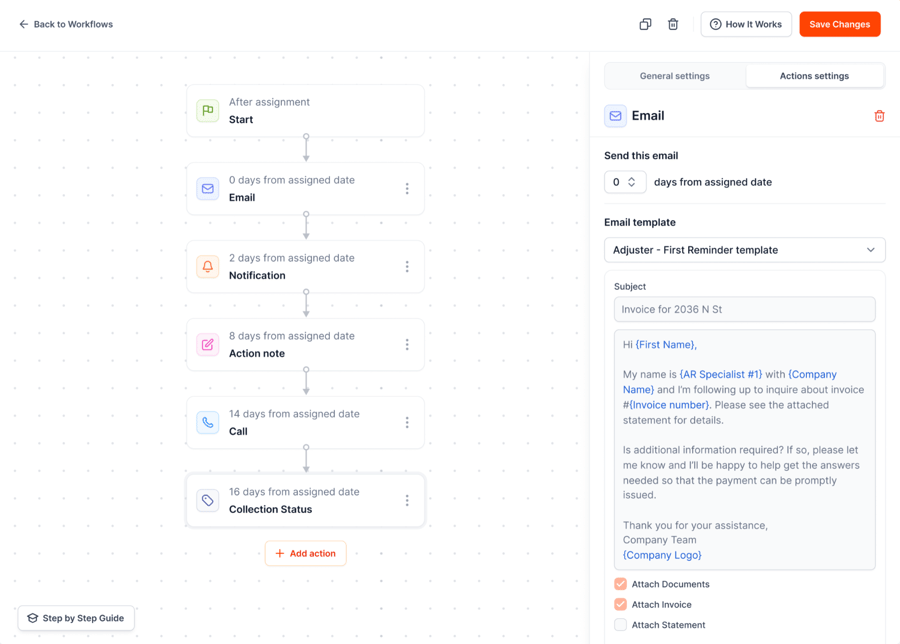
Collection workflows in AR Workflow follow your payment terms and collections schedule.
For example, your team can set up automated reminders by email and SMS, sent from a dedicated number, based on your collections schedule. The platform also tracks outstanding balances and customer communication, so employees can check what has already happened with an account before deciding what to do next.
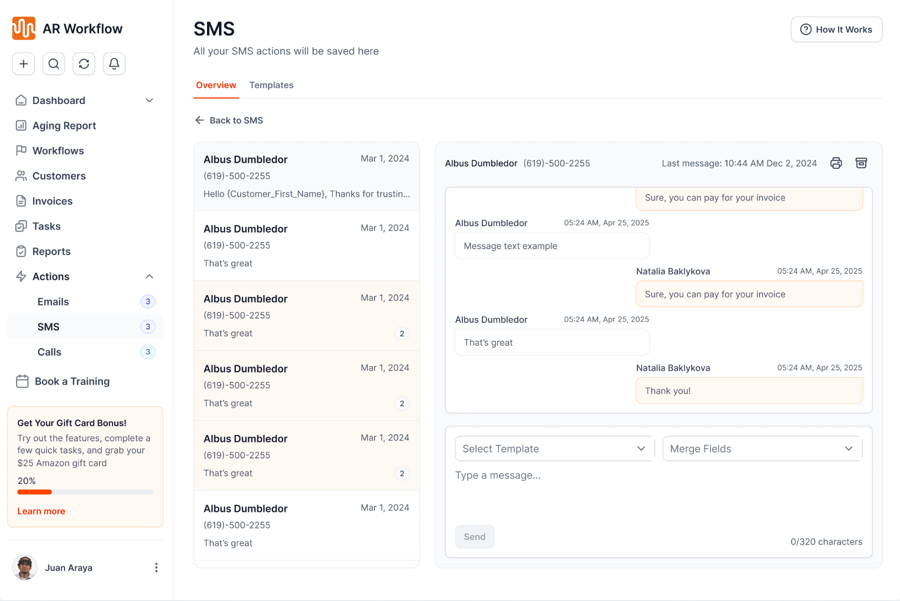
Text reminders go out from a dedicated number, with the conversation saved on the account.
Customers can also pay outstanding invoices online, making it easier to settle their balances when they receive a reminder. Meanwhile, owners and finance teams can use AR reporting to see which invoices remain unpaid and spot accounts that need more attention.
With less time spent manually tracking payments and sending reminders, your team can focus on resolving overdue accounts that need their direct involvement.
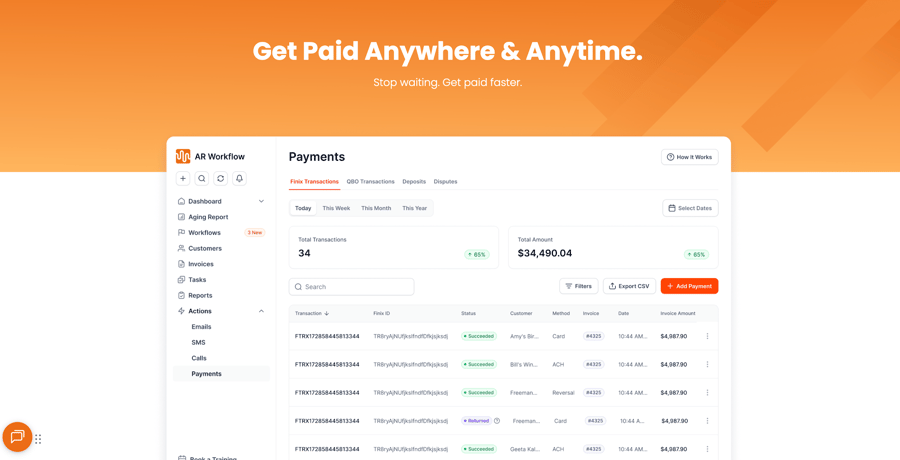
AR Workflow keeps outstanding balances and follow-up in one view.
The contractor payment terms you choose should reflect how your restoration company handles project expenses and when you expect customers to pay. But even clear agreements will not prevent every late payment. Your team still needs to monitor outstanding invoices and keep track of customer communication when payment deadlines pass.
At the end of the day, what matters is collecting the money you have earned without letting overdue payments slow down your business. With AR Workflow, your team has a simpler way to stay on top of timely payments.
Most contractors use payment terms such as Net 15 or Net 30, which give customers 15 or 30 days to pay their invoices. However, typical payment terms vary by project type. Larger jobs may require upfront deposits or progress payments to help cover expenses during the work.
Net 30 means the full invoice amount is due within 30 calendar days. The count usually starts on the invoice date, but some contracts start it at completion or when the customer receives the invoice, so state which one applies. If the invoice is dated June 1, Net 30 makes it due by July 1.
Yes, some contractors require a 50% upfront deposit to cover initial project expenses. Check your state's rules first, since some states limit how much a contractor can collect before starting a residential project.
Payment terms are the agreed rules for when and how a customer pays an invoice. Common payment terms include due on receipt, Net 7, Net 15, Net 30 and Net 60. Contractors may also use upfront deposits or milestone payments depending on when they need to collect payment.
Construction payment terms usually combine upfront deposits, progress payments, and final payments upon completion. Some contracts also include retainage or pay-when-paid clauses, which can affect when contractors receive payment.
Yes, contractors can charge late payment penalties if their contract allows them and the charges comply with applicable laws. Some states limit how much contractors can charge, so check local requirements before adding late fees to your payment terms.
Related reading
Your invoice, not a feature tour.
Bring one overdue invoice to a demo and see what AR Workflow would send, when, and how your customer would pay.
Sam owned and ran three restoration companies for more than 14 years and collected over $100 million in receivables. He built AR Workflow in 2020 to give contractors the collections system he wished he'd had.

AI writes the emails, sends the texts, and leaves the voicemails. Your team handles the conversations that matter, and your cash keeps moving.
 Keep QuickBooksStart with one invoiceStay in control

 Log in