Direct insurance billing lets restoration contractors invoice the carrier, but who gets the check? See 5 steps, Direction to Pay vs AOB, and a checklist.

Direct insurance billing in restoration can make billing jobs easier, especially when contractors can communicate directly with the insurance carrier instead of relying on the property owner to pass information back and forth.
However, that convenience also raises an important question: how much control does the restoration company actually have over the insurance claims process once the invoice reaches the insurer?
With direct insurance billing, contractors can handle the billing directly, but they still need to account for the steps that affect when they'll receive payment.
This article explains how restoration contractors can make the most of this billing arrangement while keeping their outstanding payments under control.
KEY TAKEAWAYS
Direct insurance billing is an arrangement in which a restoration company sends its invoice and supporting documents to an insurance provider for review and payment consideration.
For example, a contractor may complete water damage mitigation after a burst pipe and submit the invoice to the homeowner's insurance company directly. The insurance company then typically reviews the charges against the claim and applicable policy coverage.
This arrangement can reduce the amount of insurance paperwork the property owner needs to handle after filing insurance claims. It also allows the restoration company to communicate with the insurer about the submitted charges when the appropriate authorization is in place.
However, direct billing and direct payment aren't necessarily the same thing.
An insurer may issue payment to the policyholder, the contractor, or multiple parties, depending on the policy and payment arrangement. If the property has a mortgage, the lender may also need to participate in the payment process. Our guide to mortgage companies controlling your payments covers that situation.
The contractor should therefore establish who will receive the insurance proceeds and who remains responsible for any unpaid balance before relying on direct billing.
This is the part of direct insurance billing that catches most restoration contractors off guard. You can send the invoice to the carrier, answer the adjuster's questions and get every line approved, and the money can still land somewhere else. Where the check goes depends on the paperwork signed before the job and on who has an interest in the property.
| Payment scenario | How it usually happens | What the contractor should do |
|---|---|---|
| Paid directly to the contractor | A signed Direction to Pay is on file and the carrier honors it, or the policy and claim allow payment to the vendor. | Match the payment to the invoice and bill the homeowner only for the deductible and any non-covered items. |
| Two-party check (homeowner and contractor) | The carrier names both the policyholder and the contractor on the check. | Agree in advance how the check will be endorsed and deposited so it doesn't sit in a drawer. |
| Three-party check (homeowner, lender, contractor) | A mortgage lender is listed on the policy, so the carrier adds it as a payee. | Expect the lender's loss draft process. Send the lender what it asks for and keep the homeowner informed. |
| Paid to the homeowner only | No payment authorization exists, or the carrier pays the insured by default. | Collect from the homeowner under your work authorization, with clear dates and amounts. |
A two-party insurance check is common on restoration jobs. When a homeowner tells you the insurance check was made out to them and the contractor, both parties generally need to endorse it before it can be deposited. Setting that expectation at signing removes most of the friction later.
Tip: Ask about the mortgage at the first visit. If a lender is on the policy, the payment will likely move slower, and your billing timeline should say so from day one.
Managing direct insurance billing involves more than sending an invoice to the adjuster. Here are five steps to help you manage the process.
| 1 | Confirm the insurance and payment arrangement |
| 2 | Document the restoration work |
| 3 | Prepare the invoice and supporting documents |
| 4 | Submit the invoice for insurance review |
| 5 | Track the payment and resolve outstanding balances |
Start by confirming the claim details and how the contractor will be paid.
The company should identify the insurer, claim number, assigned adjuster, and any claim-specific billing requirements. It should also review the applicable work authorization and payment terms with the property owner.
This is especially important when the homeowner expects the insurer to pay the restoration company directly. Being allowed to bill insurance directly does not mean the check will come to you.
Submitting charges to the insurance company doesn't automatically establish a direct payment arrangement. A separate authorization may be necessary, and the insurer may have its own requirements for issuing payment.
Contractors should also clarify how the agreement addresses deductibles and charges the insurer doesn't cover.
Having these details established before invoicing gives the billing team a clearer understanding of whom to contact and how to handle any remaining balance.
Once the billing arrangement is clear, gather the specific documentation that supports the completed work.
The documentation should provide detailed information about what happened at the property, including any secondary damage, what services the company performed, and how those services relate to the charges being submitted.
For water damage restoration, this might include moisture meter readings, drying logs, drying equipment records, and job-site photographs. In a typical water damage insurance claim process, the adjuster compares those records to the estimate line by line, so gaps in the logs become questions about the invoice.
For fire damage or mold remediation, the supporting records will differ based on the work performed and the applicable insurance requirements. The goal is to make sure the invoice reflects work that the company can document.
Before submission, review the records for missing information or inconsistencies. If an invoice lists five days of equipment use, for example, the job documentation should support that duration.
Resolving those issues internally can prevent avoidable requests for clarification later.
Next, prepare the final invoice using the completed job records and the billing information confirmed earlier.
The invoice should identify the customer and property, reference the insurance claim, and provide an itemized breakdown of the services and charges. Descriptions should be specific enough for the reviewer to understand what the company billed.
For example, separate water extraction from equipment rental when they represent different charges. Include the applicable quantities or service durations so the invoice can be checked against the supporting records and itemized estimates.
Once the invoice is ready, submit it through the insurer's required channel along with the relevant documentation. Record the submission date and any confirmation or reference number.
That gives the team a starting point when checking whether the insurer received the invoice or needs additional information.
After submission, keep track of the invoice's review status throughout the entire claims process.
An insurance adjuster may request additional documentation or question a particular charge. The contractor may also need to clarify how a service relates to the documented damage or any further damage identified during restoration.
When a request arrives, identify exactly what information the reviewer needs before responding.
For example, if the adjuster questions the duration of structural drying in wall cavities, the team can refer to the drying logs and moisture readings already collected for that job.
Keep a record of the request, the response, and any revised documents submitted. This helps prevent repeated work when different employees communicate with the insurer.
When dealing with disputed or denied charges, review the stated reason and the available documentation before deciding what to do next. The appropriate response depends on the denial reason, the policy, and the service agreement.
Tip: Follow up with the adjuster for status and documentation only. Payment reminders and payment links belong with the homeowner for the part they owe, such as the deductible. Never send a payment link to an adjuster or carrier. For more on keeping adjusters moving, see speeding up payments from insurance adjusters.
Once the insurer finishes reviewing the charges, the contractor still needs to confirm how much money has actually been received.
A claim may involve partial payments or separate payments for different portions of the work. The company should match each payment to the appropriate invoice and identify any remaining balance. Your AR aging report shows which of those balances are getting older.
If an invoice remains unpaid, check its current status before contacting the responsible party.
For example, the insurer may have issued a check to the homeowner that hasn't yet reached the contractor. In that situation, contacting the homeowner may be more appropriate than sending another request to the insurer.
The team should also distinguish between amounts still under insurance review and amounts the property owner owes under the service agreement. For the homeowner's portion, our guide to collecting unpaid invoices walks through the follow-up.
Finally, continue tracking the balance until the company receives payment or otherwise resolves the account.
Bring one overdue invoice.
We'll show you how an insurance job's open balance would be tracked and followed up in AR Workflow.
The exact documents depend on the type of restoration work and the insurer's requirements. However, most direct billing arrangements rely on a combination of authorization documents and records supporting the charges.
Common documents include:
| Document | What it does |
|---|---|
| Work authorization or service agreement | Establishes the work the property owner authorized and the agreed payment responsibilities. |
| Insurance claim information | Identifies the claim, insurer, and adjuster so the billing team can connect its submission to the correct file. |
| Damage assessment and repair estimates | Describe the affected areas and the proposed scope of restoration work. |
| Job documentation | Supports the work performed through photographs, equipment logs, thermal imaging, or other relevant records. |
| Itemized invoice | Shows the completed services and the amount the contractor is requesting. |
| Payment authorization, when applicable | Documents an arrangement affecting where insurance payments should be sent or which claim rights have been transferred. |
CHECKLIST
Before you submit a direct bill
When it comes to payment authorization, restoration contractors often choose between two documents: a Direction to Pay and an assignment of benefits (AOB). They are easy to confuse, and they have very different consequences.
| Direction to Pay | Assignment of benefits | |
|---|---|---|
| What it does | Instructs the insurer to send payment for your work to you. | Transfers specified claim rights from the policyholder to the contractor. |
| Who keeps the claim | The homeowner stays the claimant. | The contractor may step into the homeowner's position for the assigned benefits. |
| Typical use | Getting paid directly without taking over the claim. | Dealing with the carrier on the policyholder's behalf where the law allows it. |
| Legal limits | Carriers may have their own requirements for honoring it. | Restricted or prohibited in some states. |
A Direction to Pay form generally instructs the insurer to issue payment to the contractor, subject to the carrier's requirements. Our guide to getting homeowners and adjusters to agree to pay you covers how to introduce it at signing. An AOB transfers specified insurance claim rights to another party where the agreement and applicable law permit it.
The law here changes by state and over time. For example, Florida's 2022 property insurance reform (Senate Bill 2-A) made attempted assignments of post-loss benefits void under residential and commercial property policies issued on or after January 1, 2023, according to the Florida Senate's bill analysis. Other states have their own rules, so check the current law where the property sits, and talk to an attorney before relying on an assignment of benefits form.
Neither document guarantees payment. Contractors should confirm which arrangement applies to each job and whether state law restricts its use.
Even when a restoration company handles direct insurance billing correctly, it may still have invoices waiting for payment.
An insurer might approve only part of the submitted charges, issue a payment that requires additional signatures, or send the proceeds to the property owner. Each situation leaves the contractor with a different next step.
Keeping track of those details can take considerable administrative time, especially when the company has several insurance-related invoices open at once.
The longer those payments remain outstanding, the more pressure they can put on the company's cash flow. Restoration contractors still need to cover payroll and purchase materials for upcoming jobs, even when they haven't collected payment for work they've already completed.
Without a consistent way to track unpaid balances and manage follow-ups, the team may spend more time figuring out which accounts need attention and what action to take next.
AR Workflow helps restoration companies address this by giving their teams a more organized way to track outstanding invoices and manage collections follow-ups.
The platform brings outstanding invoice information and collection communication into one place, making it easier for the team to review account activity before deciding what to do next.
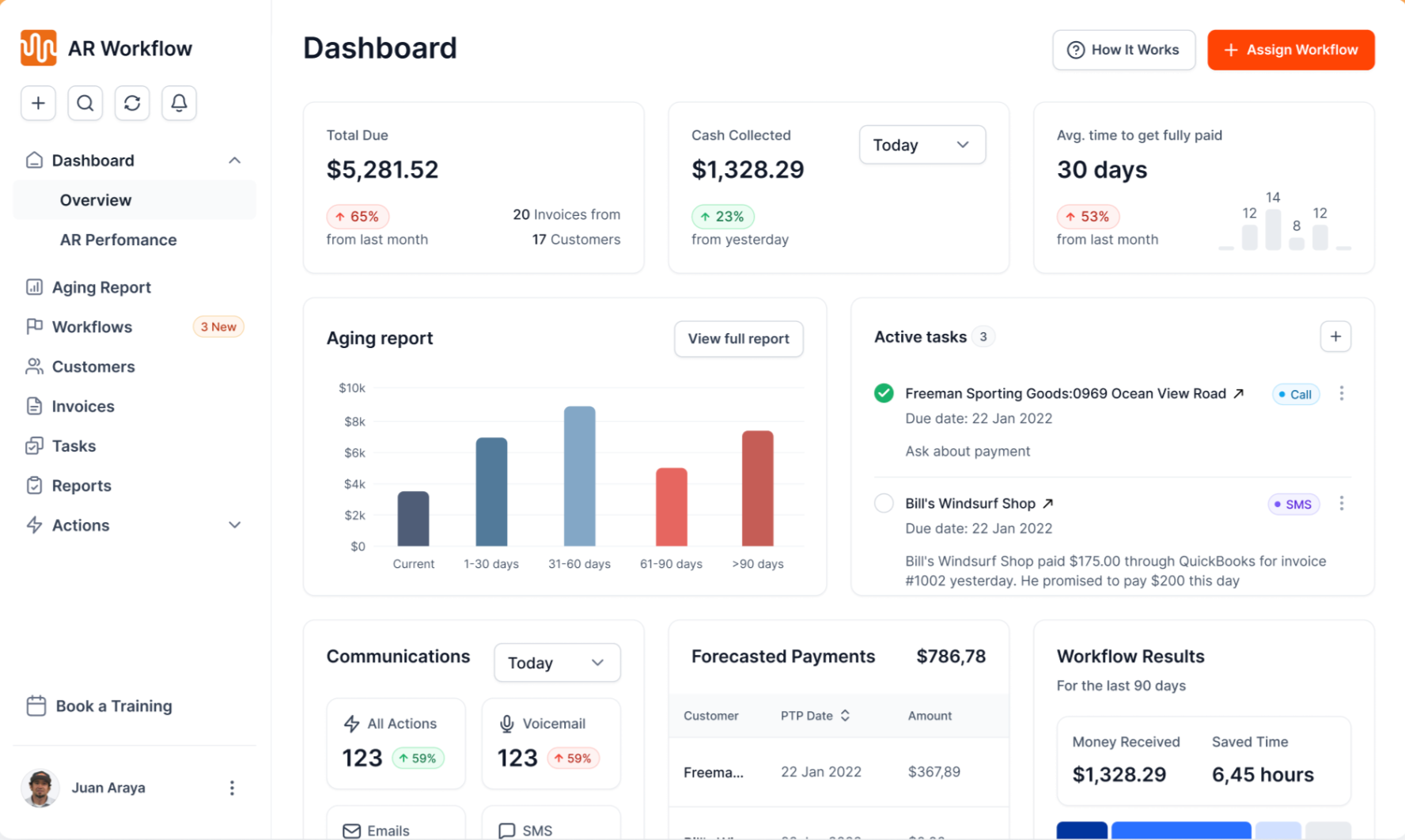
The AR Workflow dashboard brings open invoices and collection activity into one view.
For example, if a payment remains outstanding, an employee can check the account's communication history rather than searching through separate emails and spreadsheets to find the last update.
AR Workflow also supports automated email and SMS follow-ups sent from a dedicated number, along with collection workflows that help teams maintain consistent contact when payment is due.
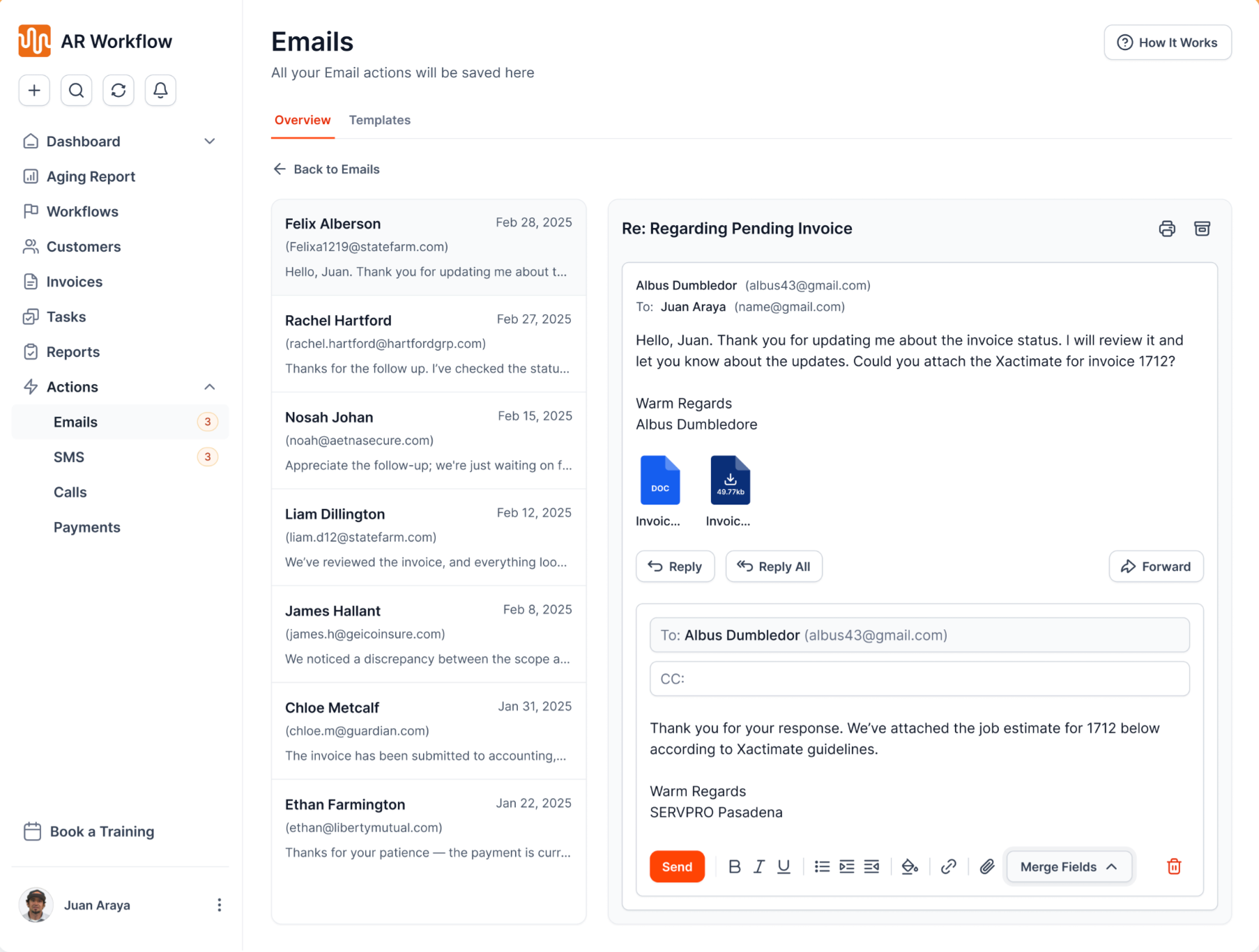
Scheduled email follow-ups keep each open balance moving.
While the platform doesn't determine insurance coverage or approve claims, its focus is to help the restoration company stay organized while managing the outstanding payments it needs to collect.
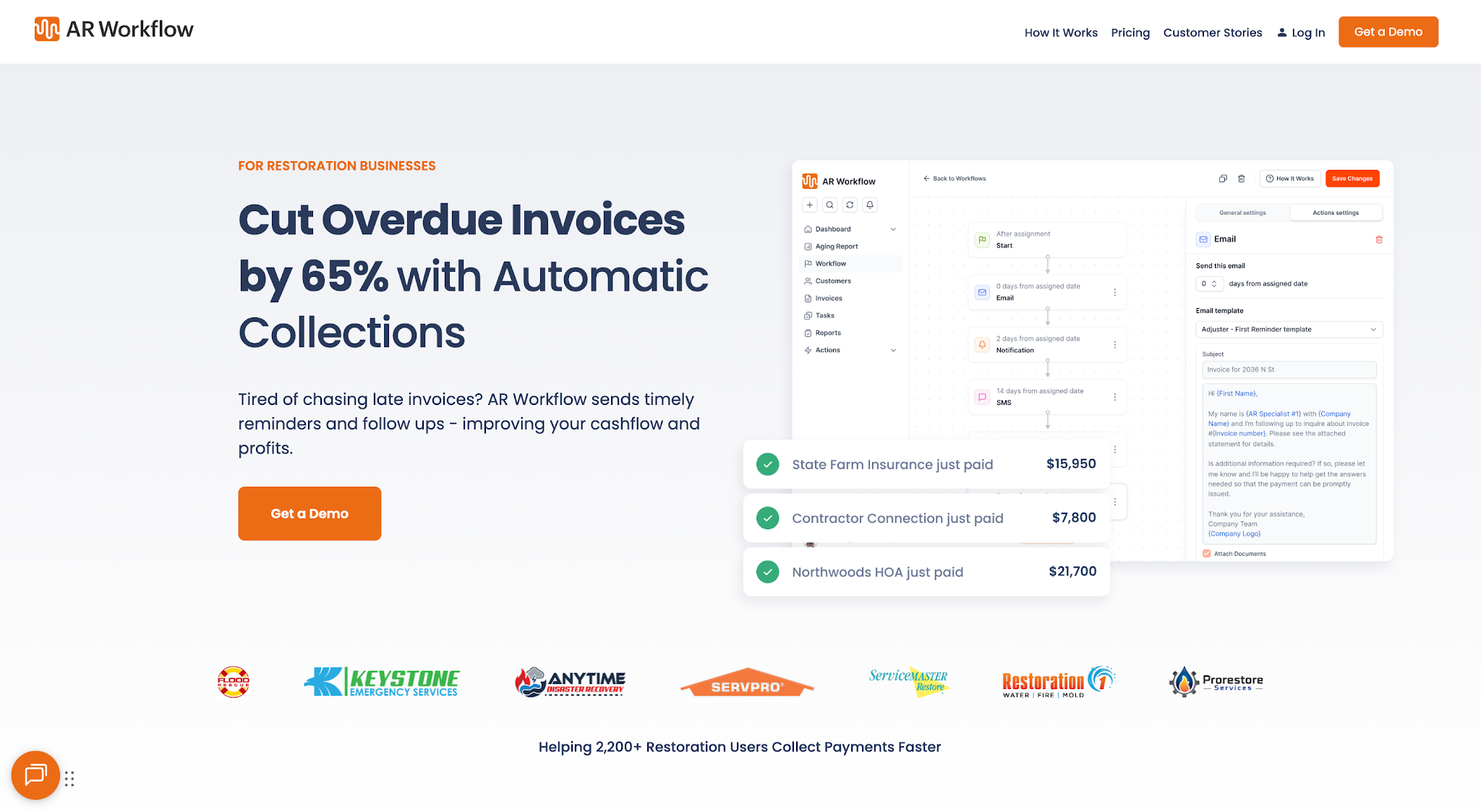
AR Workflow connects to QuickBooks Online and tracks every unpaid restoration invoice.
Direct insurance billing can make it easier to submit restoration charges for insurance review. However, contractors still need to understand the payment arrangement and keep track of any balance that remains unpaid after submission.
Even when the restoration process and billing go smoothly, outstanding invoices can still take up valuable time if the team has to manually track payments and decide which accounts need attention.
AR Workflow helps licensed restoration companies manage that part of the process by giving their teams better visibility into unpaid invoices and automating collections follow-ups.
After all, the goal isn't simply to make insurance billing easier. It's to make sure the work your company has completed turns into payments that keep your cash flow moving.
Yes, when the claim arrangement allows it. With the homeowner's authorization, a restoration company can send its invoice and job documentation straight to the insurer and discuss the charges with the adjuster. Billing directly does not guarantee direct payment, though. The carrier may still pay the policyholder or add the mortgage lender to the check, so confirm the payment arrangement before the job starts.
Insurance restoration involves repairing property damage that may qualify for insurance coverage. The property owner files a claim, the insurer reviews the damage, and the restoration contractor completes the authorized work. The insurer then determines which costs the policy covers, and the homeowner remains responsible for the deductible.
Direct billing allows restoration contractors to submit invoices and supporting documents directly to an insurance company for review. However, depending on the payment arrangement, the insurer may still pay the property owner, or issue a two-party check that both of you must endorse.
A Direction to Pay form is a document the policyholder signs asking the insurer to send payment for the contractor's work directly to the contractor. The homeowner keeps control of the claim. Carriers may have their own requirements before they honor it, so send it early and confirm it was received.
No. Direct billing is simply sending your invoice to the carrier. An assignment of benefits transfers claim rights to the contractor, and some states restrict or ban it, including Florida for property policies issued on or after January 1, 2023. Rules vary by state, so check current law before using one.
Yes, insurance can cover restoration work if the damage results from an event covered by the policy. Coverage depends on the cause of damage, insurance policies, deductibles, and exclusions.
Related reading
Your invoice, not a feature tour.
Bring one overdue invoice to a demo and see what AR Workflow would send, when, and how your customer would pay.
Sam owned and ran three restoration companies for more than 14 years and collected over $100 million in receivables. He built AR Workflow in 2020 to give contractors the collections system he wished he'd had.

AI writes the emails, sends the texts, and leaves the voicemails. Your team handles the conversations that matter, and your cash keeps moving.
 Keep QuickBooksStart with one invoiceStay in control

 Log in