How to ask for payment politely, with copy-ready email, text and phone scripts, a reminder schedule, and 5 communication hacks that get customers to pay sooner.


You've got vision. You've got drive. You've got the grit to grow your restoration business, scale your operations, and achieve financial freedom. Knowing how to ask for payment politely, and when to get firmer, is one of the fastest ways to get paid for work you have already done. These five communication hacks, plus the scripts and reminder schedule below, show you how.
But there's one thing that's holding you back. Money that's already yours is sitting in someone else's bank account.
Welcome to accounts receivable. The money that's rightfully yours is owed to you by customers and colleagues. And it should be sitting in your bank account.
What if I told you there was a way to get it more quickly?

Effective communication is an accounts receivable game-changer. Change how you communicate with customers and unlock your next level of success.
If your current "communication strategy" is sending invoices and reminders, it's time to level up your communication. Doing so will minimize work, accelerate payments, and shift the relationship with your customers such that they respect your terms, feel compelled to pay on time, and want to work with you again. It all starts with better communication.
Ready to reduce payment delays, eliminate bottlenecks, and build relationships that keep money flowing consistently? Discover our 5 communication hacks to getting paid faster.
KEY TAKEAWAYS
| 1 | Communicate with clarity and confidence |
| 2 | Tailor your communication for maximum impact |
| 3 | Automate where it counts, but keep it personal |
| 4 | Know when to escalate: the power of direct contact |
| 5 | Track, measure, and improve |

Let's start with this powerful truth: if you don't set clear expectations from the start, you're setting yourself up for struggle. If your customers aren't crystal clear on payment terms from day one, how can you expect them to meet your expectations?
Start strong by communicating your payment expectations. When you onboard a new customer, make communicating your organization's payment schedule and process part of the starting conversation.
Beyond that, your payment conversation should be as straightforward as any product or service you're offering. Be clear, be direct, and make sure to confirm everyone's on the same page from day one. This isn't just a formality; it's about setting the tone for how your business and financial relationship is expected to flow.
 Tip: Make discussing your payment procedure part of your initial value conversation.
Frame it (for yourself and your customer) as part of the service you offer. Here's an example to get you started:
"We're committed to delivering this project on time, and to keep the momentum going, our payment terms are net 30. Does that work for you?"
You're not just asking for payment. You're reinforcing your value.
When you lead with clarity, you build trust, and that trust creates action. Your customers are more likely to pay on time because they will see and want to respect your professionalism. Beyond that, because you've proactively communicated your expectations, they also are more likely to understand your process. Set the standard from the start, and customers will rise to it.
But good communication isn't a one-and-done. For success and speedy payments, you've got to keep reinforcing these expectations throughout your relationship.
Every invoice and every follow-up are opportunities to remind your customers that you expect prompt payment and that you've set a professional standard that they've agreed to meet. This clarity builds momentum. It saves time and creates a rhythm, which fuels your cash flow. Set expectations. Then, stick to them and communicate them.

Here's the customer service secret most people skip: not every customer is the same.
As a result, you need to modulate your communication styles. The way you communicate with one person will not work with another. Change your communication styles and transform your payment cadence. If you use a one-size-fits-all approach, you're leaving money on the table.
Some customers are habitual late-payers, while others pay before the ink dries on the invoice. Don't treat them the same. To win the cash flow game, you've got to tailor your communication to your different customer archetypes and their distinct behaviors.
Tip: Segment your customers. Break your customer base into segments. While we encourage you to adjust the below to your customer base, these are the three most consistent and prominent customer segments we've seen in our work with restoration clients.
| Customer segment | How they pay | How to communicate |
|---|---|---|
| Rockstar Payers | These customers always pay on time. They appreciate your service and respect your terms. | A simple reminder is all you need. |
| Consistent Delayers | They mean well but always seem to miss the due date. | A little more follow-up and perhaps firmer reminders. |
| The Unpredictables | These customers can go either way. You never know what to expect from them. | They require extra attention. |
When you segment your customers, you empower yourself to communicate more effectively. Instead of blasting out generic reminders, you can speak directly to where your customer is.
Next step: Using the above as a starting point, take a moment to assess your own clientele and see if other behaviors or subcategories arise.
Tip: Use tools like AR Workflow to customize communication for each customer segment.
For your Rockstar Payers, a polite reminder might be all you need. They appreciate a tone that is warm, courteous, and appreciative. They also always love an affirmation of their proactive behavior. If you do need to remind them, keep the reminder light and friendly, perhaps framed as a "courtesy notice" keeping them informed.
For the Consistent Delayers, a more assertive message may be necessary. They might not prioritize your invoices as highly, so a tone that is clear, firm, and holds them accountable often works best. Set concrete due dates and communicate with a polite, but firm tone, always reminding them of your aligned expectations.
If you're unsure how to ask for payment politely, here's an example of language that we've found works:
"We'd like to ensure this remains on your radar, as timely payment is essential for us to continue delivering exceptional service to you."
For more ready-to-send wording, see our past due invoice letter templates.
And for The Unpredictables? Personalized follow-ups are key. The more you tailor your communication, the more control you'll have over your cash flow.
Beyond that, we've found that a single point-person and that personalized, flexible, and steady communication work the best. Keep your tone encouraging but straightforward, and make sure that each message addresses their unique situation.

But again, you'll have to keep personalized notes and observations on each client. They are, after all, unpredictable.
People want to do business with those who care about them, make them feel important, and communicate with them in a way that feels personal.
When you tailor your communication, you make your customers feel seen and valued. They're not just another invoice. They're active partners in their restoration business journey. That connection goes a long way in ensuring they then pay on time.
Don't overlook the power of customization in communication. It will make all the difference between getting paid on time and constantly chasing down payments.
Most people who search for how to ask a customer for payment want the actual words. Below are five short scripts, one for each stage of an invoice. Swap in your own details, keep the invoice number and amount in every message, and always tell the customer exactly how to pay. For longer email versions, see our payment reminder email templates for contractors.
Subject: Invoice #1042 for 18 Oak Street is due Friday
Hi Dana, a quick heads-up that invoice #1042 for $3,480 is due this Friday, June 14. You can pay online with the link below, or call us if you'd rather pay by check. Thanks again for trusting us with the project.
Hi Dana, this is Mike from Summit Restoration. Invoice #1042 ($3,480) was due yesterday. Here's the payment link if it's easier to pay from your phone. Reply here if you have any questions.
Subject: Following up on invoice #1042
Hi Dana, I'm following up on invoice #1042 for $3,480, which was due on June 14. If something on the invoice doesn't look right, let me know and we'll sort it out this week. Otherwise, could you confirm when we can expect payment?
"Hi Dana, it's Mike from Summit Restoration. I'm calling about invoice #1042. It's two weeks past due and I wanted to check in personally. Is there anything holding it up on your end? ... Great. Can we put a date on the calendar for payment, or would a two-part payment plan help?"
Subject: Final notice: invoice #1042 is 30 days past due
Hi Dana, invoice #1042 for $3,480 is now 30 days past due. We value working with you, and we need payment or a confirmed payment plan by June 28. After that date, we'll move to the next step in our collections process. Please call me directly so we can resolve this.
Notice what every script has in common: a name, the invoice number, the amount, a date, and a single clear next step. That is how to ask for payment professionally without sounding cold. If you need a formal letter for a long-overdue account, use one of our past due invoice letter templates.
Politeness is easier when you have a plan. Decide in advance what goes out and when, so every customer gets the same fair treatment and nobody falls through the cracks.
| When | Channel | Tone | Goal |
|---|---|---|---|
| 5 days before due | Friendly heads-up | Make sure the invoice was received and is correct | |
| Due date | Email or text | Friendly | Make paying one tap away |
| 3 days late | Text | Friendly, direct | Catch simple oversights |
| 7 days late | Polite, specific | Surface disputes or questions | |
| 14 days late | Phone call | Calm, solution-focused | Get a payment date or plan |
| 30 days late | Email and letter | Firm | State the next step and deadline |
| Instead of this | Say this |
|---|---|
| "Sorry to bother you, but..." | "I'm following up on invoice #1042." |
| "Just checking in to see if you maybe..." | "Can you confirm the date payment will be sent?" |
| "You still haven't paid." | "Our records show invoice #1042 is still open." |
| "Pay as soon as possible." | "Please pay by Friday, June 14." |
| "Let me know." | "Here is the payment link. Reply if anything looks off." |
The difference is small but it matters. Specific, neutral language keeps the conversation about the invoice, not about the person, which is exactly how to ask for payment politely and still get a date.

How much time are you spending on collections every month? If you're like most business owners, the answer is "way too much."
Automating your recurring tasks and admin will allow you to focus on building your empire. For us, automation isn't about replacing the personal touch. It's about freeing you up to be even more personal where it matters most.
Automation can be your best friend when it comes to reminders, follow-ups, and keeping customers on track. Tools like AR Workflow allow you to send out timely reminders automatically, ensuring that no customer slips through the cracks. You set the schedule (five days before the due date, the day of, and two days after) and let the system do the work for you. See how automated payment reminders work by email and text.
Automation is not the enemy of personalization. The best workflow systems blend both seamlessly. And when you do it right, your customers don't feel like they're part of a machine. Instead, they feel truly considered and in a meaningful business partnership with you.
Tip: Use automated reminders intelligently.
Automated reminders work best when they're coupled with a personal touch. Customize your reminders with personal details, like the customer's name and specific project details, so they feel like the reminder is coming from you, to them, about their project.
When your automation is on point, it not only saves you time but also builds consistency. Your customers will come to expect your reminders, and that means fewer surprises and more predictability in your cash flow.
Tip: Build your automated workflow.
Automate a first reminder that goes out five days before payment is due, and then follow up with a personal phone call if the payment is late by more than a few days. Use automation as the foundation and personal engagement to seal the deal.
We've found that automating our basic procedures saves us time on admin and lowers costs on the natural level of human error that often occurs. Let your team members enjoy more organized systems and a reduced level of tedium with automated workflows.
Bring one overdue invoice.
We'll show you the reminders AR Workflow would send on it, and when.

Most restoration businesses don't escalate quickly enough. After a few automated reminders go unanswered, it's easy to let overdue invoices slide while you focus on new customers and projects. But overdue payments are your money, money you've already earned. You need to fight for it like your business depends on it, because it does.
When automated reminders fail, that's your cue to take action. This is the moment where personal touch is the most powerful tool in your arsenal. Pick up the phone. Yes, you read that right: call your customer. This isn't the time for automation. This is the time for a real, human conversation.
Tip: When making the call, stay calm, professional, and focused on the solution.
You're not calling to demand payment; you're calling to work out a solution. If you're wondering how to ask a client for payment on the phone without sounding pushy, open with a question instead of a demand. Stay focused on your end goal and stay professional, collected, and able to receive the payment you deserve. Here's some language to get you started:
"I noticed the invoice is overdue, and I wanted to check in. Is there anything on your end that's causing a delay? Let's figure out how to get this sorted."
Customers respect the effort, and many times, it's a simple oversight on their part. By taking control of the situation with a call, you show leadership and commitment to getting the job done, not just for them, but for your business too.
Remember, most of the time your customers aren't trying to avoid paying you. They've just got a lot going on. A quick call returns their focus back to your invoice and moves it to the top of their priority stack. And never apologize. You're not bothering them or reminding them to pay. You're reinforcing the value you bring to the table. If an invoice keeps slipping, our guide to unpaid invoices lays out the next steps.

Success leaves clues. If you want to consistently improve your accounts receivable process, track what's working and what's not. This isn't just about sending more reminders. It's about optimizing every piece of your communication strategy so that it works better and faster every time.
| Metric to track | The question it answers |
|---|---|
| Payment timelines | How long does it take for each segment of your customers to pay? |
| Open and response rates | Are your emails being opened? Are reminders being acted upon? |
| Dispute resolution times | How long does it take to resolve issues or disputes that slow down payments? |
By analyzing these metrics, you will gain the insights necessary to tweak and refine your communication strategy.

Maybe you'll discover that your "friendly" reminders aren't getting opened as often as you'd like. Or perhaps you'll find that a certain customer segment needs a more personalized touch. Whatever the case, tracking your communication performance ensures that you can make informed decisions that supercharge your cash flow.
Tip: Leverage AR Workflow's tracking and analytics features to gain insights into your payment process.
Identify bottlenecks, celebrate successes, and continuously improve your approach. You'll be amazed at how a few small changes can lead to massive improvements in payment speed and consistency.
Once you have the data, you have the power to transform your business. Adjust your approach, test new strategies, and find out exactly what gets your customers to pay on time, every time. The secret to success is in the data, and the more you track, the more successful you'll be.
Here are some AR Workflow features that help restoration businesses level up:
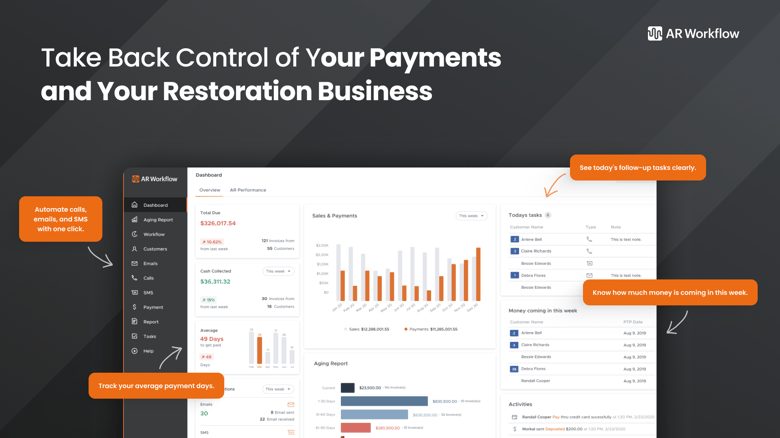
AR Health Dashboard: Access a real-time overview of your accounts receivable status, including key metrics and trends. This dashboard helps you celebrate successes and identify areas for improvement, facilitating continuous enhancement of your payment processes.

The AR Health Dashboard gives a real-time overview of receivables.
Aging Report: Get up-to-date information on open balances, recent payments, and overdue invoices to easily identify bottlenecks and prioritize collection efforts effectively. Learn more about reading an AR aging report.

The aging report shows open balances, recent payments and overdue invoices.
Customer Contact: Maintain a consolidated history of all interactions with each customer, including notes, emails, calls, and payments. This comprehensive view allows you to monitor communication patterns and assess the effectiveness of your follow-up strategies.

Every note, email, call and payment in one customer history.
By utilizing these analytics tools, you can gain valuable insights into your payment workflows, make informed decisions, and implement targeted strategies to improve payment speed and consistency. Get more organized and spend less time on repetitive admin with AR Workflow.
We're invested in your success. Literally. Book a demo of AR Workflow to see the difference and build the company that always gets paid, on time.

How you communicate determines how fast you get paid. When you master the art of clear, confident, and personalized communication, you're not just collecting payments. You're building relationships, strengthening your cash flow, and taking control of your financial future.
You have the tools. You've read the strategy. Now it's time for you to step up, believe in your business, and implement these game-changing communication hacks.
Start with one change this week: pick the script above that matches your oldest open invoice and send it today.
The result? A business that's more profitable, more efficient, and more successful than ever. And you're more organized and spending less time on admin. Grow your business without the stress. Your business deserves it, and so do you.

While the above may all sound well and good, how are you going to work this advice into already existing workflows and project processes? We know you're already overworked, exhausted, and pushed to your limit.
Being professional, organized, and consistent with every customer can be easy. We like to use all of the above with AR Workflow. While there's plenty of project management tools out there, we designed AR Workflow for restoration professionals like you.
Consolidated documentation
Remember what we said about thorough documentation and transparent communication? That can start with AR Workflow. With AR Workflow you're always ready for questions or conversations. Keep all photos, notes, communications, and status updates in one place. Save time, while you level up the quality of your project management. Build comprehensive dossiers for each project to accelerate project completion, easy communication, and your payment timeline.
Customized analytics and insights
AR Workflow helps you keep your own stress low and your head clear with easy-to-understand, real-time insights and analytics on your project. By knowing what's going on, you'll be able to communicate clearly and confidently with every customer. Make data-driven decisions, standardize operating procedures, and refine your process. Success starts with these real-time AR Workflow insights.
Automated email and SMS reminders
Lastly, AR Workflow keeps your communication with customers consistent and professional with reminders, automation, and customizable email and SMS templates, with texts sent from a dedicated number. Communicate clearly to accelerate payment, and always be ready for the next conversation about an open invoice.
Sound like the kind of business you'd like to be running? We think so.
The principles stay the same in every trade, but who you ask and when you ask changes. A few trade-specific adjustments:
How you communicate determines how fast you get paid. When you set expectations early, tailor your tone, automate the routine reminders, call when it counts, and track what works, you stop chasing and start collecting. Most of your customers want to pay you. Clear, polite, specific requests simply make it easy for them.
Set clear payment terms before work starts, invoice promptly, send consistent reminders, make it easy to pay online, and call when reminders go unanswered. Tracking how long each customer takes to pay shows where to tighten the process.
Reference the invoice number, amount and due date, keep the tone friendly and direct, and tell them exactly how to pay. For example: "We'd like to ensure this remains on your radar, as timely payment is essential for us to continue delivering exceptional service to you."
Stick to facts: the invoice number, the amount, the due date and how to pay. Avoid apologizing or guessing at why they haven't paid. A neutral line such as "Our records show invoice #1042 is still open" is polite, clear and hard to take offense at.
A good payment reminder message names the customer and the job, states the invoice number and balance, gives the due date or how late it is, and includes a payment link or instructions. Keep it short enough to read on a phone, and end with an easy way to ask a question.
Once automated reminders have gone unanswered, usually if the payment is late by more than a few days. Keep the call calm and focused on finding out what is causing the delay and how to resolve it.
No. Send adjusters and carriers status requests and supporting documentation. Payment links belong in messages to the homeowner or customer who owes a balance, such as a deductible. See our restoration insurance billing guide.
Related reading
Your invoice, not a feature tour.
Bring one overdue invoice to a demo and see what AR Workflow would send, when, and how your customer would pay.
Sam owned and ran three restoration companies for more than 14 years and collected over $100 million in receivables. He built AR Workflow in 2020 to give contractors the collections system he wished he'd had.

AI writes the emails, sends the texts, and leaves the voicemails. Your team handles the conversations that matter, and your cash keeps moving.
 Keep QuickBooksStart with one invoiceStay in control

 Log in