Free fire damage restoration invoice template with a filled-in example, common fire and smoke line items, and how to avoid adjuster cuts and get paid faster.

A fire and smoke restoration invoice template gives you a consistent format for billing jobs that vary widely depending on the extent of the damage. One project might only require soot cleaning and odor removal, while another could involve extensive debris removal and replacement of damaged materials.
Because the scope of work can differ so much between projects, preparing the final fire damage restoration invoice requires you to account for the specific services your team completed and the charges that go with them.
A template makes this process easier by giving you the same structure no matter how much work the project involved.
This guide explains what to include in the template and how to use it to prepare an invoice that accurately reflects the completed job.
KEY TAKEAWAYS
Download our free fire and smoke restoration invoice template:
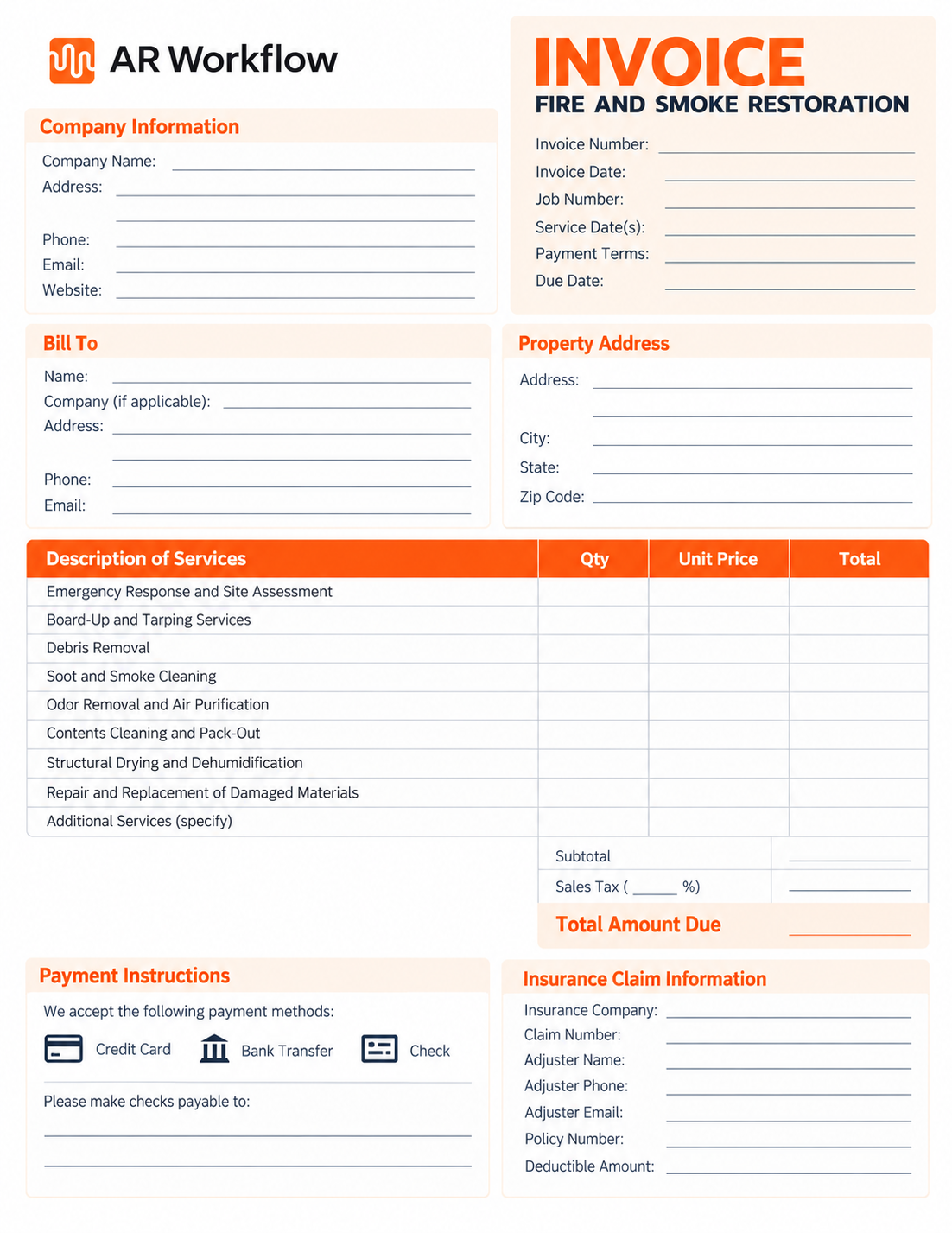
Free fire and smoke restoration invoice template.
Use this free fire and smoke restoration invoice template to help you prepare your first invoice without starting from scratch. Feel free to customize and print it as needed to match your company's billing format and project requirements. Billing other loss types? See our restoration invoice template, water damage restoration invoice and mitigation invoice guides.
A fire and smoke restoration invoice typically includes seven main components. Each serves a different purpose, from identifying the restoration project to explaining the final amount due.
| 1 | Business and customer information |
| 2 | Invoice and job details |
| 3 | Insurance and claim information |
| 4 | Itemized fire and smoke restoration services |
| 5 | Labor, materials, and equipment costs |
| 6 | Total charges and outstanding balance |
| 7 | Payment terms and instructions |
Here's what each component covers and why it belongs on the invoice.
This section identifies the restoration company issuing the invoice and the customer responsible for the bill.
It includes the company's name and contact information, along with the customer's name and billing address. Depending on the project, the billing address may differ from the property where the restoration work took place.
These details establish who provided the services and who should receive the invoice. They also give the customer or claims reviewer the correct contact information if they need clarification about the charges.
Invoice and job details connect the bill to a specific restoration project.
The invoice number serves as a unique reference for tracking the bill in the company's accounting records. The invoice date and due date establish when the company issued the invoice and when it expects payment.
Project details typically include the property address and the dates of service. Restoration companies may also use an internal job number to connect the invoice with their project records.
Together, these details help the office team identify the correct invoice when reviewing payments or responding to billing questions.
Insurance and claim information helps connect restoration charges to the corresponding insurance claim.
For insurance jobs, this section typically includes the insurance carrier's name and the claim number. It may also include the insurance adjuster's contact details when the company needs to identify the person handling the claim.
These references help the claims reviewer match the invoice with the correct loss and supporting documentation.
However, insurance information doesn't determine who must pay the invoice. The signed contract and applicable payment arrangements establish the customer's obligations, including any deductible they must pay, and any direct-payment arrangements.
This section explains which restoration services the company completed and how much it charged for each one.
Fire and smoke restoration projects may involve emergency board-up, soot removal, smoke residue cleaning, odor treatment, or debris removal. Depending on the damage, the work may also include contents cleaning, pack-out services, or repair work.
Each line item identifies a particular service and its corresponding charge.
For example, a smoke damage invoice might list soot removal from interior walls separately from smoke odor treatment. This distinction helps the recipient understand which part of the restoration work each charge covers.
The descriptions should reflect the completed scope and the company's agreed pricing method.
Labor, materials, and equipment costs explain the resources behind the restoration charges.
Labor costs cover the work performed by restoration technicians. When the company bills by the hour, the invoice may show the number of hours and the applicable labor rate.
Material costs account for supplies used during the project, such as cleaning agents or sealing products.
Equipment costs cover items such as air scrubbers and other equipment used during restoration. The invoice may calculate these charges using the equipment's daily rate and the duration of use.
This information helps the recipient understand how the company calculated charges that depend on labor time or resource usage.
The total charges section summarizes the financial amount of the invoice.
It includes the subtotal of all line items and any applicable taxes or additional fees. It also accounts for deposits or previous payments that the customer has already made.
The outstanding balance represents the amount the customer still owes after those adjustments.
For example, a $12,000 restoration invoice with a $2,000 deposit would show a remaining balance of $10,000.
This section gives the customer a clear payment amount and helps the company's accounting team track the unpaid balance.
Payment terms explain when the customer must pay the invoice and which payment methods the company accepts.
They typically include the payment due date and instructions for submitting payment. Companies that accept online payments may also provide the customer with a payment link.
The invoice may include additional payment conditions that the signed contract establishes, such as an agreed payment schedule.
These details give the customer the information needed to settle the balance under the agreed terms.
Tip: On insurance jobs, the payment link goes to the homeowner for the portion they owe, such as the deductible. The adjuster gets the invoice and supporting documentation for review. Never send a payment link to an adjuster or carrier.
Fire jobs produce some of the longest invoices in restoration because the damage spreads past the burned area. Smoke and soot travel through HVAC systems, wall cavities and contents, so a kitchen fire can generate charges in every room. The table below lists the line items that show up most often on a fire damage restoration invoice, how they are usually measured, and what to keep in the job file to support them.
| Line item | Usually billed by | Support to keep on file |
|---|---|---|
| Emergency board-up and roof tarping | Square foot of opening or tarp, plus labor | Before and after photos, time on site |
| Debris removal and haul-off | Hour, load or dumpster | Load counts, dump tickets, photos |
| Demolition of charred materials | Square foot or linear foot | Room-by-room photos and measurements |
| Dry soot removal and HEPA vacuuming | Square foot of surface cleaned | Photos, affected room list |
| Wet cleaning of walls, ceilings and structure | Square foot of surface cleaned | Photos, cleaning method used |
| Smoke odor treatment (thermal fogging, hydroxyl or ozone) | Room, cubic foot or equipment day | Treatment log with dates and areas |
| Air scrubbers and HEPA air filtration | Unit per day | Equipment log with set and pickup dates |
| Odor-sealing primer on affected surfaces | Square foot | Photos, product used |
| Contents pack-out, inventory and storage | Box, hour or storage period | Signed inventory, box count, storage dates |
| Contents cleaning and deodorization | Item, box or hour | Inventory with cleaned, restored or non-salvageable status |
Use the same units your estimate used. If the approved estimate priced soot cleaning by the square foot, the invoice should too. Switching units between the estimate and the final bill is one of the fastest ways to invite questions from the adjuster reviewing the claim.
Most jobs involve both, but the invoice reads differently depending on which one drove the work. A fire damage invoice leans on demolition, debris removal, board-up and rebuild-ready cleaning in the burned area. A smoke damage invoice leans on surface cleaning, odor treatment, air filtration and contents work in rooms the flames never reached. When smoke traveled far from the origin, list the affected rooms by name so the reviewer can see why cleaning charges extend past the burn zone.
Now that you know what each part of the invoice covers, the next step is to fill out the template using the information from your completed restoration project. Here's how to prepare the invoice from your job records.
Before entering anything into the template, collect the records that confirm the work your company completed.
Start with the signed contract, the approved estimate, and the final scope of work. Review any approved change orders that added services or changed the original charges.
Then check the job records for labor hours and equipment usage. These details help you confirm the quantities and rates that belong on the invoice.
For insurance jobs, keep the claim number and relevant insurance information available.
Once you have these records, you can complete the template using the final project details without repeatedly checking with the project manager.
Start by entering your company info and contact information in the appropriate fields.
Then add the customer's name and billing address. Review the contract to confirm whether the customer, general contractor, or another party is responsible for payment.
Next, enter the property address and service dates. Assign an invoice number and include the invoice date and due date.
If the project involves an insurance claim, add the carrier's name and claim number.
Before moving on to the charges, compare these details with your job file to make sure everything matches.
With the project information in place, you can start entering the services your team completed.
Review the final scope of work and create a line item for each service, including any installation work, that requires a separate charge.
For example, if your team cleaned soot from interior walls and performed smoke odor treatment, list those services separately when the billing arrangement calls for separate charges.
Next, enter the quantity and applicable rate for each item. For labor, multiply the number of hours by the agreed hourly rate. For equipment, multiply the number of days used by the agreed rate.
Repeat the process until the invoice accounts for all completed services.
After entering the charges, add the line-item amounts to calculate the subtotal, then include any applicable taxes or additional fees under the contract.
Check your payment records for deposits or previous payments related to the project. Subtract those amounts from the total to determine the remaining balance.
For projects with progress billing, compare the invoice with earlier bills to avoid charging twice for the same work.
The final payment amount should match what your accounting records show the customer still owes.
Finally, before sending the invoice, compare the completed template with your final job records.
Use a checklist to confirm that the invoice includes the correct services and quantities. Make sure that the rates match the contract and that the total accounts for previous payments, then review the customer details and payment instructions.
If the customer or insurance reviewer requires supporting documents, including relevant permits, prepare them alongside the invoice.
Once everything matches, save the invoice as a PDF and send it to the appropriate recipient. Keep a copy with the project records for future reference.
Bring one overdue invoice.
We'll show you how a fire and smoke job's open balance would be followed up until it's paid.
Here's an example of what a completed invoice looks like.
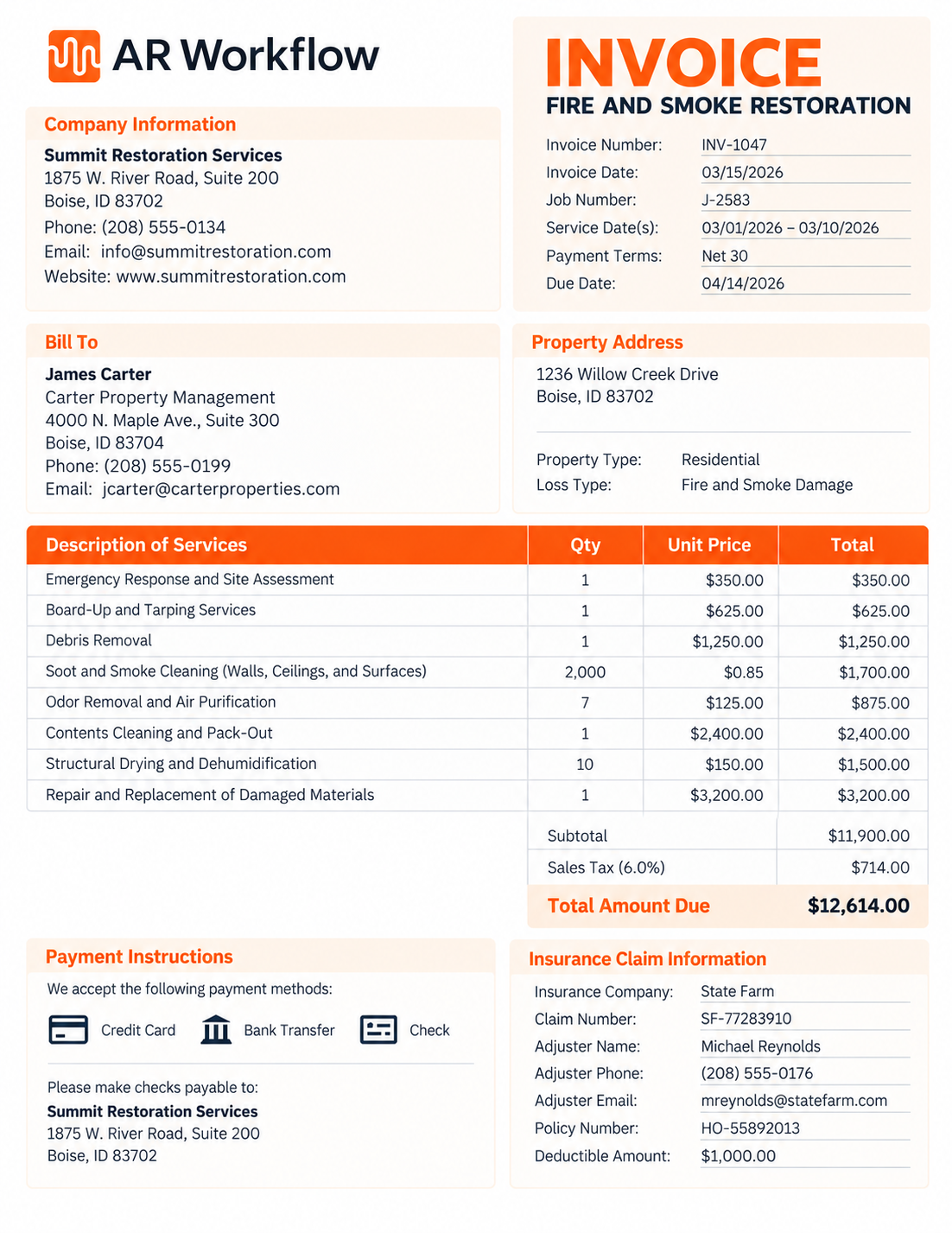
A completed fire and smoke restoration invoice with itemized charges and balance due.
Even a well-built invoice can come back from the carrier lower than you billed. Many carriers and adjusters review restoration charges against estimating software line items and the scope they approved, so anything that doesn't line up gets questioned. These are the most common reasons a fire damage restoration invoice gets cut, and how to head them off.
Our guide to insurance price reductions goes deeper on submitting bills that get paid as written.
Tip: Send the invoice and its supporting documents together, in one package, labeled by room. Reviewers move faster when they don't have to request the photos separately.
Once your team sends the completed invoice, the focus shifts to collecting the outstanding balance.
Restoration companies often manage payments from multiple projects at the same time. As invoice volume grows, tracking outstanding balances and maintaining consistent follow-up can require significant administrative work. Your AR aging report shows which balances need attention first.
Your collections process should help your team identify which invoices need attention and keep customer communication organized. That way, employees can manage overdue accounts without repeatedly checking spreadsheets or searching through previous emails. If an invoice is already late, start with our guide to collecting unpaid invoices and our past due invoice letter templates.
AR Workflow helps restoration companies handle this work through automated email and SMS payment reminders sent from a dedicated number. It also gives finance teams visibility into outstanding invoices so they can track payment activity and manage collections more consistently.
With a more organized collections process, your team can spend less time on repetitive follow-ups while maintaining better control over unpaid invoices.

AR Workflow tracks unpaid invoices, sends reminders and collects payments in one place.
Having a fire and smoke restoration invoice template can save your team time when preparing invoices for completed jobs.
But if your team still spends hours checking unpaid balances and reminding customers to pay, there's another part of your billing process that deserves just as much attention: your collections process.
AR Workflow helps you improve that process by automating payment follow-ups and giving your team a clearer view of outstanding invoices.
With one platform to track unpaid invoices, send reminders, and collect payments, your team can manage collections without having to juggle multiple tools or handle every follow-up manually.
Your team has already invested considerable time and resources into completing restoration jobs for your clients. Make sure collecting the payments you've rightfully earned doesn't require even more time and resources.
A fire damage invoice should list your company and customer details, the invoice number, dates and property address, and the insurance carrier and claim number. Then itemize each service, such as board-up, soot removal and odor treatment, with quantities, rates, labor, materials and equipment. Finish with the subtotal, taxes, deposits paid, balance due and payment terms.
Yes. The free fire and smoke restoration invoice template above gives you the basic billing fields without buying dedicated invoicing software. Edit it to reflect the completed work and payment terms for each project.
Bill smoke odor removal as its own line item, separate from surface cleaning. Name the method, such as thermal fogging, hydroxyl or ozone treatment, and the unit used, such as per room or per equipment day. Attach the treatment log showing dates and treated areas so the reviewer can match the charge to the work.
A restoration contractor should send the final invoice after completing the agreed scope of work and confirming all charges. However, the contract may require the contractor to meet specific billing milestones or submit supporting documents before issuing the final invoice.
Each line item should clearly describe the completed service and show how the contractor calculated its cost.
Include quantities and applicable rates, such as square footage for soot cleaning or hours worked for labor charges, so customers and insurance adjusters can understand each charge.
A fire and smoke restoration invoice may require supporting documents such as the signed work authorization, final scope of work, and approved change orders. For insurance claims, adjusters may also request job photos, equipment logs, or completion records to verify the services and charges on the invoice.
Related reading
Your invoice, not a feature tour.
Bring one overdue invoice to a demo and see what AR Workflow would send, when, and how your customer would pay.
Sam owned and ran three restoration companies for more than 14 years and collected over $100 million in receivables. He built AR Workflow in 2020 to give contractors the collections system he wished he'd had.

AI writes the emails, sends the texts, and leaves the voicemails. Your team handles the conversations that matter, and your cash keeps moving.
 Keep QuickBooksStart with one invoiceStay in control

 Log in