How to improve accounts receivable with 6 strategies contractors can use now: clear terms, faster invoicing, steady follow-up and easy ways to pay.

You can have plenty of work coming in and customers who are happy with your services. But if you struggle to collect payments on time, your business can still run into cash flow problems. The right accounts receivable strategies fix that by changing how you set terms, send invoices and follow up, so money arrives on a schedule you can plan around.
The longer payments remain outstanding, the harder it becomes to cover payroll, pay suppliers and plan for what's next. This guide covers six accounts receivable strategies you can start using this week, with examples for restoration and other contracting businesses, a sample follow-up schedule and the numbers to track.
KEY TAKEAWAYS
Accounts receivable strategies determine how your business manages the payment cycle, from sending an invoice to collecting payment. How well you manage that window makes a real difference in your cash flow.
For example, two businesses might generate the same revenue in a month but end up with very different cash positions. One collects most of its invoices within 30 days, while the other regularly waits 60 to 90 days for payment. The difference affects how much money each business can put toward its next projects or operating expenses, even though both earned the same revenue.
Your AR strategies improve cash management by setting when customers should pay, how your team handles outstanding invoices, and what happens when payments don't arrive as expected. The more consistently you manage that process, the less uncertainty you have when planning around incoming payments. For the bigger picture, see our guide to accounts receivable management.
Improving accounts receivable doesn't require changing your entire financial process. Start by reviewing how your business handles invoices and overdue payments, then pick the practices that need the most work.
| Strategy | What it fixes | First step this week |
|---|---|---|
| 1. Clear payment terms | Customers who did not know when or how to pay | Put due dates, deposits and payment methods in your contract template |
| 2. Streamlined invoicing | Late or incorrect invoices | Invoice the day a job or milestone is complete |
| 3. Proactive collections | Invoices that sit for weeks without contact | Write down a reminder schedule and assign an owner |
| 4. Monitoring and analysis | Not knowing which accounts need attention | Review your aging report every week |
| 5. Clear communication | Disputes and questions that stall payment | Log every customer conversation and promise to pay |
| 6. Regular review | Process changes nobody measures | Record your DSO today so you have a baseline |
One way to prevent payment problems is to make sure customers understand when and how they need to pay you.
Define your payment terms in your contracts and invoices. For example, Net 30 means the customer has 30 days to pay, while Net 15 gives them 15 days. Choose terms that make sense for your business and communicate them before you start work. Our guide to contractor payment terms covers the options.
Explain any conditions that could affect payment, such as deposits, late fees or credit limits. If you intend to charge late fees, confirm that your agreement and your state's laws allow them.
Don't assume that a due date on an invoice means the customer agreed to it. Review payment expectations early and document the agreement so both parties can refer to it if questions come up later.
Revisit your terms periodically, including whether an early payment discount makes sense. If customers usually pay beyond the agreed deadline, ask whether your current credit terms still support your cash flow needs. Clear terms won't prevent every late payment, but they give your team a clear basis for collections when an invoice becomes overdue.
Tip: On insurance restoration jobs, your terms should say who pays what. The homeowner usually owes the deductible and anything outside the approved scope. Put that in the work authorization before the first day of work.
Even when customers agree to your payment terms, errors or delays in invoicing affect when you get paid. If you finish a job but wait two weeks to send the invoice, you've delayed the start of the payment clock by two weeks.
Set a rule that invoices go out as soon as work reaches the agreed billing milestone. Make sure the person responsible for invoicing gets the information they need, such as job notes, change orders and photos, without chasing other employees for it.
Pay close attention to what goes into each invoice. Customers should be able to see the work you did, the amount owed, the due date and how to pay. Include any supporting documents the payer needs to verify the charges. An invoice with incorrect information has to be revised before the customer can pay, which adds days.
Finally, make paying easy. Provide an online payment link and offer card and ACH contractor payment options so customers have fewer steps to complete.
CHECKLIST
What every contractor invoice should include
Sending correct invoices on time is a start, but you still need a plan for payments that haven't arrived. If employees only contact customers after noticing an overdue balance, some invoices go weeks without attention.
A proactive collections process gives your team a schedule for contacting customers before and after their due dates. For example, send a reminder a few days before an invoice is due. If the customer misses the deadline, send another reminder and call when necessary.
To make this work, your team needs to follow the schedule consistently. Record when you contact each customer and what they say. If someone promises to pay by a specific date or agrees to a payment plan, document that commitment so the next person knows when to check the account again.
Set an escalation process for invoices that stay unpaid despite repeated attempts. Depending on the situation, a manager can review the account or your team can send a formal past due letter. Automated payment reminders help your team keep this schedule without sending every message by hand.
| When | Channel | Message |
|---|---|---|
| 3 days before due | Friendly heads-up with the invoice and payment link | |
| Due date | Text from a dedicated number | Short due today reminder |
| 7 days past due | Firm reminder and an offer to answer questions | |
| 15 days past due | Phone call | Ask what is holding up payment and log the answer |
| 30 days past due | Letter or email | Formal past due notice with the balance and next steps |
| 45 to 60 days past due | Manager review | Final notice, payment plan or collections decision (lien and collection rules vary by state) |
Tip: On insurance jobs, keep two tracks. Payment reminders and links go to the homeowner for their portion. Follow-up with the adjuster sticks to claim status and documentation. Never send a payment link to an adjuster or carrier.
Bring one overdue invoice.
We'll show you the follow-up schedule AR Workflow would run on it, step by step.
Tracking outstanding invoices helps your team see which payments need attention and what may be delaying them.
Start by reviewing your accounts receivable aging report regularly. It shows how long invoices have been unpaid and groups them into periods such as 1 to 30, 31 to 60, 61 to 90, and more than 90 days overdue.
Knowing how old an invoice is only gives you part of the picture. Suppose your report shows two invoices that are both 60 days overdue. One customer has promised to pay next week, while the other hasn't answered your last three reminders. Both fall into the same aging bucket, but they need different actions. Review the payment history and collection notes on each account before deciding which ones to prioritize.
Use the same information to spot customers who pay late again and again, and decide whether their terms need to change. Alongside aging reports, factor expected incoming payments into your cash flow projections so you plan for money that may arrive later than promised.
Your collections process also depends on how well your team communicates when payment delays come up. A customer may hold payment because they have a question about an invoice or disagree with a charge. Repeated reminders won't fix a dispute if no one addresses the underlying concern.
When a customer raises an issue, ask what information they need and identify who can resolve it. If they question a charge, review the invoice and supporting records before responding. If your team made an error, correct it promptly and explain the adjustment.
Keep a record of every conversation and any agreement you reach. That way no one asks the customer to explain the same problem twice, and your team knows exactly what has to happen before the customer can pay.
Even when payments become seriously overdue, keep a professional tone. State the outstanding balance and tell the customer what they need to do next. Clear communication resolves payment issues while protecting the relationships your business has worked to build.
After putting these accounts receivable strategies into practice, check whether they are working. You may have clear terms and a consistent reminder schedule, but that doesn't automatically mean customers are paying sooner.
Start by watching your overdue balances. Are fewer invoices reaching 60 or 90 days past due? Are the same customers still missing deadlines? Then track a few key numbers:
| Metric | How to calculate it | What to watch for |
|---|---|---|
| Days sales outstanding (DSO) | Accounts receivable divided by credit sales for the period, times the days in the period | A rising DSO means payments are taking longer to arrive |
| Percent over 90 days | Balances more than 90 days past due divided by total receivables | A commonly cited guideline is to keep this under 10% |
| Collection effectiveness index (CEI) | Amount collected in the period divided by the amount that was collectible | A falling CEI means follow-up is slipping |
| Invoice lag | Days from job completion to invoice sent | Anything over a day or two is cash you can speed up |
Use these numbers to find the part of your process that needs attention. If invoices regularly go out late, look at how your team receives billing information. If customers often question charges, check whether your invoices give enough detail. AR reporting software can track these numbers for you.
Rather than changing several things at once, pick one problem, make one change and see whether it improves cash flow. That way you know which accounts receivable strategies are working before you decide what to fix next.
If you can only fix one thing this month, let the symptom choose it for you.
| If you see this | Start with |
|---|---|
| Customers say they didn't know a payment was due | Strategy 1: clear payment terms |
| Invoices go out days or weeks after the job | Strategy 2: streamlined invoicing |
| Nobody contacts a customer until 30 days past due | Strategy 3: proactive collections |
| You are surprised by how much is over 90 days | Strategy 4: weekly monitoring |
| Payments stall over disputed line items | Strategy 5: clear communication |
| You changed your process but can't tell if it helped | Strategy 6: regular review |
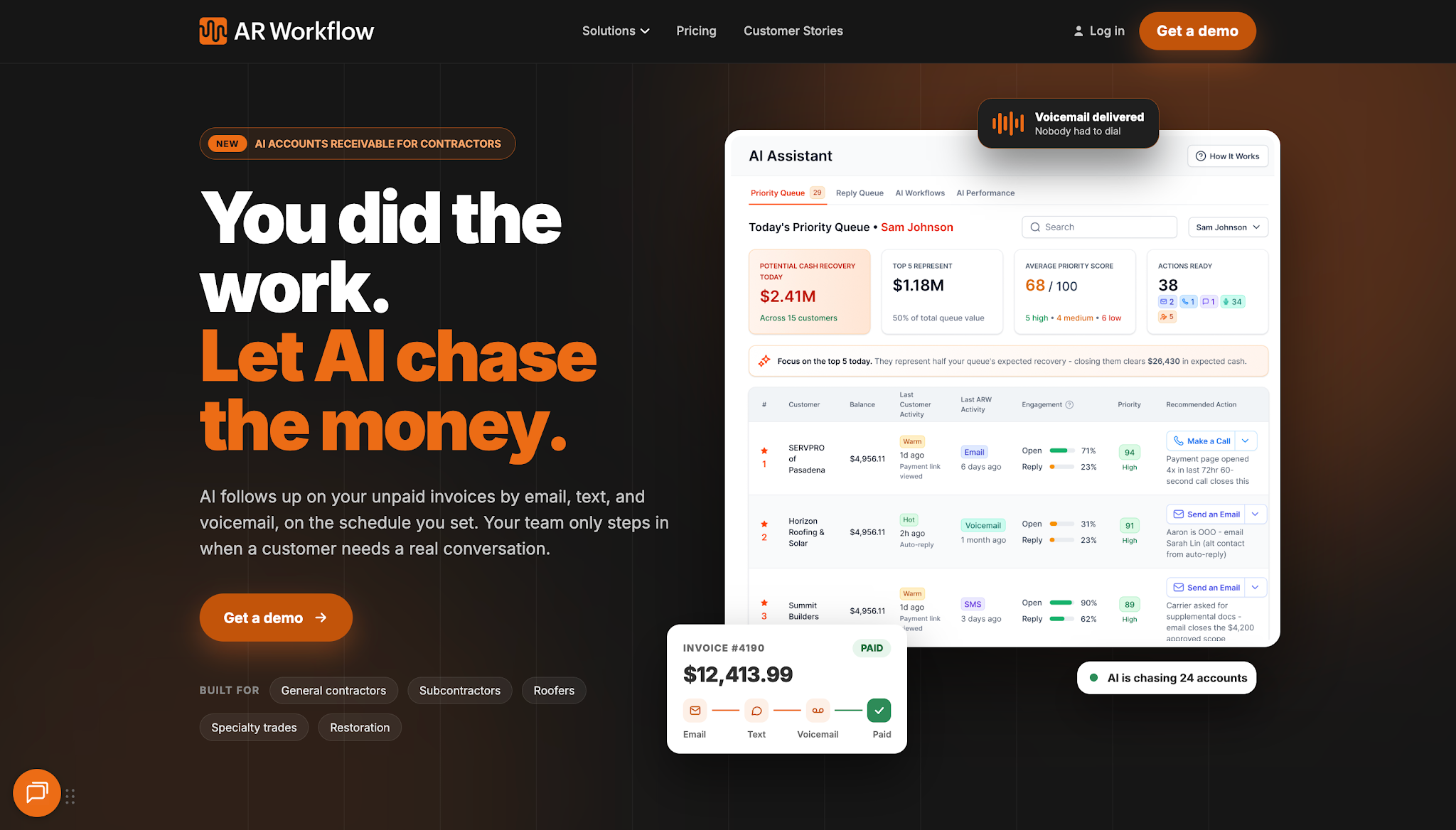
These strategies improve collections, but keeping them up takes time, especially as your business grows and handles more invoices. Software that connects to your accounting system can run the repetitive parts without adding work to your team.
AR Workflow is accounts receivable software that helps restoration companies and other contractors put this into practice through accounts receivable automation, starting with how they follow up on outstanding invoices.
You can create custom collection workflows and schedule email or SMS reminders, with texts sent from a dedicated number, based on your preferred follow-up schedule. Your team doesn't have to contact every customer by hand or keep track of reminder dates.

Collection workflows schedule each reminder automatically.
AR Workflow also keeps a record of customer communications and payment activity. When someone on your team reviews an overdue invoice, they can see previous conversations and decide what to do next.

Dashboards show where outstanding receivables stand and where to focus.
Beyond individual accounts, dashboards and reports show overall outstanding receivables and where your team should focus its collection efforts. When customers are ready to pay, a secure online payment portal gives them a convenient way to settle their invoices.
Knowing which accounts receivable strategies improve collections is a start. The real difference comes from applying them consistently so your business collects what it is owed without spending more time chasing it.
Your business has already invested time and materials to earn that revenue. The longer it takes to collect, the longer you wait to put that money back into your operations. A consistent process keeps payments moving and gives your team more time for the work that grows the business.
Send invoices promptly, set clear payment expectations before work starts, and follow up consistently on a set schedule. Review your aging report weekly and automate repetitive reminders so nothing slips.
The core best practices are written payment terms, same-day invoicing, multiple payment options, a reminder schedule that starts before the due date, weekly aging review and a clear escalation path. Tracking DSO and the share of balances over 90 days tells you whether they are working.
The five Cs are character, capacity, capital, collateral and conditions. Businesses use them to evaluate a customer's creditworthiness and ability to pay before extending credit.
The 10% rule is a commonly cited guideline suggesting that invoices more than 90 days overdue stay below 10% of total receivables. It isn't a universal standard, and appropriate targets vary by industry and payment terms.
Review your aging report at least weekly, and look at DSO and other trends monthly. Weekly review catches slipping accounts while a phone call can still fix them.
Establish clear payment terms, send accurate invoices on time and monitor outstanding balances regularly. Consistent follow-ups and prompt handling of disputes keep invoices from becoming seriously overdue.
Related reading
Your invoice, not a feature tour.
Bring one overdue invoice to a demo and see what AR Workflow would send, when, and how your customer would pay.
Sam owned and ran three restoration companies for more than 14 years and collected over $100 million in receivables. He built AR Workflow in 2020 to give contractors the collections system he wished he'd had.

AI writes the emails, sends the texts, and leaves the voicemails. Your team handles the conversations that matter, and your cash keeps moving.
 Keep QuickBooksStart with one invoiceStay in control

 Log in