How to deal with insurance adjusters on restoration claims: what a claims adjuster does, the adjuster types, negotiation steps and what not to say.


Knowing how to deal with insurance adjusters is as important to a restoration business as doing great work. On insurance jobs, getting paid quickly and consistently depends on working with insurance adjusters efficiently and strategically, from the first inspection to the final supplement.
It is easy to get caught up in the grind of running your restoration business. But one thing can make or break it: your ability to navigate the payment process. And that depends on how well you collaborate with adjusters. This guide covers the types of adjusters you will meet, how to prepare for an inspection, how to negotiate with an insurance adjuster, and what not to say when a claim gets tense.

Insurance adjusters are the people standing between you and your payouts. If you crack the code of working with them, you open the door to faster payments, fewer disputes and a much smoother claims process, which is a foundation for sustainable growth and reliable income. Here are five insurance adjuster tips for contractors that you can put to work on your next claim.
KEY TAKEAWAYS

| 1 | Know the role of the insurance adjuster |
| 2 | Be the professional they want to approve |
| 3 | Master the art of documentation |
| 4 | Handle disputes like a professional |
| 5 | Use technology to win the game |
A claims adjuster is the person an insurance company relies on to investigate a claim, decide how much of the loss the policy covers, and settle it. On property claims, "claims adjuster" and "insurance adjuster" mean the same job. The U.S. Bureau of Labor Statistics groups adjusters with appraisers, examiners and investigators, and describes the work as evaluating insurance claims to decide whether the insurer should pay and how much (BLS Occupational Outlook Handbook). Most states license adjusters, and the rules vary by state.
For a restoration contractor, the claims adjuster is the person who decides whether your scope and pricing are accepted. That makes them the most important reader of every estimate, photo log and invoice you send. Knowing what they are responsible for tells you what to give them and when.
Day to day, insurance adjuster responsibilities on a restoration claim usually include:
On larger losses the adjuster often recommends payment and a claims examiner or supervisor approves it, which is one reason big claims take longer. Claim checks are usually made out to the policyholder, sometimes with the mortgage lender named too, so your invoice and follow-up for the balance go to the homeowner. Send adjusters documentation and status updates, not payment requests. For mitigation jobs, our walkthrough of water mitigation adjuster billing shows what to submit and when.
Three types of adjusters cover most claims you will see:
"Desk" and "field" describe where an adjuster works rather than who employs them: a desk adjuster reviews the claim remotely, a field adjuster inspects on site. The table in Strategy 1 shows what each type means for your documentation. If you bill the carrier directly under an assignment of benefits or direction to pay, our guide to direct insurance billing covers the steps, and rules on those agreements vary by state.
Get a head start on your competitors by getting crystal clear on what an insurance adjuster's role is and why it matters to you.
Adjusters have one core mission: protect the insurance company's financial interests.

Adjusters are always on alert for fraud. It is part of their profession, and it is why they scrutinize every detail of a claim. They need to verify that the work was done, that the charges are fair, and that no invoice is padded. It is not personal. It is their job.
That means they are constantly checking that claims are legitimate, work was completed as stated, and every charge is justified. They are trained to be skeptical, and they will approach you and your work with scrutiny and a desire for a clear project narrative. Once you know that, you are no longer blindsided when they question your invoices or ask for more proof.
Instead, you expect it. Rather than getting defensive, you are ready to make their lives easier, and that makes your project move faster. Adjusters are not out to make your life harder. They are doing their job. This small shift builds trust that speeds up your process.
Your job is to make it as easy as possible for them to say "yes" to your claim. The rest of these strategies show how. For the payment side, see our guide to speeding up payments from insurance adjusters.
On a typical water, fire or mold loss, the adjuster confirms the policy covers the cause of loss, inspects the damage (in person, by photo, or both), reviews your estimate and documentation, decides what scope and pricing the carrier will accept, and approves payment. On larger losses they may also order a reinspection or ask for moisture logs, drying records and invoices from subcontractors before they release funds.
Not every adjuster works for the carrier, and not every adjuster will ever visit the job. Knowing who you are talking to tells you what they need and how fast they can move.
| Adjuster type | Who they work for | What it means for you |
|---|---|---|
| Staff adjuster | The insurance company, as an employee | Follows carrier guidelines closely. Clear, guideline-friendly documentation moves fastest. |
| Desk adjuster | The carrier, working remotely | Never sees the loss. Your photos, sketches and moisture readings are the whole story. |
| Field adjuster | The carrier or an adjusting firm, on site | Inspects in person. Be there, walk the loss together, and agree on scope before you leave. |
| Independent adjuster | An outside firm hired by the carrier | Common after storms. Often carries a heavy caseload and reports to a carrier examiner who approves payment. |
| Public adjuster | The policyholder, usually for a percentage of the settlement | Advocates for the homeowner. Coordinate on scope, but your contract is still with the homeowner. |
The public adjuster vs insurance adjuster question comes up on most large claims. The carrier's adjuster (staff, desk, field or independent) works for the insurance company. A public adjuster is licensed to represent the policyholder. Contractors should be careful not to drift into that role: the Texas Department of Insurance, for example, states that Texas does not allow a contractor to act as a public adjuster on a claim where they are also doing the work. Rules vary by state, so check with your state's department of insurance before you negotiate a claim on a homeowner's behalf.

Decide to be the restoration professional insurance adjusters love working with. That starts with setting your business tone, bringing respect to every interaction, prioritizing clear communication, and being aware of their time constraints.
From the first email to the final payment, it is up to you to set the tone. Decide which words you want an adjuster to associate with your company, such as prompt, accurate and easy to work with, then act like that on every call, email and site visit.
Tip: Do a quick branding exercise to define your brand's tone of voice and style. Then use it everywhere.

Every call with an adjuster is a chance to show you are organized and prepared.
Treat adjusters with respect and you will see a real shift in your interactions. Show that you understand their responsibilities and respond to their requests promptly. When you send complete, accurate documentation from the start, you are telling the adjuster: "I'm a professional. I respect your work. And I know what I'm doing."
When you show up organized, proactive and timely, your adjuster will trust you faster. And when adjusters trust that you respond promptly with exactly what they need, they are more likely to move your claim along. Watch the relationship move from contention to collaboration.
Keep adjusters informed throughout the project. Do not just submit a claim and disappear. Give them updates as the work progresses, let them know about changes or unexpected issues, and make sure they are not surprised when the final invoice lands on their desk.
If you keep the lines of communication open, you are not just another contractor in their pile of claims. You are a trusted partner making their job easier, and when it is time to approve your claim, that rapport makes a real difference. Try it for yourself. Our communication tips to get paid faster can help.

Tip: AR Workflow is an accounts receivable platform designed to help restoration professionals streamline their workflows. Use it to log every communication and document every interaction, so the project stays transparent and organized from day one. If a dispute comes up, you have a clear record of what was discussed.
Along with showing respect, help adjusters move quickly by being aware of the time pressure in their work. Adjusters are always working against the clock and juggling many claims besides yours. Be responsive, be proactive, and get them what they need fast. The easier you make their life, the faster they move on your claim. When you respect their time, they respect yours.

Documentation is the foundation of a smooth claims process. Master it and you set yourself up for faster payouts and fewer disputes with the adjuster. Here are three steps.
Commit to thorough, clear documentation. Any time a project advances, document it. Capture everything, label photos clearly, and keep plenty of visual proof. Photos, detailed descriptions of the work performed and a breakdown of costs are not extras. They are essentials that speed up approval and smooth out your relationship with the adjuster.
Here is the truth: you are never just submitting paperwork. You are building a case.

Every invoice, photo and communication is part of a bigger picture that tells the adjuster, "This work was necessary, done right, and fully justified." It can feel tedious, but meticulous documentation speeds up your process and changes the relationship. When you deliver everything without the adjuster having to dig, you build trust and speed up payment. See our guide to restoration documentation in 7 steps to level up.
Photos are your undeniable proof that the work was done, and done right. Take photos before, during and after the job. Every time the project progresses, take a photo. (Yes, that might mean every day.) Label them, organize them by date, and make sure they tell a clear story of the work. This is the evidence that helps adjusters move your claim forward.

With AR Workflow, uploading, organizing and sharing these photos is simple. Everything is stored securely and ready the moment an adjuster needs proof, so you spend less time sorting through files.
The site inspection is where most scope disagreements start or end. Treat it like a meeting with an agenda, not a walk-through you happen to attend.
CHECKLIST
Adjuster meeting checklist
That recap email matters more than anything said on site. It turns a verbal agreement into a dated record you can point to if the scope changes later. Our guide to collecting from carriers, adjusters and homeowners shows how that record carries through to payment.
Adjusters are always watching for overbilling. They do not want to pay for inflated charges or services that were not performed.
Break down your invoices, show exactly what you did, and explain why it was necessary. Explain every service, every material used and every hour worked. The more detailed you are, the fewer questions adjusters will have and the faster they can approve your claim. Our insurance adjuster invoice guide shows how.

When adjusters see that you have justified every cost, you make it easy for them to approve without hesitation. Remove the barriers and your whole project timeline speeds up. Transparency with adjusters is your greatest asset: give them everything they need upfront.
AR Workflow lets you organize your invoices, photos and reports clearly, making it easy for adjusters to say yes.
Tip: Send adjusters and carriers documentation and status updates, not payment requests. Payment links belong with the homeowner for their deductible or balance, never with an adjuster or carrier.
Bring one overdue invoice.
We'll show you how AR Workflow keeps the adjuster file and homeowner follow-up organized.

Even when you do everything right, disputes can happen. The key to resolving them is to stay calm, stay professional, and always be prepared.
Disputes are frustrating, but getting defensive will not get you paid faster. Stay calm, provide the documentation they need, and focus on the solution. When you handle disputes professionally, you show the adjuster you are someone they can work with, not against. Dealing with insurance adjusters gets easier when every reply is calm, specific and backed by a document.

Sometimes you will need to negotiate to reach a solution. Stay flexible, but protect your business. If necessary, escalate the issue to the adjuster's supervisor or the claims department. Just make sure you have documented everything. With AR Workflow, tracking these interactions is simple.
Most negotiations are about a short list of line items, not the whole estimate. Work through them one at a time:
If the cuts are coming from price list adjustments, our post on insurance price reductions explains why it happens and how to bill so it happens less.
TEMPLATE
Supplement request email to an adjuster
Subject: Claim [number], [property address]: supplement for [items]
Hi [Adjuster name],
Thanks for your time on site on [date]. Attached is our supplement for the items we discussed: [line items]. For each one we have included dated photos, [moisture logs / supplier invoices / code reference], and a short note on why the work was necessary.
Could you confirm what else you need to review these, and when we can expect a decision? I'm available at [phone] if a quick call is easier.
Thanks, [Name], [Company]
Tension is normal on a disputed claim. A few phrases reliably make it worse, and a calmer version usually gets you further.
| Avoid saying | Say instead |
|---|---|
| "Your number is ridiculous." | "Can we go through the items where our estimates differ?" |
| "The homeowner told me it's covered." | "Here is the damage we found and the cause we documented." |
| "We always charge this." | "Here is the supplier invoice and labor breakdown for this item." |
| "I'll negotiate the claim for the homeowner." | "I can answer any questions about our scope and pricing." |
| Guesses about dates, causes or quantities | "Let me check my notes and send that to you in writing today." |
We designed AR Workflow to track, consolidate and organize every step of the process. Support your team with consolidated communication and clear documentation, and lose less time and money to disorganization or human error.

Think of the adjuster's approval as the final boss in a video game. Once you have earned their trust, you have won the level, and the payout is yours. The faster you give them what they need, the faster you unlock payment. That is the win to optimize for.
Every interaction and every document should be focused on making the adjuster's job easier. Respond quickly. Do not be argumentative. Be extra clear in your documentation. Keep disputes impersonal. Do that, and you change your relationship with adjusters and speed up dispute resolution and cash flow. Our restoration insurance billing guide covers the claim side in depth.

Technology is your secret weapon for collaborating with adjusters. Tools like AR Workflow streamline the process, making it easier to document, communicate and manage claims. See how it fits a claims-heavy business on our AR Workflow for restoration page.
When you use technology to stay organized and proactive, you are not just improving how you communicate with adjusters. You are setting your business up for long-term success: saving time, improving the quality of your admin work, and becoming the restoration professional adjusters in your area appreciate working with.
AR Workflow has centralized communication built in. Collect and sync all customer communications, whether emails, SMS messages sent from a dedicated number, or phone call notes, in one system. Any team member can review the full history with a customer, which removes confusion and duplicate follow-ups. If you are on QuickBooks Online, see our QuickBooks accounts receivable automation guide.

With AR Workflow you can centralize communication, documentation and follow-up.

Plenty of people in our industry can make your projects harder. Adjusters do not have to be one of them. Instead of approaching this critical relationship as adversarial, think of the adjuster as an untapped ally.
Use the five strategies to do just that: know their role and see the project from their point of view, stay professional, master documentation, stay professional in disputes, and use technology. Do all of that and you are on your way to faster approvals.
This is your moment. Take control of your collections process, build those relationships with adjusters, and work toward faster payments, smoother operations and stronger cash flow.
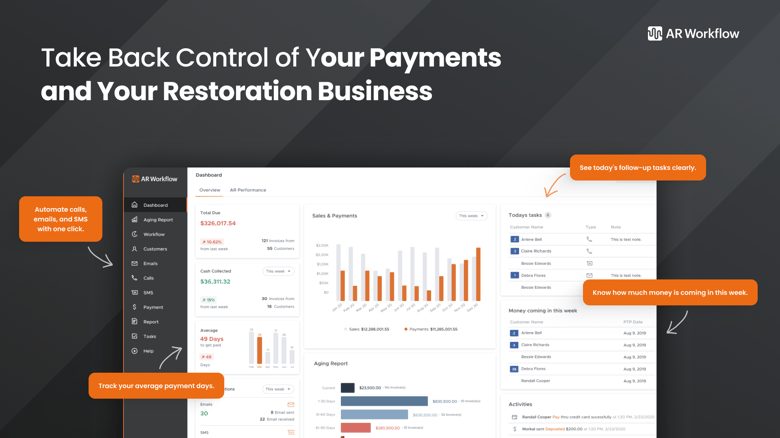
AR Workflow keeps claims communication and collections in one place.
Carriers and mortgage companies may shape when restoration payments arrive, but that does not mean you have to be at their mercy. By understanding their processes, building strong relationships, streamlining your operations and managing your cash flow, you can take back control of your payments and your business.
This is your business. Rise above the challenges, take control of the process, and create room for growth.
A claims adjuster investigates an insurance claim for the insurer: they confirm coverage, inspect the damage, write or review the estimate, and recommend how much to pay. Staff and independent adjusters work for the carrier. A public adjuster works for the policyholder.
Verifying coverage, investigating the loss, estimating the damage, reviewing contractor estimates and supplements, and recommending payment. On a restoration invoice they look for proof that the work was necessary and completed as described, fair pricing, and no padding. Itemize every service, material and hour, attach photos and receipts, and get written approval for any scope changes.
Understand that the adjuster's job is to protect the carrier's financial interests, then make approval easy: communicate throughout the job, respond quickly, and submit complete documentation with photos and itemized invoices from the start. To speed up payment, answer requests the same day, keep a log of every conversation, and follow up with the homeowner separately for their deductible or any balance they owe. Automated payment reminders can handle that homeowner follow-up.
An insurance adjuster (staff, desk, field or independent) works for the insurance company and evaluates the claim on its behalf. A public adjuster is licensed to represent the policyholder and is usually paid a percentage of the settlement. Licensing rules vary by state.
A contractor can explain and support their own scope and pricing. Negotiating the claim itself on the policyholder's behalf is restricted in some states: the Texas Department of Insurance, for example, says contractors cannot act as public adjusters on jobs they are working. Rules vary by state, so check with your state's insurance department.
Stay calm, ask exactly what they need, and send the supporting documentation. Negotiate where it makes sense. If you cannot reach agreement, escalate to the adjuster's supervisor or the claims department, with every interaction documented.
Related reading
Your invoice, not a feature tour.
Bring one overdue invoice to a demo and see what AR Workflow would send, when, and how your customer would pay.
Sam owned and ran three restoration companies for more than 14 years and collected over $100 million in receivables. He built AR Workflow in 2020 to give contractors the collections system he wished he'd had.

AI writes the emails, sends the texts, and leaves the voicemails. Your team handles the conversations that matter, and your cash keeps moving.
 Keep QuickBooksStart with one invoiceStay in control

 Log in