Late payments drain contractor cash flow. See the common causes of payment delays, what they cost, and a step-by-step plan to get paid on time.


If you're running a restoration or contracting business, you're likely dealing with late payments from customers, and odds are, those delayed payments are strangling your cash flow.
If you're like most restoration business owners, you've surely had nights where you lay awake thinking, "How am I going to cover payroll? How am I going to keep the lights on?"
Delayed payments are where we do most of our consulting. These delinquent checks don't have to be a keep-you-up-at-night challenge. They can also be an opportunity. Discover how to stop playing defense and start playing offense.
With the right strategies, mindset, and focus, you can take control of your cash flow and crush these big threats to your business. Read on to discover the true cost of late payments, the four actual causes of delayed payments, the other common payment delays that catch contractors out, a step-by-step plan for handling late payments from customers, what to know about late fees, and how to prevent the next one.
KEY TAKEAWAYS
Delayed payments don't just impact your bottom line. Their impact goes far beyond.
When your cash flow is disrupted, it kicks off a chain reaction that touches every corner of your restoration business. Here's the full and often unseen chain reaction of delayed payments for a restoration business:

Think about it. You're running a restoration business: delivering value, growing your brand, and making moves that count. What happens if the money you're owed isn't flowing in when it should? Everything stalls.
Let's skip that payment train wreck and instead start being clear in our payment terms. If you don't, here are the five ripple effects you're likely to see:
| Ripple effect | What it looks like |
|---|---|
| 1. Operations grind to a halt | Inventory delays, project postponements |
| 2. Employee morale takes a hit | Payroll stress, cuts and layoffs |
| 3. Missed opportunities | Growth on hold, playing it safe |
| 4. Compromised financial strategies | Dipping into reserves, borrowing, interest eating profits |
| 5. Your reputation takes a hit | Credit strain, lost credibility |
When cash isn't flowing, everything slows down. You can't buy materials, hire staff, or pay your bills on time. Every part of your business feels it. You're forced to juggle payments, delay projects, and stretch your financial resources to their breaking point. The first two major steps of this domino fall are:
Inventory delays: No cash means you can't restock supplies or buy new equipment. And without inventory, your business simply stops.
Project postponements: If you don't have the cash to fund new projects or maintenance, you have to push back timelines, putting your business at risk of falling behind on already promised payments.

As operations slow, this downturn can also impact your employees. If your team sees that the company is struggling to make payroll or cover expenses, it creates anxiety and uncertainty, most often experienced as:
Payroll stress: When cash flow gets tight, payroll becomes a stress point. Your team relies on that paycheck, and any sign of instability can lead to fear, frustration, increased smack-talk, and decreased morale.
Cuts and layoffs: When cash runs dry, tough decisions need to be made, like cutting hours, delaying raises, or even laying off employees. This sends shockwaves through your organization, damaging trust, loyalty, and productivity.

As momentum and morale stall, you also start to slow on growth. I know you know what I'm talking about.
How many opportunities have you missed because your cash was tied up in overdue payments?
How many times have you passed on a growth opportunity because you didn't have the funds to invest?
We've been there too. Here's what often happens:
Growth on hold: When you're waiting for cash that's tied up in accounts receivable, it's impossible to invest in the future. You can't hire the team you need, you can't invest in new equipment, and you can't scale your business. Simply put, you miss out.
Playing it safe: Cash flow problems force you into a scarcity mindset. Instead of making bold moves, you play it safe. You're focused on surviving instead of thriving, and that's not the mindset of a leader. You're not growing, and in fact, you're shrinking. This starts your death spiral of degrowth.

When you're stuck waiting for payments, you then may turn to borrowing to cover expenses. It's a quick fix, but it's also a dangerous cycle. The more you borrow, the more interest you pay, and the more you're spending to just stay in the game. Here's what that often looks like:
Dipping into reserves: When cash isn't flowing, you might dip into savings or emergency funds. And once those are gone, you start borrowing, which means you're paying interest and fees, and increasing your stress levels. You're on a slippery slope to a compromised business, and every act of borrowing sinks you deeper.
Short-term relief, long-term pain: Borrowing feels like relief at first. It gives you breathing room. But over time, those debts pile up, and suddenly you're working overtime just to pay off the money you borrowed to cover someone else's truancy. It's time to stop putting yourself in these dilemmas. They're not how you win in the restoration business.
Interest eats into profits: Every loan, every line of credit you take out to cover delayed payments eats into your profits. You're losing money just to keep the doors open. And the longer you don't get paid, the deeper you're in the hole. Our guide to unlocking your cash flow covers the alternatives.

Your reputation is everything. If word spreads that your business is struggling with cash flow, it can impact your relationships with suppliers, customers, and lenders. Down-chain impacts include:
Credit strain: If delayed payments cause you to miss payments to your suppliers, it can strain those relationships. Suppliers may tighten credit terms, demand prepayments, or even refuse to do business with you.
Lost credibility: If customers or partners start hearing that your business is financially unstable, it can scare away potential deals. That kind of reputation can stick, and it's hard to shake.
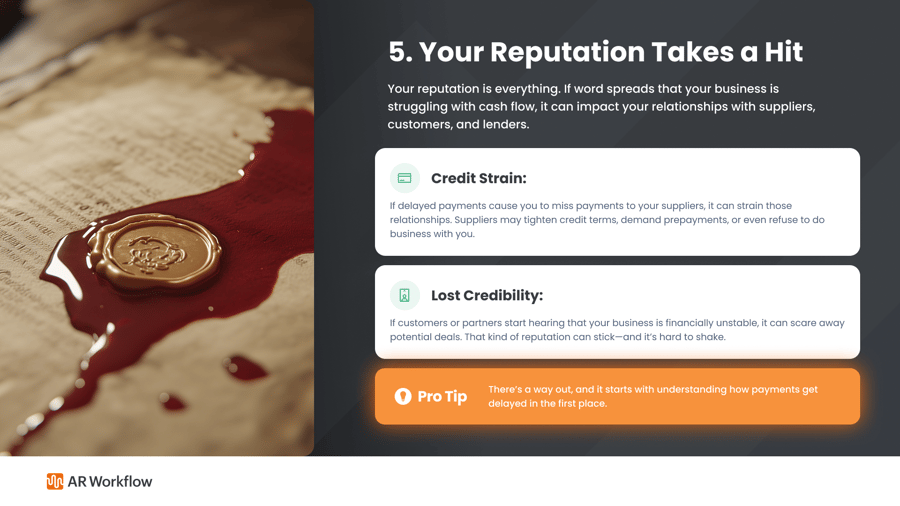
Here's the bottom line: delayed payments are costing you more than money. But the good news? There's a way out, and it starts with understanding how payments get delayed in the first place.

| 1 | Inaccurate invoices |
| 2 | Customer bureaucracy |
| 3 | Calendar holidays and events |
| 4 | Customer cash flow issues |
One of the biggest reasons payments get delayed is because there are errors in the invoices YOU send out. That's right: something as simple as a typo can cost you weeks of delays.
Customers often use any excuse (or error) to delay payment. Make sure everything's right before they release the funds. Don't let your inaccuracies cost you.
Beyond that, if your invoice doesn't clearly state the terms, project details, or amounts due, you're giving your customer an excuse to pay on their schedule instead of yours. Include your payment terms on every interaction and check twice that all the information necessary for payment is there before sending. Accelerated payment awaits. Our restoration invoice template covers every field.
If you're dealing with large organizations or government customers, you know how frustrating their internal approval processes can be. Every invoice needs to go through multiple layers of approval before it even gets to the person who cuts the check.
To stop getting flummoxed by multiple approvals, build your project timeline to account for delays. Analyze the time previous projects requiring the same level of approval needed and build that timeline or level of delay into your current project.
Even if you do everything right, internal delays, like vacations, staff turnover, or corporate policies, can hold up payment for weeks or even months.
To not get delayed by the annual calendar, analyze what your average seasonal project delay is and start building it into your projects. Separately, account for holidays and high-vacation time periods and shift your timeline accordingly.
Aim to be accurate rather than optimistic. Bulletproof your projects by planning ahead.
Just like you, your customers are dealing with their own cash flow challenges. If they're experiencing financial difficulties, they might delay your payment to manage their own issues.
When cash is tight, customers will prioritize who they pay first. Make sure you're not at the end of their list.
To avoid deprioritization, make sure your payment terms and penalties are listed out clearly on every communication and that you've kept social capital high in the relationship. By being pleasant to work with and clear about the consequences, you're more likely to get paid first.
Clear terms are the foundation. We cover late fees and how to write payment terms customers follow later in this guide.
Tip: Diversify your client portfolio.
If your business relies on a small number of high-revenue customers, their financial struggles can become your financial struggles. That's why you need to stay ahead of their issues and manage your risk.
Diversify your customer portfolio with a variety of customers. Have you noticed a certain type of customer often pays late? Make sure at least 30% of your customer portfolio is steady, well-paying customers at any given time.
The four causes above do most of the damage, but they are not the only reasons payments are delayed. These smaller contractor payment problems show up in almost every trade, and each one has a simple fix.
| Payment delay | Why it happens | Fix |
|---|---|---|
| Invoice sent late | The office waits for the end of the month or for a quiet afternoon | Invoice the day the job or milestone is complete |
| Unclear payment terms | The customer does not know when payment is due or what "net 30" starts from | Put the due date, not just the terms, on every invoice |
| Wrong contact | The invoice went to the site contact, not the person who pays | Confirm the billing contact and their email before the job starts |
| Hard to pay | Check only, or no payment instructions on the invoice | Add a card and ACH payment link for homeowners and small commercial customers |
| Deductible not collected | The homeowner assumes insurance covers everything | Explain the deductible at the start and invoice it separately |
| Supplements pending | Extra scope is waiting on carrier approval, and the whole invoice sits with it | Bill the approved scope now and track the supplement on its own |
| Several parties on one check | The carrier, the owner and a mortgage company each work on their own clock | Name every signer early, give each clear instructions and track each signature |
| No reminder | Nobody follows up until the invoice is 60 days old | Send the first reminder before the due date and follow a fixed schedule after it |
On insurance work you often wait on the carrier, the property owner and a mortgage company at the same time. Anyone can drop the ball, so keep it moving yourself:

Now that you know what's causing delayed payments and the impact they have on your business, it's time to get to work.
Here's how to take control, build a system that works for you, and create a cash flow that's as strong as your drive to succeed. Discover how to simplify, be proactive, reward good behavior, and manage disputes:
Your invoicing process is the foundation of your cash flow. If you're not sending clear, accurate, and timely invoices, you're leaving money on the table. Here's what to do to invoice better:
Clear payment terms: Every invoice should include clear payment terms. Make sure your customers know exactly when payment is due, what penalties exist for late payments, and how they can pay you. Remove the guesswork, and you'll remove delays.

An aging report shows which invoices are slipping.
Double-check everything: Before you send out an invoice, make sure it's accurate. Every detail needs to be correct: the billing amount, the due date, the terms, everything. The fewer errors, the fewer excuses for your customer to delay payment.
One of the best ways to ensure you get paid on time is to stay in regular communication with your customers. Don't wait until the payment is late. Be proactive. Here's how:
Automated reminders: Set up automated reminders to notify customers when their payment is due. Use tools like AR Workflow to automate these reminders and keep payments top of mind for your customers.
Personalized follow-up: If an invoice is overdue, don't rely solely on email. Pick up the phone and have a conversation. Personalized follow-up shows that you're paying attention and that you're serious about getting paid. Our 5 communication hacks to get paid faster show how.
Incentivize your customers to pay early by offering small discounts for prompt payments.
Early payment discounts: A 1-2% discount for early payment can be a powerful motivator for customers to settle their invoices quickly. It's a small price to pay for consistent, reliable cash flow.

Customers can pay by card or ACH through the payment portal.
Disputes happen, but they don't have to derail your payments. By addressing disputes quickly and professionally, you can keep the payment process on track.
Clear dispute process: Have a clear, documented process for handling disputes. Make sure both your team and the customer know what to do if a disagreement arises.

Track disputes so they get resolved, not forgotten.
Quick response: Resolve disputes as quickly as possible. The faster you handle the issue, the faster you get paid. If a dispute turns into a customer who won't pay at all, see our guide to unpaid invoices.
Fixing the causes cuts down on delayed payments, but some invoices will still run late. When they do, use the same escalation schedule every time. A consistent plan is easier for your office to run, feels fair to customers, and leaves a clean record if you ever need to escalate.
| 1 | Before the due date. Send a friendly reminder a few days before the invoice is due, with the invoice attached and a way to pay. Most late payments start as forgotten invoices. |
| 2 | On the due date. Send a short note that the invoice is due today. Keep it neutral: no blame, just the amount, the invoice number and the payment link. |
| 3 | 3 to 7 days late. Follow up by email and text, then call. Ask a direct question: is anything holding this up? This is where you find the wrong address, the missing document or the dispute. |
| 4 | 14 days late. Send a firmer message to the decision maker, restate your terms, and ask for a specific payment date or a written payment plan. |
| 5 | 30 days late. Send a formal letter. Our past due invoice letter templates give you wording for each stage. |
| 6 | 45 to 60 days late. Send a final notice that states the next step, such as a lien, small claims court or a collection agency, and follow through. Check any lien deadlines well before this point, because they vary by state. |
Running this schedule by hand on every open invoice is where most offices fall behind. Automated payment reminders send the early steps for you and stop when the customer pays, so your team can spend its time on the calls that need a person.
Tip: On insurance jobs, split the follow-up. Ask the adjuster or carrier for claim and payment status, and send payment reminders and the payment link only to the homeowner for their share, such as the deductible. Never send a payment link to an adjuster or carrier.
Template
Subject: Invoice [number] for [job address] is now [X] days past due
Hi [Name],
I'm following up on invoice [number] for [amount], which was due on [date] for the work at [job address]. I haven't seen a payment come through yet.
If something is holding it up, such as a question about the invoice or a missing document, just reply and I'll sort it out today. Otherwise, you can pay by card or bank transfer here: [payment link].
Could you let me know when we should expect payment?
Thanks,
[Your name]
[Company] | [Phone]
Template
Hi [Name], this is [Your name] from [Company]. Invoice #[number] for [job address] was due on [date] and still shows $[amount] open. Is anything holding it up on your end? If it helps, you can pay all or part of it here: [payment link]. Just reply with a date that works.
Use this version for homeowners and property owners. For an adjuster or carrier, ask for the claim status and what documents they still need instead.
A late fee can change a customer's habits, but only if you have the right to charge it and you apply it consistently. The rules are set by your contract and by state law, so treat this as general information, not legal advice.
Check your state's rules, or ask an attorney, before you add a late fee to your terms. Our guide to contractor payment terms shows how to write terms customers understand.
The cheapest late payment to collect is the one that never happens. Most of the prevention work happens before the first invoice goes out:
Run this checklist on every job:
| When | What to do |
|---|---|
| Before the job | Agree on payment terms in writing, confirm who pays and how, explain the deductible on insurance work, and collect the paperwork the payer will need, such as a signed work authorization. |
| During the job | Document the work with photos and notes, get change orders signed before doing extra work, and keep the customer updated so the invoice is no surprise. |
| At invoicing | Double-check line items against the scope, attach supporting documents, show the due date and include a payment link where it fits. |
| After invoicing | Confirm receipt, send a reminder before the due date, follow up on a fixed schedule after it, and log every contact. |
Bring one overdue invoice.
We'll show you how AR Workflow would keep it from slipping any further.
Payment tracking means logging every payment-related contact with a customer, including emails, calls, texts and payment status updates, so you always know where each invoice stands. It adds a little work, but it moves you from reacting to planning.
| Benefit | What it means |
|---|---|
| Cash flow control | A real-time view of what you are owed and when it is coming lets you plan ahead instead of scrambling. |
| Less office time | Automatic logging tied to payment status saves time and keeps follow-up moving. |
| Stronger customer relationships | Anyone on your team can see the history, so customers never get the same question twice. |
| A clean record | If a payment turns into a dispute, a documented history of every contact is your best support. |
Review your aging report every week to see which invoices are furthest overdue, and look for the same delays showing up on the same customers or job types. Fix the step that causes them.

When you take control of delayed payments and master your cash flow, everything changes. You're not just building a more resilient business. You're building a future-proof business that's ready to scale and grow.
Here's what you have to look forward to:
Consistent cash flow: With a solid receivables process in place, cash flow will become predictable and reliable. You'll have the resources to cover your expenses, fund new projects, and grow your business without stress.
Stronger relationships: When you manage your payments proactively, you strengthen relationships with customers, suppliers, and lenders. They'll see that you're a professional, reliable partner, someone they can trust.
More freedom, more growth: With cash flow under control, you'll have the freedom to focus on what really matters: growing your business and taking it to the next level.

Emails, texts and call notes in one customer history.
Sound good? Here's a tool we've designed to support you in your success: AR Workflow. AR Workflow is restoration accounts receivable software, a payment and workflow management tool we've designed specifically for our industry. With AR Workflow you can:
Simplify payments
Customers can pay directly through AR Workflow's payment portal, either by credit card or ACH bank transfers. This reduces friction for customers, enabling faster payments. Businesses can track payments in real-time, and the portal syncs directly with QuickBooks, keeping records up to date without manual intervention. It also supports flexible payment options such as full payments, installments, or subscriptions.
Centralize communications
Collect and store all customer communications, whether they're emails, SMS messages, or phone call notes, in a centralized system. Ensure that any team member can easily review the history of communications with a customer, eliminating confusion or duplicated follow-ups. Save time and build professional uniformity with integrated templates. Log and access all messages, regardless of the platform used, in one location.
Automate reminders
Automate your entire accounts receivable process, eliminating the need for manual intervention. This frees your team to focus on higher-level tasks. Automatically follow up with customers, send reminders (texts go out from a dedicated number), and update records to reduce workload and boost overall efficiency.
Monitor accounts
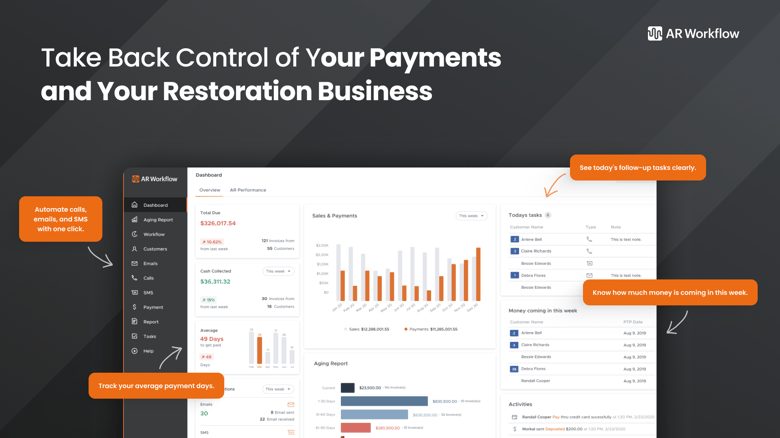
Enjoy a comprehensive, user-friendly view of your accounts receivable operations. Access real-time data on active customers, total amounts due, cash collected, and open invoices. Monitor financial health at a glance, reducing the need for manual checks or data consolidation from multiple sources. Beyond that, you can track key metrics like average payment speed, allowing managers to make informed decisions to enhance collection strategies.
AR Workflow connects to QuickBooks Online, so invoices, payments and follow-up stay in sync without re-keying.

Late payments don't have to control your business. Accurate invoices, clear terms, a consistent follow-up schedule and a fair dispute process turn delayed payments from a monthly crisis into a routine your office can run.

The four most common causes are inaccurate invoices, customer bureaucracy and approval layers, holidays and internal events, and customers' own cash flow problems. Insurance and mortgage company involvement can add more steps, because each party has its own approvals before money moves.
Put clear terms and penalties on every invoice, automate reminders before and after the due date, call when reminders go unanswered, and consider a small early payment discount to change the habit. If the balance is still open after that, send a formal past due invoice letter before you think about collections.
A 1-2% discount for early payment can be a powerful motivator for customers to settle invoices quickly. Weigh the discount against the cost of waiting or borrowing to cover the gap.
Invoice promptly and accurately, review your AR aging report weekly, follow up consistently, and avoid relying on a few large customers so one late payer cannot stall the business.
Start early. Identify every party who must sign, send clear instructions to each, track the status of each signature, and follow up on a set schedule. Build extra time for endorsements into your project timeline.
Keep it short and specific: the invoice number, the amount, the due date, and a direct question about what is holding it up. Offer an easy way to pay and ask for a date. A question gets a reply far more often than a reminder that only repeats the balance.
Payment tracking is monitoring and documenting every payment-related interaction with a customer, including emails, calls, texts and payment status updates, so you always know where each invoice stands.
Usually only if the fee was part of the agreed terms before the work started, and only within the limits your state allows. Many states cap interest rates, and rules for consumer accounts can be stricter. Check your state's rules or ask an attorney before adding late fees to your terms.
Once you have followed a consistent schedule of reminders, calls and a formal letter, often around 60 to 90 days past due, and the customer has stopped responding or broken a payment plan. Before you hand it off, check whether a lien deadline applies, since those rules vary by state and can expire first.
Related reading
Your invoice, not a feature tour.
Bring one overdue invoice to a demo and see what AR Workflow would send, when, and how your customer would pay.
Sam owned and ran three restoration companies for more than 14 years and collected over $100 million in receivables. He built AR Workflow in 2020 to give contractors the collections system he wished he'd had.

AI writes the emails, sends the texts, and leaves the voicemails. Your team handles the conversations that matter, and your cash keeps moving.
 Keep QuickBooksStart with one invoiceStay in control

 Log in