A direction to pay gets your company on the insurance check. Learn how it differs from an AOB, what the form needs, and how to get homeowners to pay.

Dealing with both an insurance adjuster and a customer can be awkward. When it feels like they are questioning every charge, how do you change their tune and get them to agree to pay you? Two things do most of the work: a homeowner who understands what they owe, and a signed direction to pay that tells the carrier to put your company on the check.
Good, consistent communication is the only way to make this unwieldy, three-way relationship work, and it is the key to getting paid by the insurance company and the homeowner. This post covers what a direction to pay is and how it differs from an assignment of benefits, what each side needs to hear from you, what to put in writing, and how AR Workflow can help.
KEY TAKEAWAYS
A direction to pay is a short, signed document in which the policyholder instructs their insurance company to send claim payments for your work to your company, or to include your company as a payee on the check. Contractors also call it a direction to pay letter, a letter of direction or a contractor payment authorization.
The key point is what it does not do. With a direction to pay, the homeowner stays in charge of the claim. They still deal with the adjuster, approve the scope and remain responsible for the deductible and anything insurance does not cover. Your company simply gets paid from the claim proceeds for the work you performed, instead of waiting for the homeowner to deposit the check and pay you out of it.
That matters because many carriers make claim checks out to the homeowner, and to the mortgage company if there is one. Without a direction to pay, your money can sit in the homeowner's account, or in a mortgage company's loss draft process, long after the job is finished.
Tip: A direction to pay is a request to the carrier, not a guarantee. Whether the insurer honors it depends on the policy, the carrier's own procedures and state law. Send it early, confirm the adjuster has it in the claim file, and keep your contract with the homeowner as your main protection.
Contractors often mix these two up, and the difference affects who controls the claim. An assignment of benefits (AOB) transfers some of the policyholder's rights under the policy to the contractor. A direction to pay leaves those rights with the policyholder and only redirects where the money goes.
| Question | Direction to pay | Assignment of benefits |
|---|---|---|
| Who controls the claim? | The homeowner | The contractor, for the assigned benefits |
| Who does the carrier pay? | The contractor, or the contractor and homeowner jointly | The contractor |
| Who negotiates with the adjuster? | The homeowner, with your documentation in support | The contractor |
| Who owes the deductible and any shortfall? | The homeowner | Depends on the agreement and state law |
| Legal status | Widely used, but carriers handle it differently | Restricted or regulated in some states |
Rules on both documents vary by state. Florida is the best-known example: under Senate Bill 2-A, passed in a December 2022 special session, residential and commercial property insurance policies issued on or after January 1, 2023 no longer allow post-loss assignment of benefits. That is one reason many restoration companies now rely on a direction to pay and a strong contract instead. Check your own state's statutes, or ask an attorney, before you choose a form. Our guide to direct insurance billing covers how billing the carrier works in practice.
The average person does not deal with restoration work every day, so they may not have a clear understanding of the insurance adjuster's role. They might not realize that when the homeowner insurance claim payment comes in short, the cuts the adjuster made to your bill will ultimately come out of their wallet.
Set that expectation early and in writing. AR Workflow makes it easy to have your first email template for customers with insurance include a reminder that they are responsible for whatever their insurance does not pay for, including late charges.
Most payment disputes on insurance jobs start with a homeowner who assumed "insurance is handling it" meant they would never see a bill. A two-minute conversation before work starts prevents most of them. Cover three points: what their deductible is and when it is due, that you will bill the carrier for the covered work but they remain responsible for the balance, and what a direction to pay does for both of you.
SAMPLE SCRIPT
"We'll work directly with your adjuster and send them everything they need to approve the claim. Your insurance pays for the covered work. You're responsible for your deductible and anything the carrier doesn't approve, and we'll tell you right away if that happens."
"This direction to pay asks your insurance company to include us on the check for our work. You still own the claim and make the decisions. It just means you don't have to deposit the check and then pay us separately."
Your contract is what you point to if a payment question comes up months later. Make sure it is signed by all owners of record and states:
Our post on contractor payment terms covers the wording to use for deadlines, deposits and late fees.
A direction to pay form does not need to be long. It needs to be specific enough that the adjuster can match it to the claim without a phone call. Include:
SAMPLE DIRECTION TO PAY LETTER
To: [Insurance Company], Claim No. [number], Policy No. [number]
I/We, [Policyholder names], authorize and direct [Insurance Company] to issue payment for the restoration and repair work performed at [property address] for the loss on [date of loss] directly to [Contractor legal name], or to include [Contractor legal name] as a payee on any check issued for this work.
This direction does not assign my rights under the policy. I remain responsible for my deductible and for any amount not paid by insurance.
Signed: ____________ Date: ________ (each named insured)
Use this as a starting point only. Have your attorney review the final form for your state before you put it into use.
| 1 | Get it signed with the contract. The homeowner is most engaged on day one. Do not wait until the check is about to be cut. |
| 2 | Send it to the carrier right away. Email it to the adjuster with the claim number in the subject line and ask them to confirm it is in the file. |
| 3 | Attach it to every invoice and supplement. New adjusters and desk reviewers may not have seen it. Resend it each time. |
| 4 | Track payments issued on the claim. Ask the adjuster when payments are released and who they were made out to. |
| 5 | Bill the homeowner for their share separately. The deductible and any shortfall go on a homeowner invoice with its own due date and reminders. |
| 6 | Escalate on a schedule. If the carrier ignores the direction to pay or the homeowner sits on a check, follow your written collections steps instead of improvising. |
What about the insurance adjuster? If you provided a clear contract and detailed estimates, the customer is happy with your work, and you backed everything up with plenty of documentation, you have made the adjuster's job easier. You have also increased the odds that the insurer will cover your charges in full without delay.
That documentation should start with a contract signed by all owners of record that spells out the scope of work, cost factors and payment terms. Our guide to speeding up insurance adjuster payments lists what adjusters look for, and bulletproof documentation shows how to build the file as you work.
| Party | What they need from you | How to follow up |
|---|---|---|
| Homeowner | A clear contract and a reminder that they owe whatever insurance does not pay, including late charges | Payment reminders with a way to pay their share |
| Insurance adjuster | Detailed estimates, a signed contract, the direction to pay and plenty of documentation | Claim status requests and documents, never a payment link |
| Your team | One record of what was sent to whom, and when | A shared workflow so nobody repeats or misses a step |
For the full picture of billing claims, see our restoration insurance billing guide.
Even with a direction to pay, many carriers issue a joint check. If the home has a mortgage, the lender is often named too, because the policy protects its interest in the property. Every payee has to endorse the check, which adds steps and time.
Plan for it. Tell the homeowner up front that they will need to endorse the check promptly and pass it to you or to the lender. If a lender is named, ask the homeowner to start the lender's claim check process early, since many lenders hold funds and release them in stages as work is inspected. Our post on mortgage companies holding insurance checks walks through that process.
Keep adjuster follow-ups about the claim: status requests, supporting photos and moisture logs, supplements and the signed direction to pay. Do not send a payment link to an adjuster or carrier. Their payment comes through the claims process, and a link meant for a homeowner only creates confusion. Save the "pay now" option for the homeowner's share.
Bring one overdue invoice.
We'll show you how the homeowner and adjuster follow-ups on that job would be sent.
AR Workflow is packed with user-friendly tools that streamline your communications. It is a cinch to upload and attach the documentation you need to make your case, including the signed direction to pay, and email templates and workflows make sure each party hears from you on schedule. Texts go out from a dedicated number.
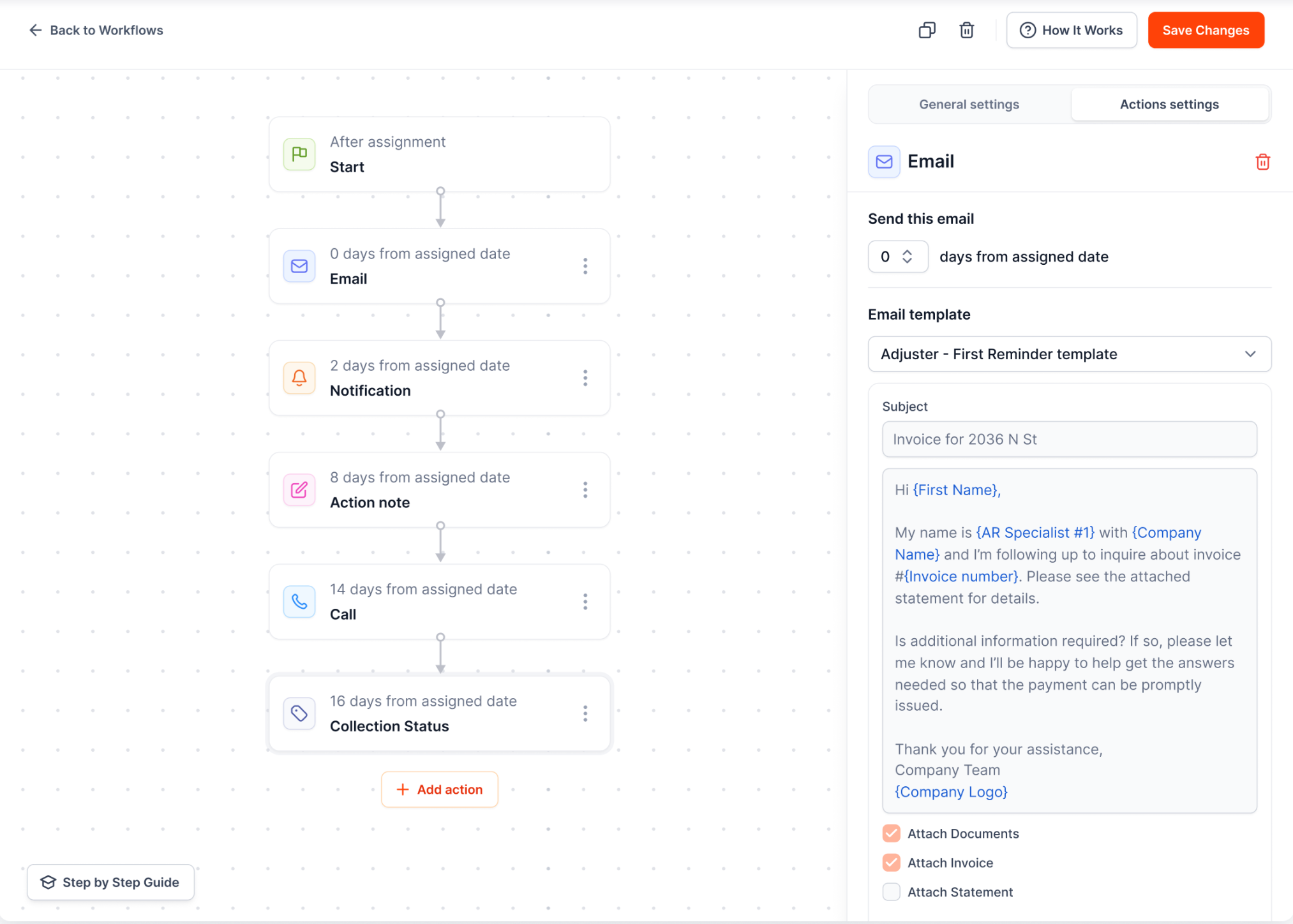
Workflows in AR Workflow decide when each follow-up goes out.
Homeowners get reminders for their share with a way to pay. Adjusters get claim status follow-ups with the right documents attached. Your team sees every message on the account, so nobody has to guess what was last sent or to whom.
While the interactions may be tricky, a three-way win for you, your customer and their insurance carrier is in everyone's best interest. AR Workflow's tools help you navigate these delicate conversations with confidence.
Sometimes. Many carriers make the check out to the homeowner, and to the mortgage company if there is one, so the contractor is paid through them. A homeowner can sign a direction to pay or another contractor payment authorization asking the insurer to pay you directly, but whether the carrier honors it depends on the policy and state law. Check your state rules first.
It is a signed instruction from the policyholder asking the insurance company to pay the contractor directly, or to add the contractor as a payee, for work on a specific claim. The homeowner keeps control of the claim and stays responsible for the deductible and any uncovered amount.
No. An assignment of benefits transfers some of the policyholder's rights under the policy to the contractor, while a direction to pay only redirects payment. Some states restrict assignments of benefits. Florida, for example, eliminated them for property policies issued on or after January 1, 2023, so check your state's rules.
Generally, the homeowner is responsible for what insurance does not cover, which is why your contract and first communication should say so clearly. Coverage and payment responsibility still depend on the policy and the circumstances of the loss.
Give them a clear contract, detailed estimates and thorough documentation, and make sure the customer is satisfied with the work. A complete file gives the adjuster less reason to question charges. Our post on submitting bills that get paid covers pricing.
Follow a consistent schedule of reminders and calls, then escalate. Our guide to collecting unpaid invoices walks through it step by step.
Related reading
Your invoice, not a feature tour.
Bring one overdue invoice to a demo and see what AR Workflow would send, when, and to whom.
Sam owned and ran three restoration companies for more than 14 years and collected over $100 million in receivables. He built AR Workflow in 2020 to give contractors the collections system he wished he'd had.

AI writes the emails, sends the texts, and leaves the voicemails. Your team handles the conversations that matter, and your cash keeps moving.
 Keep QuickBooksStart with one invoiceStay in control

 Log in