Build an accounts receivable collection process in 5 steps, with a collections policy template, escalation schedule and KPIs your restoration team can use.

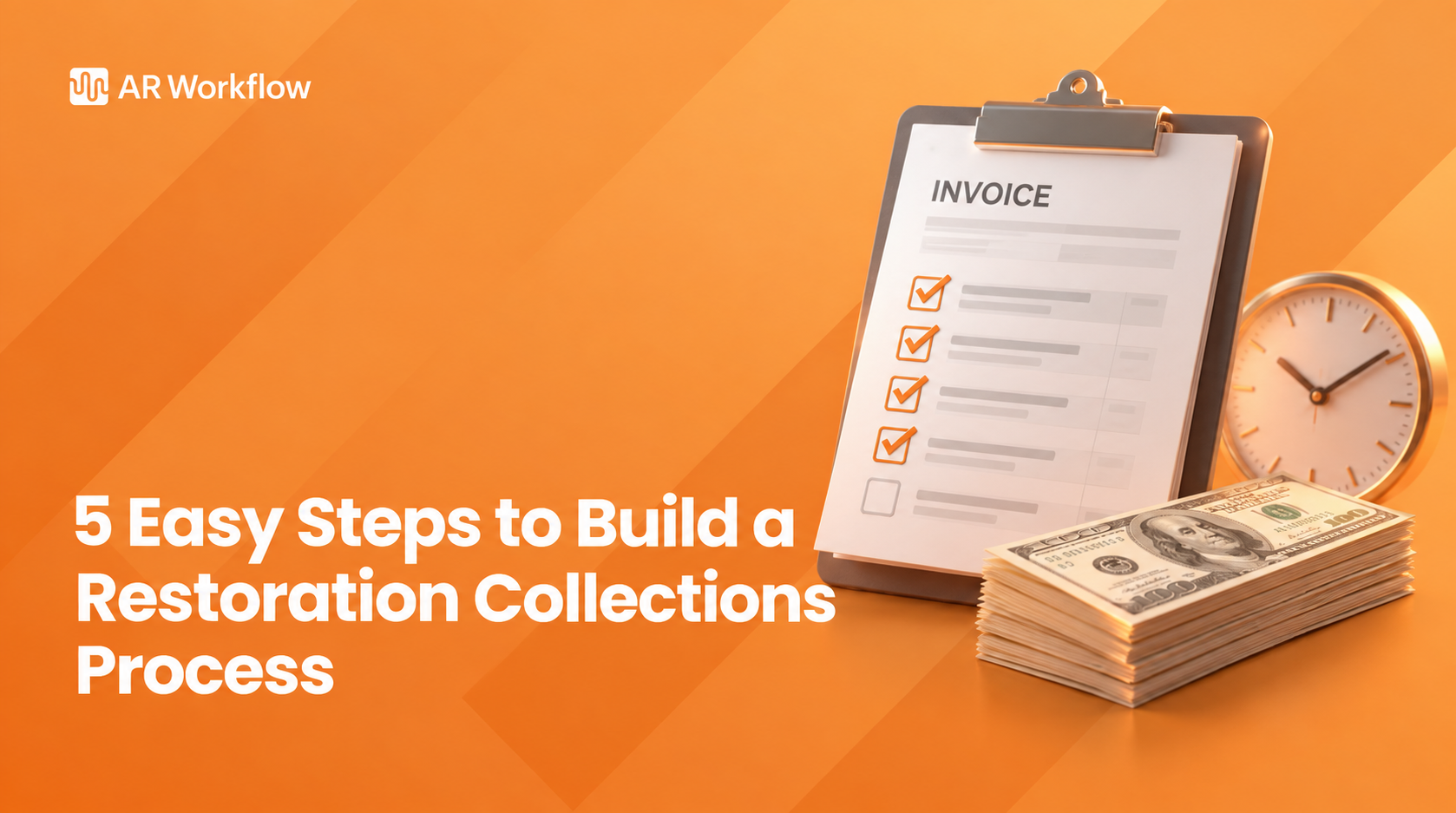
Finishing a restoration job and invoicing for the work should mean you are one step closer to getting paid. Yet when invoices stay outstanding for weeks or months, your team can end up spending as much time chasing restoration payments as they did keeping the job moving.
A clear accounts receivable collection process gives your team a better way to manage that work. It defines which invoices need attention, when to follow up, who takes action, and what happens when payment still does not come through.
This guide walks through five practical steps for building a restoration collections process, with a collections policy template, an example schedule and the KPIs to track, so your team stays on top of outstanding invoices and more of your earned revenue reaches your bank account.
KEY TAKEAWAYS
It is easy for collections to become reactive. An invoice becomes overdue, someone notices it on the aging report, and then the team starts figuring out who needs to follow up and what has already been done.
The problem is that every overdue invoice is money your business expected to collect but still does not have. As invoices pile up, a significant amount of earned revenue can sit in receivables instead of coming back into the business.
Recent payment data shows how large that gap can get. Atradius' U.S. Payment Practices Barometer found that 43% of the total value of B2B invoices was overdue. For a restoration company already paying crews and covering job costs, waiting longer for that money puts even more pressure on cash.
A defined process helps your team act on invoices before they become just another aging balance. You decide when follow-up begins, how often it happens, and when an account needs more attention.
Consistency matters just as much. If one overdue account gets regular follow-up while another goes untouched for weeks, the process still depends on who remembers to check. Following the same guidelines gives every outstanding invoice a clear next step, and gives customers clear, respectful communication without your team reinventing the approach each time.
The goal is not to control when every payment arrives. Restoration professionals cannot control every carrier or mortgage company delay. It is to control what you can manage: how quickly the team responds, how consistently it follows up, and how it keeps each invoice moving toward resolution.
These five collections process steps give you a practical structure you can adapt to how your restoration business already handles receivables.
| 1 | Set clear payment and collection policies |
| 2 | Monitor outstanding invoices and prioritize follow-up |
| 3 | Create a consistent follow-up and escalation schedule |
| 4 | Assign ownership and keep collection activity organized |
| 5 | Make payment easier and track collection performance |
Define the rules your team will follow before an overdue invoice lands on someone's desk.
Clear payment terms should state when payment is due and which payment methods you accept. If you charge late fees or have other terms for overdue balances, spell those out too.
Then decide on your collection strategy: how an invoice is handled once it becomes overdue. When does the first follow-up happen? When does an account get escalated? Who gets involved if payment keeps stalling?
Your communication guidelines deserve the same attention. Our guide on how to ask for payment politely has scripts for each stage. Decide which channels your team will use and how the tone changes as an invoice ages. Our past due invoice letter templates give you a friendly, firm and final version to start from.
Documenting these policies gives your team something consistent to work from and sets expectations with clients early, rather than introducing new terms after a payment problem has started.
Your written collections policy does not need to be long. One page that answers the questions below covers most restoration and contracting businesses. Fill in the blanks and share it with everyone who touches receivables.
1. Payment terms. Invoices are due within ___ days of the invoice date. Deductibles and non-covered work are due from the property owner ___ (at signing / at completion).
2. Accepted payment methods. Card, ACH, check. Payment plans require written approval from ___.
3. Late fees. A late fee of ___ applies after ___ days, where permitted by your contract and state law.
4. Follow-up schedule. Reminder ___ days before due, on the due date, then at 7, 14 and 30 days past due.
5. Escalation. At ___ days past due, the account moves to ___ (owner or office manager) for a phone call. At ___ days, we send a final notice. At ___ days, we review lien rights, a collection agency or small claims.
6. Ownership. Every open account has one named owner who logs each contact and the next step.
7. Disputes. Disputed invoices pause automated reminders until ___ reviews the dispute, with a target response within ___ business days.
Tip: Lien deadlines, late fee limits and collection rules vary by state. Check your state's statutes or ask your attorney before you put specific deadlines or fees into your policy.
Once your policies are in place, you need to know which invoices actually require attention.
Start with your AR aging report. It shows which invoices are outstanding and how long they have been unpaid, so your team can spot accounts moving further into aging and decide where to start.
Do not base that decision on age alone. A large balance that is 90 days old may deserve different attention than an invoice that went overdue yesterday. An account with a payment commitment in place needs a different next step than one your team cannot reach.
Before following up, check what has already happened with the account:
Knowing that helps your team choose the right action instead of sending another reminder that does not address what is actually delaying payment.
Knowing which invoices need attention only helps if your team follows through.
Set a schedule for when customers and other responsible parties hear from you as an invoice ages. You might send a reminder around the due date, follow up after it goes late, and increase contact if the balance stays unpaid. The exact timing depends on your terms. What matters is that nobody decides from scratch when to follow up on each account.
Define when the approach should change. An email may work for an early reminder, while an older or larger balance may call for a phone call. Templates can handle routine messages while leaving room for people to step in.
If several follow-ups have not moved an invoice closer to payment, find out what is holding it up. A dispute, missing documentation or an unresolved claim will not be fixed by the same reminder again. Your escalation rules should tell the team when to investigate, involve someone else, or move the account to the next collection action.
Tip: On insurance jobs, run two schedules side by side: status requests and documentation to the adjuster, and payment reminders with a payment link to the homeowner for the deductible. Never send a payment link to an adjuster.
A follow-up schedule can still fall apart if nobody knows who is responsible for it.
Give each account or collection task a clear owner. That person should be able to see past communication, payment commitments, open tasks and the next action required.
This matters most when several people touch the same account. One person sends an email, another speaks with the customer by phone, and someone else handles the escalation. If those touches are not recorded in one place, the next person has to piece together what happened before they can move forward.
Your team should be able to open any outstanding account and answer two questions quickly: what has already happened, and what needs to happen next? Keeping that history organized also protects customer relationships by preventing conflicting messages and duplicate work.
Once someone is ready to pay, do not make it harder than it needs to be.
Give customers clear instructions for settling their balance. Online payment options, including card and ACH, cut out back and forth, and structured payment plans can work for accounts where you have agreed to payments over time.
Then watch what happens after the process is running. Your aging report shows whether balances keep sliding into older buckets. DSO shows roughly how long it takes to collect. You can also track how much overdue AR you carry and whether it is shrinking.
If the same problems keep showing up, revisit the process. Follow-up may start too late, accounts may not be escalated when they should be, or employees may be spending too much time on routine work by hand. Use your receivables data to decide what to change.
Put the five steps together and your process gives the team a clear course of action as an invoice moves from due to paid. Not every invoice follows the same path. A customer who missed the due date may only need a reminder, while an older account with a payment issue may need a call or escalation. Here is one example:
| Invoice stage | Possible collection action | Goal |
|---|---|---|
| Approaching due date | Confirm invoice and payment details | Catch issues before the due date |
| Recently overdue | Follow up and confirm payment status | Find out when payment can be expected |
| Still outstanding | Continue follow-up through the right channel | Keep the account from sitting untouched |
| Payment issue identified | Address the specific issue delaying payment | Resolve the reason payment has not moved |
| Significantly overdue | Escalate according to your collection policy | Decide what the account requires next |
| Payment promised | Record and track the promised date | Follow up if the promise is missed |
| Paid | Update the account and close open tasks | Keep AR records up to date |
The timing depends on your payment terms and the account. The point is that an invoice never just sits until someone remembers it. Your team knows what happened at the last contact, when to follow up again, and when to switch channels, call the person responsible for payment, or escalate. For a step-by-step plan once an invoice is already late, see our guide to collecting unpaid invoices.
Bring one overdue invoice.
We'll show you exactly how it would move through a collections process like this one.
A single collections strategy rarely fits every account in restoration, because the person who owes the money changes from job to job. Use the same process, but adjust the channel, the message and the escalation path for each type of payer.
| Who owes | What usually delays payment | What works |
|---|---|---|
| Homeowner (deductible or non-covered work) | Confusion about what insurance covers, or waiting on the claim | Collect the deductible early, send text and email reminders with a payment link, call at 14 days |
| Insurance carrier | Missing documentation, estimate disputes, supplements | Status requests and documentation to the adjuster; no payment links |
| Mortgage company | Check endorsement and inspection requirements on loss drafts | Ask the homeowner for the loss draft contact early and track each release step |
| Property manager or commercial client | Approval chains, purchase orders, net terms | Confirm the approver and PO before work starts, invoice to the exact AP contact |
| General contractor | Pay-when-paid clauses, retainage, missing paperwork | Track contract terms, submit every required document with the invoice |
When an account still will not move after your final notice, our guide to restoration debt collection covers when to use an agency, small claims or lien rights.
You will only know whether your accounts receivable collection process works if you measure it. Review these numbers monthly, and compare them by payer type so you can see where the process breaks down.
| KPI | How to calculate it | What it tells you |
|---|---|---|
| Days Sales Outstanding (DSO) | (Accounts receivable / total credit sales for the period) x days in the period | Roughly how long it takes to collect after invoicing |
| Collection Effectiveness Index (CEI) | (Beginning AR + credit sales - ending total AR) / (beginning AR + credit sales - ending current AR) x 100 | How much of the collectible balance you actually collected |
| Percent of AR over 60 or 90 days | AR in the 61+ or 91+ buckets / total AR | Whether balances are sliding into older buckets |
| Promise-to-pay kept rate | Payment promises kept on time / total promises recorded | Whether follow-up is turning into real payments |
| Average days to first contact | Average days from due date to first follow-up | Whether the team starts follow-up on time |
An AR reporting dashboard keeps these numbers current without rebuilding a spreadsheet every month.
A defined process does more than give you a better way to chase overdue invoices. Your team catches payment issues earlier and spends less time figuring out what needs attention.
The sooner you collect money you have already earned, the sooner you can improve your cash flow and put it back into the business. Regular follow-up keeps invoices moving and gives your team a better chance of addressing payment issues before they drag on. Over time, incoming cash becomes easier to plan around when payroll, equipment, materials and new jobs compete for the same dollars.
An unpaid invoice is harder to ignore when your process tells someone to check it, follow up and take the next step. That gives your team more chances to catch problems while there is still something to do about them.
Collection conversations do not have to feel uncomfortable or improvised. With clear policies and a consistent schedule, your team can see what has already been said and continue the conversation without mixed messages or repeated questions.
Organized collection activity gives you a clearer view of which balances remain unpaid, how long they have been outstanding, and what your team is doing about them. You can make decisions based on what you have actually collected rather than assuming every invoice will arrive on time.
Much of the work that keeps a collections process running is the same tasks repeated. Handling them by hand is fine at first. As outstanding invoices grow, though, it starts to eat staff time.
With the right tools, collections automation takes over that repetitive work. You can schedule reminders, keep activity organized, and give employees a clear view of outstanding accounts without checking spreadsheets or individual inboxes. Online payment options give customers a direct way to pay, and reporting shows owners how receivables are changing.
Automation will not solve every reason a restoration invoice stays unpaid. An insurance delay, a dispute, missing information or mortgage company involvement may still need someone to step in. But it lets your team focus on those accounts while routine follow-up runs in the background. If you invoice in QuickBooks, AR Workflow syncs with it so you do not re-enter anything.
AR Workflow for restoration puts automation around the collections process you have already defined. Your team can build custom collection workflows and schedule email and text follow-ups from a dedicated number. Tasks and activity stay organized, so everyone can see what has happened and what still needs attention.
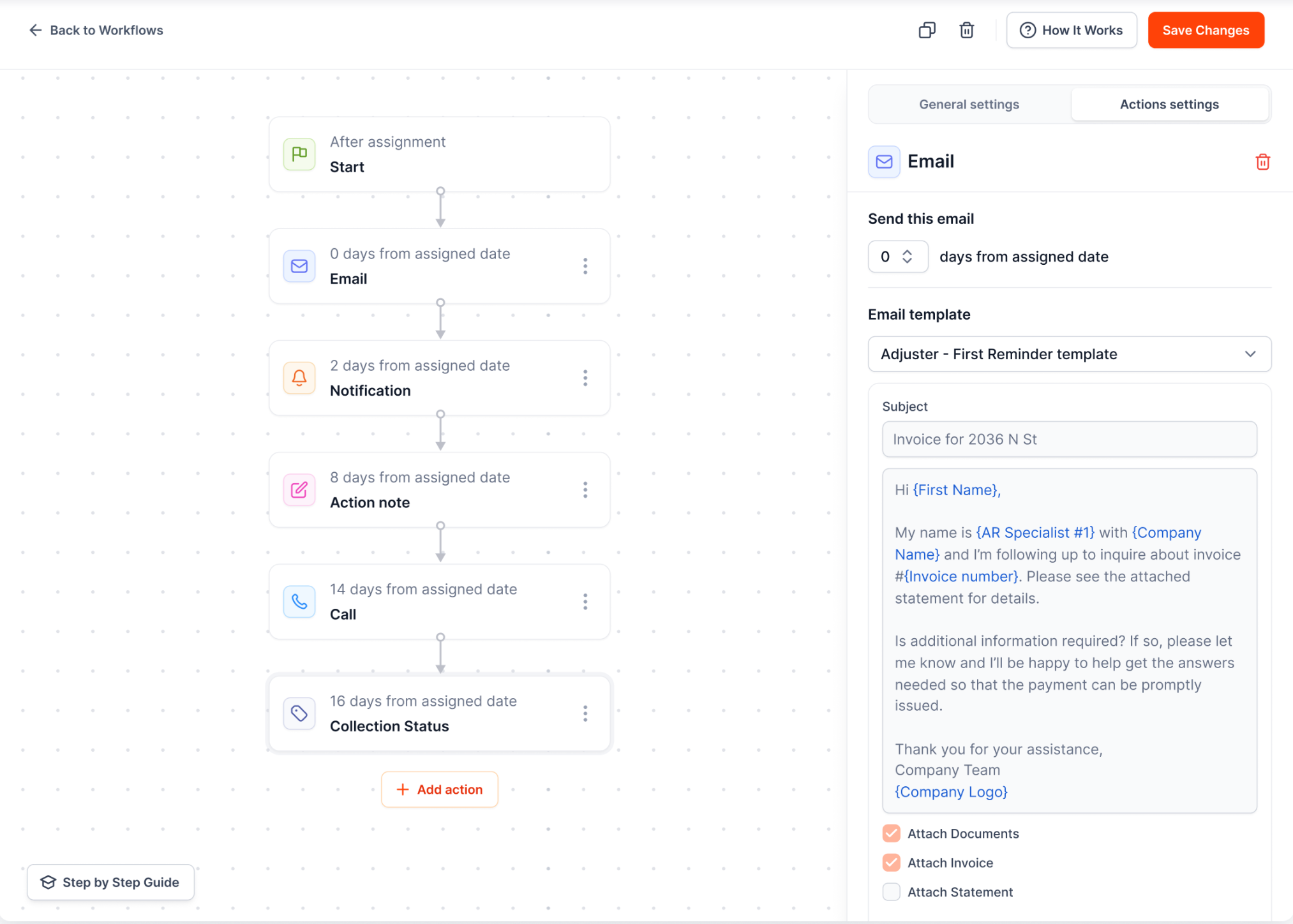
Collection workflows in AR Workflow decide when each follow-up goes out.
Owners and finance teams get a live view of outstanding AR through dashboards and reporting. When a customer is ready to pay, online payment options and payment plans give them a direct way to settle the balance.
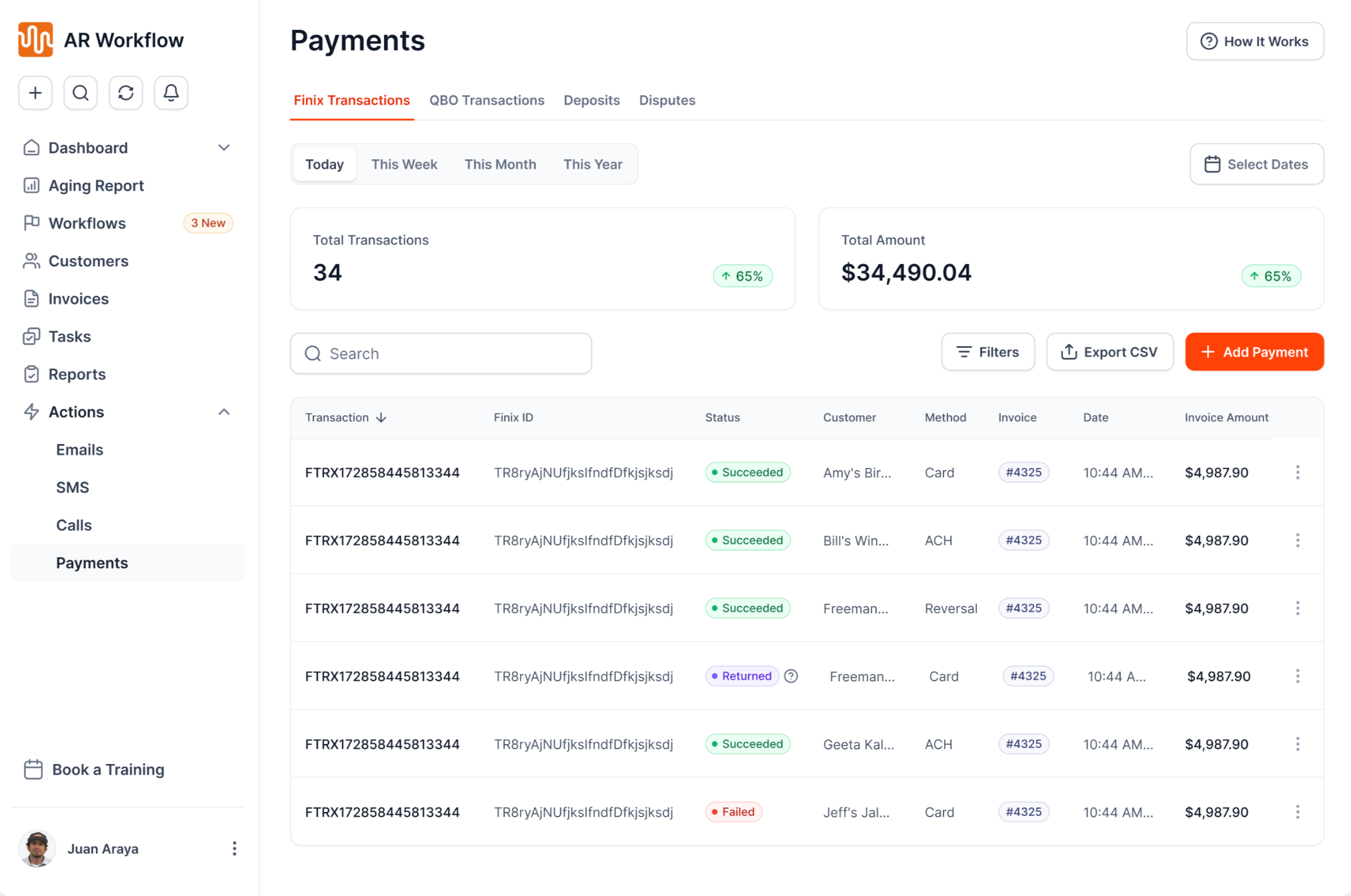
Customers can pay by card or ACH, with payments posting back to QuickBooks.
AR Workflow connects with QuickBooks, so your team manages the collection work around receivables without spreadsheets and scattered messages. The point is not to remove your team from collections. It is to cut the repetitive work so they can spend time on the payment issues that need a person.
It is the accounts receivable collection process a restoration company follows to collect unpaid invoices: payment policies, a follow-up schedule, escalation rules, ownership of each account, and tracking. It covers homeowners, insurance carriers, adjusters and mortgage companies, which often need different approaches.
Most collections processes follow five steps. Set clear payment and collection policies. Monitor outstanding invoices on your aging report and prioritize follow-up. Follow a consistent reminder and escalation schedule. Give every account an owner who records each contact. Then make payment easy and track aging AR and DSO, so you can see whether the process is helping you collect sooner.
Under federal law, the 7-in-7 rule generally limits a covered collection agency to no more than seven phone calls within seven days about a particular consumer debt. After speaking with the consumer by phone about that debt, the collector generally must wait seven days before calling again. The rule comes from the Consumer Financial Protection Bureau's Regulation F, which implements the Fair Debt Collection Practices Act (FDCPA), and applies to covered third-party debt collectors. Some state laws, such as California's Rosenthal Act, also apply to businesses collecting their own debts, so rules vary by state.
The exact stages depend on the type of loss, but a restoration job generally moves through assessment and planning, mitigation, cleaning or drying, and repairs. Industry guidance also calls for ongoing documentation and monitoring. From an AR point of view, collections begin once the company has invoiced billable work and needs to track that payment.
Collection agencies may reduce or stop attempts, but an unpaid debt does not disappear because they stop calling. Collection rights and the time available for legal action depend on the type of debt and state law. For restoration companies managing their own receivables, waiting until an account is badly aged makes recovery harder, so start follow-up early.
There is no single standard. Timing varies by payment method, processor and bank, especially if the transaction runs into an issue.
Related reading
Your invoice, not a feature tour.
Bring one overdue invoice to a demo and see what AR Workflow would send, when, and how your customer would pay.
Sam owned and ran three restoration companies for more than 14 years and collected over $100 million in receivables. He built AR Workflow in 2020 to give contractors the collections system he wished he'd had.

AI writes the emails, sends the texts, and leaves the voicemails. Your team handles the conversations that matter, and your cash keeps moving.
 Keep QuickBooksStart with one invoiceStay in control

 Log in