Prompt payment act (prompt pay act) rules in every state: how fast owners and primes must pay contractors and subs, plus late interest. 2026 table.

A prompt payment act is a state law that says how fast you must be paid on a construction job. It sets a deadline for the owner to pay the prime, and for the prime to pay its subs. If they pay late, many states add interest. This guide explains how prompt pay laws work and lists the rules for all 50 states plus DC, for both private and public jobs.
Quick answer: prompt payment act
Last updated: November 23, 2026
This is not legal advice. This table is our plain-English summary of each state's law, based on the American Subcontractors Association and Kegler Brown chart "Prompt Payment Laws in the 50 States" (revised January 2024) and the statutes it cites. Laws change and many have exceptions. Read the current law or ask a construction attorney before you rely on a deadline.
A prompt payment act (or prompt pay law) is a state law that sets how many days someone has to pay for construction work. Most states have one for public jobs, like schools and roads. Many also have one for private jobs, like offices, stores and sometimes homes.
Most prompt pay laws have three parts:
"No general law" means the state has no prompt pay law for most private jobs. Then the contract sets the terms. Click a state for its lien deadlines.
| State | Owner pays prime | Prime pays sub | Late interest |
|---|---|---|---|
| Alabama | 30 days after invoice | 7 days after prime is paid | 1% per month |
| Alaska | No general law | No general law | None stated |
| Arizona | 7 days after bill is OK (21 days or more) | 7 days after prime is paid | 1.5% per month |
| Arkansas | No general law | No general law | None stated |
| California | 30 days after demand for pay | 7 days after prime is paid | 2% per month |
| Colorado | No general law | No general law | None stated |
| Connecticut | 30 days after invoice | 30 days after prime is paid | 1% per month |
| Delaware | 30 days after billing period or invoice | 30 days after prime is paid | Interest; rate not set |
| District of Columbia | 7 days after contract pay date | 7 days after prime is paid | 1.5% per month |
| Florida | Per contract; final pay 14 days after done | Per contract; or 30 days after prime is paid | Contract rate or state CFO rate if higher |
| Georgia | 15 days after invoice | 10 days after prime is paid | 1% per month |
| Hawaii | No rule | 10 days after prime gets sub invoice | 1.5% per month |
| Idaho | No general law | No general law | None stated |
| Illinois | 40 days after invoice | 15 days after prime is paid | 10% per year |
| Indiana | No general law | No general law | None stated |
| Iowa | No general law | No general law | None stated |
| Kansas | 30 days after good pay request | 7 business days after prime is paid | 18% per year |
| Kentucky | 30 business days after invoice | 15 business days after prime is paid | 12% per year |
| Louisiana | No set deadline | 14 days after prime is paid | 0.5% per day penalty; 15% max |
| Maine | Per contract; else 20 days after invoice | 7 days after prime is paid or invoice | Judgment rate or contract rate if higher |
| Maryland | 7 days after contract pay date | 7 days after prime is paid | Legal rate |
| Massachusetts | 15 days to OK plus 45 days to pay | 7 more days for each lower tier | No rate in law; 12% added to judgments |
| Michigan | No general law | No general law | None stated |
| Minnesota | Monthly unless contract says | 10 days after prime is paid | 1.5% per month |
| Mississippi | Final pay 30 days after job done | 15 days after prime is paid | 1% per month to prime; 0.5% per day to subs |
| Missouri | As agreed | As agreed | Up to 1.5% per month if court awards |
| Montana | 7 days after bill is OK | 7 days after prime is paid | 1.5% per month |
| Nebraska | 30 days after pay request | 10 days after prime is paid | 1% per month |
| Nevada | 21 days after invoice unless agreed | 10 days after prime is paid | Prime rate plus 4% or agreed rate if higher |
| New Hampshire | No general law | No general law | None stated |
| New Jersey | 30 days after billing date | 10 days after prime is paid | Prime rate plus 1% |
| New Mexico | 21 days after invoice | 7 days after prime is paid | 1.5% per month |
| New York | 42 days: 12 to OK plus 30 to pay | 7 days after prime is paid | 1% per month |
| North Carolina | No rule | 7 days after prime is paid | 1% per month |
| North Dakota | No general law | No general law | None stated |
| Ohio | No rule | 10 days after prime is paid | 18% per year |
| Oklahoma | 28 days after billing or per contract | 10 days after prime is paid or per contract | No rule |
| Oregon | 14 days after invoice | 7 days after prime is paid | 1.5% per month |
| Pennsylvania | 20 days after billing period or invoice | 14 days after prime is paid | 1% per month |
| Rhode Island | No general law | No general law | None stated |
| South Carolina | 21 days after invoice | 7 days after prime is paid | 1% per month if noted on invoice |
| South Dakota | No general law | No general law | None stated |
| Tennessee | 30 days after invoice | 30 days after sub invoice | 1.5% per month or contract rate |
| Texas | 35 days after invoice | 7 days after prime is paid | 1.5% per month |
| Utah | No progress rule; final 45 days after invoice | 30 days after prime is paid | 1% per month |
| Vermont | 20 days after billing period or invoice | 7 days after prime is paid | 12% per year |
| Virginia | No general law | No general law | None stated |
| Washington | No general law | No general law | None stated |
| West Virginia | No general law | No general law | None stated |
| Wisconsin | No general law | No general law | None stated |
| Wyoming | No general law | No general law | None stated |
Public jobs are paid by a state, city, county or school district. Many states have different rules for state and local jobs.
| State | Owner pays prime | Prime pays sub | Late interest |
|---|---|---|---|
| Alabama | 30 days after job done and invoice | 7 days after prime is paid | Rate the state charges |
| Alaska | 30 days; 21 days if grant or federal money | 8 working days after prime is paid | Legal rate |
| Arizona | 14 days after bill is OK | 7 days after prime is paid | 1% per month |
| Arkansas | Local: 5 days; state: 90 days | No rule | 8% or 10% per year penalty |
| California | 30 days after good pay request | 7 days after prime is paid | 2% per month; 10% per year for state |
| Colorado | Monthly if job is over $150K | 7 days after prime is paid | 15% per year to subs or contract rate if higher |
| Connecticut | 45 days after good claim (state) | 30 days after prime is paid | State Short Term Fund yield |
| Delaware | 21 days after work estimate is OK | 21 days after prime is paid | Up to prime rate plus 2% |
| District of Columbia | 30 days after invoice | 7 days after prime is paid | Rate set by mayor rule |
| Florida | State: 30 days after OK; local: 25 days | 30 days after work or 10 days after prime is paid | 2% per month |
| Georgia | 15 days after invoice | 10 days after prime is paid | 1% per month |
| Hawaii | 30 days after invoice | 10 days after prime is paid | Prime rate plus 2% |
| Idaho | 60 days after invoice | No rule | Rate set by law |
| Illinois | 90 days after invoice | 15 days after prime is paid | 1% per month to prime; 2% per month to subs |
| Indiana | State: 35 days; local: 45 days after invoice | 10 days after prime is paid | 1% per month |
| Iowa | 14 days after pay request (up to 30) | 7 days after prime is paid | Interest from day 31 after work done |
| Kansas | 30 days after invoice | 7 business days after prime is paid | 1.5% per month or 18% per year |
| Kentucky | 30 business days after invoice | 15 business days after prime is paid | 12% per year |
| Louisiana | 45 days after certified pay request | 14 days after prime is paid | 0.5% per day; 15% max |
| Maine | Per contract; else 20 or 25 days after invoice | 7 days after prime is paid or invoice | Judgment rate or contract rate if higher |
| Maryland | 30 days after invoice or due date (later) | 10 days after prime is paid | 9% per year to prime; none for subs |
| Massachusetts | 15 or 30 days after invoice | Right after prime is paid | Fed rediscount rate plus 3% |
| Michigan | Later of 30 days after OK or 15 days after funds | No rule | Reasonable interest |
| Minnesota | State: 30 days after invoice; local: 35 or 45 | 10 days after prime is paid | None for state; 1.5% per month local |
| Mississippi | Per contract; final 45 days after done | 15 days after prime is paid | 1% per month to prime; 0.5% per day to subs |
| Missouri | 30 days after work or invoice | 15 days after prime is paid | 1.5% per month |
| Montana | 7 days after bill is OK; state: 30 days | 7 days after prime is paid | 1.5% per month |
| Nebraska | State: 45 days after invoice; local: 30 days | Local: 10 days after prime is paid; state: no rule | Fed short-term rate plus 3% (state) |
| Nevada | 30 days after invoice | 10 days after prime is paid | Top 90-day CD rate (to prime) |
| New Hampshire | No general law | No general law | None stated |
| New Jersey | 30 days after billing; some state jobs 60 days | 10 days after prime is paid | Prime rate plus 1% |
| New Mexico | 21 days after invoice; 45 for some local | 7 days after prime is paid | 1.5% per month |
| New York | 30 days after invoice; 15 for small business | 7 days after prime is paid | State tax overpayment rate |
| North Carolina | Per contract; final 45 days after OK | 7 days after prime is paid | 1% per month |
| North Dakota | 45 days after invoice | 45 days after prime is paid | 1.75% per month |
| Ohio | 30 days after invoice | 10 days after prime is paid | Legal rate to prime; 18% per year to subs |
| Oklahoma | 30 days after invoice | 10 days after prime is paid | See statute; 1.5% if prime pays sub late |
| Oregon | 30 days after invoice | 10 days after prime is paid | 3x Fed 90-day paper rate; max 30% |
| Pennsylvania | 45 days after invoice unless agreed | 14 days after prime is paid | Overdue tax rate; plus 1% per month if bad faith |
| Rhode Island | 30 days after good invoice | 10 days after prime is paid | Prime rate (to prime only) |
| South Carolina | 21 days after invoice | 7 days after prime is paid | 1% per month if noted on invoice |
| South Dakota | 45 days after invoice | 30 days after prime is paid | 1.5% or contract rate |
| Tennessee | 45 days after invoice | 30 days after prime is paid | 1.5% per month |
| Texas | 31 days after invoice or goods (later) | 10 days after prime is paid | Prime rate plus 1% |
| Utah | 60 days unless agreed | 30 days after prime is paid | IRS refund rate plus 2% to prime; 15.5% to subs |
| Vermont | 20 days after billing period or invoice | 7 days after prime is paid | 12% per year |
| Virginia | State: 30 days; local: 45 days after invoice | 7 days after prime is paid | Prime rate for state primes; else 1% per month |
| Washington | 30 days after invoice | 10 days after prime is paid | 1% per month to prime; top legal rate to subs |
| West Virginia | 60 days after invoice | No rule | Legal rate after 60 days |
| Wisconsin | 30 days after invoice | 7 days after prime is paid | 12% per year |
| Wyoming | 45 days after invoice | No rule | 1.5% per month |
Know your dates. When a pay app is approved, put the prompt pay due date on your calendar. If it passes, send a polite reminder that names the law. Then check your lien deadlines so you do not lose your backup plan.
Yes, in most states, for a good reason. Common reasons are defective work, work that is not done, or a lien from someone else on the job. Most laws say the owner must tell you in writing what is wrong, and only hold back enough to cover the problem. Retainage is also allowed, within limits. See our guide to retainage in construction.
These are the laws behind the tables above. Always read the current version before you rely on it.
On private jobs, the owner must pay the prime within 35 days after getting the invoice, and the prime must pay subs within 7 days after it gets paid. Late payments earn 1.5% interest per month. On public jobs, the government pays within 31 days after the invoice or delivery, whichever is later, and the prime pays subs within 10 days after it gets paid. See the Texas guide.
On private jobs, payment mostly follows the contract, and the final payment is due 14 days after the work is done. On public jobs, state agencies pay within 30 days after approval and local governments within 25 days, and the prime pays subs within 10 days after it gets paid. Late public payments earn 2% per month. See the Florida guide.
On private jobs, the owner pays the prime within 30 days after a written demand for payment, and the prime pays subs within 7 days after it gets paid. Late payments earn 2% per month. Public jobs use the same 7-day rule for subs. See the California guide.
On private jobs, the owner pays the prime within 40 days after the invoice, and the prime pays subs within 15 days after it gets paid. Late payments earn 10% interest per year. On public jobs, primes also pay subs within 15 days after they get paid. See the Illinois guide.
On private and most public jobs, the owner pays the prime within 30 days after the billing date, and the prime pays subs within 10 days after it gets paid. Late payments earn interest at the prime rate plus 1%. See the New Jersey guide.
A prompt payment act is a state law that sets how many days an owner has to pay a contractor, and how many days a contractor has to pay its subs and suppliers. Many add interest when payment is late.
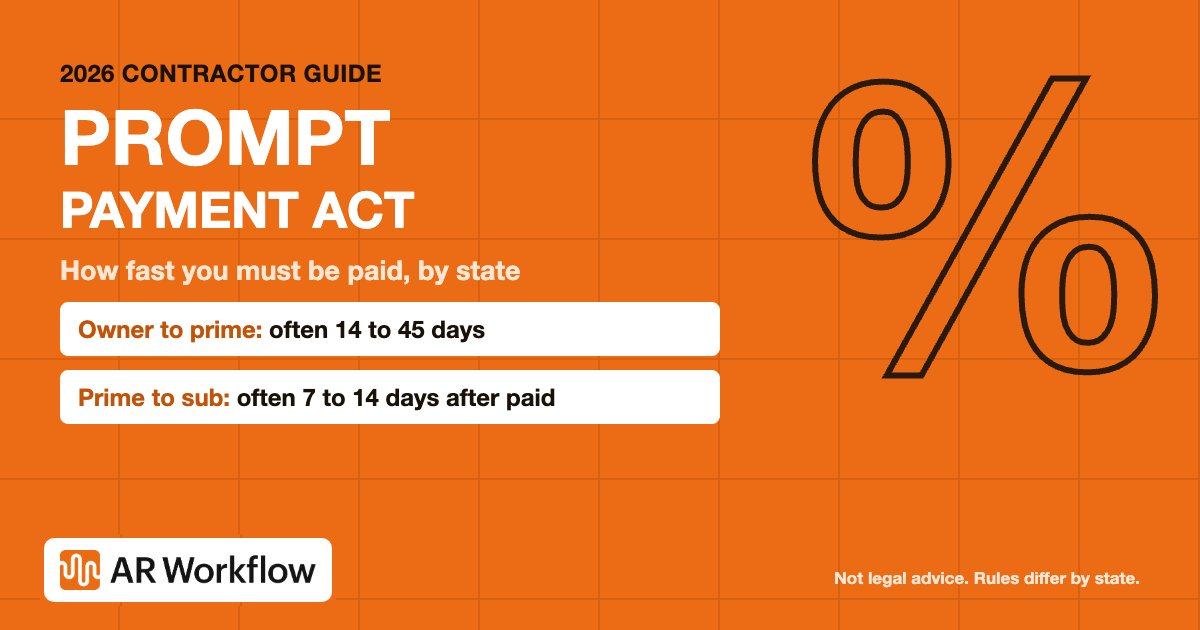
It depends on the state and the type of job. Most states give the owner 14 to 45 days after an approved pay app or invoice. Check the tables above for your state.
In most states with a prompt pay law, the prime must pay the sub within 7 to 14 days after the prime gets paid. A few states allow up to 30 days or more.
In many states, yes. But some states only have a prompt pay law for public jobs. On private jobs in those states, your contract sets the payment terms.
Many states set interest at 1% to 1.5% per month on late payments. Some use a rate tied to the prime rate or the state's legal rate. A few have no interest rule at all.
Yes. The federal Prompt Payment Act covers federal government jobs. It requires prompt payment to primes and makes primes pay subs within 7 days after they are paid. State laws cover state, local and private jobs.
No. This page is a plain-English summary. Prompt pay laws have many exceptions and change over time. Read the law or ask a construction attorney in your state.
Tools and related guides
The law says pay on time. We make sure it happens.
AR Workflow works with QuickBooks and follows up on every invoice and pay app for you, from the first friendly reminder to the final notice. Bring one overdue invoice to a demo and see what we would send, and when.
Source for the state tables: American Subcontractors Association and Kegler Brown Hill + Ritter, "Prompt Payment Laws in the 50 States" (rev. January 2024), summarized in our own words. This article is general information, not legal advice.
Sam owned and ran three restoration companies for more than 14 years and collected over $100 million in receivables. He built AR Workflow in 2020 to give contractors the collections system he wished he'd had.

AI writes the emails, sends the texts, and leaves the voicemails. Your team handles the conversations that matter, and your cash keeps moving.
 Keep QuickBooksStart with one invoiceStay in control

 Log in