Who must send a preliminary notice (notice to owner, notice of furnishing or 20-day notice), when it is due, and what happens if you miss it. All 50 states.

A preliminary notice is a short letter you send early in a job. It tells the owner who you are and that you have the right to file a lien if you are not paid. In many states, if you skip it, you lose your lien rights before the job is even done. This guide shows who has to send one, when it is due, and the rules in all 50 states plus DC.
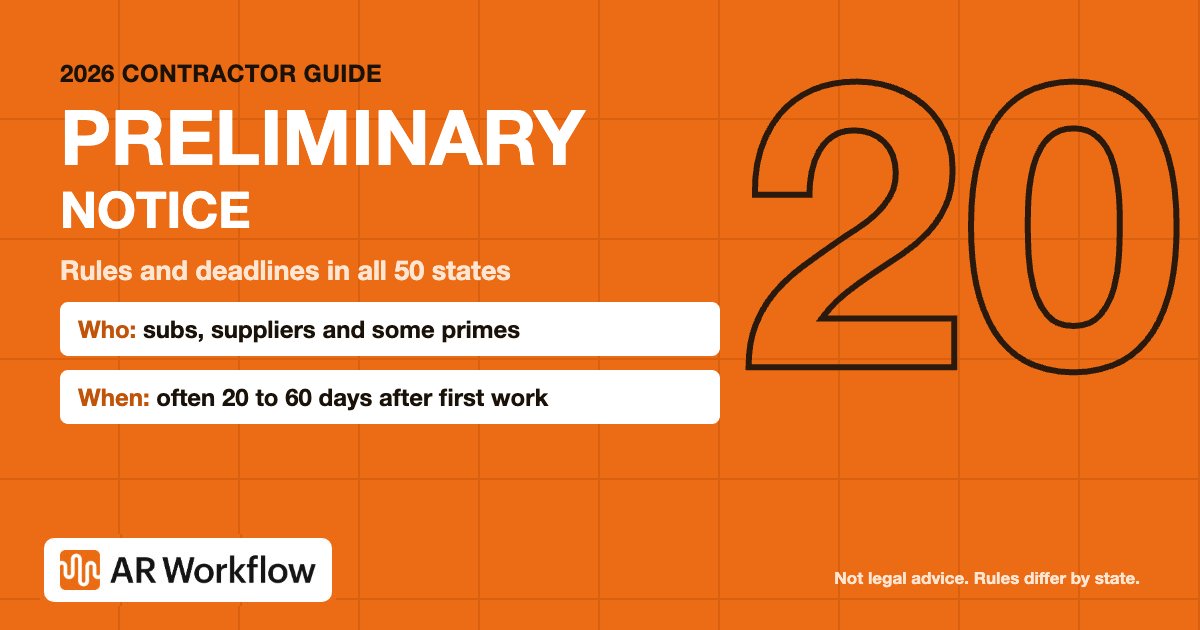
Quick answer: preliminary notice
Find your exact date with our lien deadline calculator.
Last updated: November 23, 2026
This is not legal advice. Rules change, and the facts of your job matter. We summed up each rule from the state's lien law in November 2026. Read the law or ask a construction attorney in your state before you rely on a date.
A preliminary notice is the first step in protecting your right to file a mechanics lien. It is sent near the start of the job, not when you are already owed money. That is the point. It lets the owner know early that you are on the job, so the owner can make sure you get paid.
It goes by many names. California and Arizona call it a 20-day preliminary notice. Florida calls it a notice to owner. Ohio and Michigan call it a notice of furnishing. They all do the same job.
"Yes" means the notice is needed on most jobs. "Sometimes" means it depends on the job type, the size of the job, or whether the owner filed a notice of commencement. Click a state for its full lien guide.
| State | Prime | Sub | Supplier | Main deadline | Calculator |
|---|---|---|---|---|---|
| Alabama | No | Sometimes | Sometimes | Suppliers: before first delivery, for a full lien | Get my dates |
| Alaska | Optional | Optional | Optional | Optional, before work starts | Get my dates |
| Arizona | Yes | Yes | Yes | 20 days after first work | Get my dates |
| Arkansas | Sometimes | Sometimes | Sometimes | Homes: prime before work. Commercial: 75 days | Get my dates |
| California | Sometimes | Yes | Yes | 20 days after first work | Get my dates |
| Colorado | No | No | No | No notice | Get my dates |
| Connecticut | No | Yes | Yes | 90 days after last work | Get my dates |
| Delaware | No | No | No | No notice | Get my dates |
| District of Columbia | No | No | No | No notice | Get my dates |
| Florida | Sometimes | Yes | Yes | 45 days after first work | Get my dates |
| Georgia | No | Sometimes | Sometimes | 30 days after first work or Notice of Commencement | Get my dates |
| Hawaii | No | No | No | No notice | Get my dates |
| Idaho | No | No | No | No notice (home primes give a disclosure) | Get my dates |
| Illinois | No | Yes | Yes | 90 days after last work | Get my dates |
| Indiana | No | Sometimes | Sometimes | Owner-occupied homes: 30 or 60 days after first work | Get my dates |
| Iowa | Sometimes | Sometimes | Sometimes | Homes: state registry. Commercial: 30 days | Get my dates |
| Kansas | No | Sometimes | Sometimes | Owner-occupied homes: send at the start | Get my dates |
| Kentucky | No | Yes | Yes | 75 or 120 days after last work | Get my dates |
| Louisiana | Sometimes | Sometimes | Sometimes | Suppliers: 75 days after month of delivery | Get my dates |
| Maine | No | Optional | Optional | Optional, send early | Get my dates |
| Maryland | No | Yes | Yes | 120 days after last work | Get my dates |
| Massachusetts | No | Optional | Optional | Optional, 30 days after start | Get my dates |
| Michigan | No | Yes | Yes | 20 days after first work | Get my dates |
| Minnesota | Sometimes | Sometimes | Sometimes | 45 days after first work | Get my dates |
| Mississippi | No | Sometimes | Sometimes | 30 days after first work | Get my dates |
| Missouri | Sometimes | No | No | Prime: before first payment | Get my dates |
| Montana | No | Sometimes | Sometimes | 20 days after first work | Get my dates |
| Nebraska | Optional | Optional | Optional | Optional (homes) | Get my dates |
| Nevada | No | Yes | Yes | 31 days after first work | Get my dates |
| New Hampshire | No | Yes | Yes | Before or during work | Get my dates |
| New Jersey | Sometimes | Sometimes | Sometimes | Homes: 60 days after last work | Get my dates |
| New Mexico | No | Sometimes | Sometimes | 60 days after first work (claims over $5,000) | Get my dates |
| New York | No | No | No | No notice | Get my dates |
| North Carolina | Sometimes | Sometimes | Sometimes | 15 days after first work (if a lien agent is named) | Get my dates |
| North Dakota | No | No | No | No notice | Get my dates |
| Ohio | No | Sometimes | Sometimes | 21 days after first work (if Notice of Commencement) | Get my dates |
| Oklahoma | No | Sometimes | Sometimes | 75 days after last work | Get my dates |
| Oregon | No | Sometimes | Yes | 8 business days after first delivery | Get my dates |
| Pennsylvania | No | Sometimes | Sometimes | 45 days after first work ($1.5M+ jobs) | Get my dates |
| Rhode Island | Yes | No | No | Prime: before work starts | Get my dates |
| South Carolina | No | Sometimes | Sometimes | Only if a Notice of Commencement; no set day | Get my dates |
| South Dakota | No | Sometimes | Sometimes | 60 days after last work (if Notice of Commencement) | Get my dates |
| Tennessee | No | Sometimes | Sometimes | 90 days after each unpaid month | Get my dates |
| Texas | No | Yes | Yes | 15th day of 3rd month after each unpaid month (2nd for homes) | Get my dates |
| Utah | Yes | Yes | Yes | 20 days after first work | Get my dates |
| Vermont | No | Yes | Yes | Before the lien; send early | Get my dates |
| Virginia | Sometimes | Sometimes | Sometimes | Homes: 30 days (if a lien agent is named) | Get my dates |
| Washington | No | Sometimes | Yes | 60 days after first work (10 for new homes) | Get my dates |
| West Virginia | No | Optional | Optional | Optional, before work | Get my dates |
| Wisconsin | Sometimes | Sometimes | Sometimes | 60 days after first work (homes and small jobs) | Get my dates |
| Wyoming | Yes | Yes | Yes | 30 days after first work; prime before first pay | Get my dates |
Not sure? Send one anyway. A notice that was not required does no harm, and in many states it still helps you get paid. Then mark your lien filing date with our calculator.
They are mostly the same notice with different names. Each state picks its own name and deadline:
The table above shows the main deadline in each state. Use the lien deadline calculator to get the exact date for your job.
Most states have their own form or set of words. Use your state's form if it has one. Most notices include:
Most states want certified mail with a return receipt, or another way to prove it was delivered. Some states, like Utah, use an online state registry. Keep proof of every notice you send. If you ever file a lien, you will need it.
It depends on the state. In some states, like Florida and Illinois, a missed notice can wipe out your lien. In others, like California and Arizona, a late notice still works but only covers work from a short time before you sent it. Either way, sending late costs you money. Send it in the first week of every job.
A notice is not a threat. It is just good business. Most jobs never get close to a lien. But if a pay app goes past due, follow up fast: a friendly reminder, then a firm past due letter, then a notice of intent to lien. Know how fast you must be paid under your state's prompt payment rules, and see all your lien dates in our state lien guide.
A 20-day preliminary notice is the notice California and Arizona use. Subs and suppliers send it to the owner, the prime and the lender within 20 days of their first work. If you send it late, it only covers work from the 20 days before you sent it.
A preliminary lien notice is another name for a preliminary notice. It tells the owner early in the job that you are working there and may file a lien if you are not paid.
A preliminary notice is a letter sent early in a job that tells the owner you are providing work or materials and may file a lien if you are not paid. In many states it is required to keep your lien rights.
Yes, mostly. Different states use different names: preliminary notice, notice to owner, notice of furnishing, notice of right to lien. They all tell the owner early that you are on the job.
It depends on the state. Common deadlines are 20, 30, 45 or 60 days after your first day of work or first delivery. A few states count from your last day of work instead. Use our lien deadline calculator to find your date.
Usually not, because the prime already has a contract with the owner. But some states require a notice from the prime, mostly on homes. Check the table above for your state.
It should not. It is a normal step that owners see all the time. It also helps the owner make sure everyone on the job gets paid.
In some states a late notice still works but only covers recent work. In others, a late notice means you lose the lien. Send it in the first week of every job to be safe.
No. This page is a plain-English guide based on each state's lien law. Laws change. Check the law or talk to a construction attorney in your state before you rely on a deadline.
Tools and related guides
Send the notice. Then get paid without the fight.
AR Workflow works with QuickBooks and follows up on every invoice and pay app for you, from the first friendly reminder to the final notice. Bring one overdue invoice to a demo and see what we would send, and when.
This article is general information, not legal advice.
Sam owned and ran three restoration companies for more than 14 years and collected over $100 million in receivables. He built AR Workflow in 2020 to give contractors the collections system he wished he'd had.

AI writes the emails, sends the texts, and leaves the voicemails. Your team handles the conversations that matter, and your cash keeps moving.
 Keep QuickBooksStart with one invoiceStay in control

 Log in