Tennessee mechanics lien: file within 90 days after completion. Notice rules, home rules and how to file, with the law, in plain English.

Tennessee mechanics lien law gives contractors, subcontractors and suppliers a way to get paid when a customer won't pay for work on a property. But a lien only works if you send the right notices and file on time. Miss one step and you can lose the lien. This guide explains the Tennessee mechanics lien deadlines in plain English, with the law behind each rule.
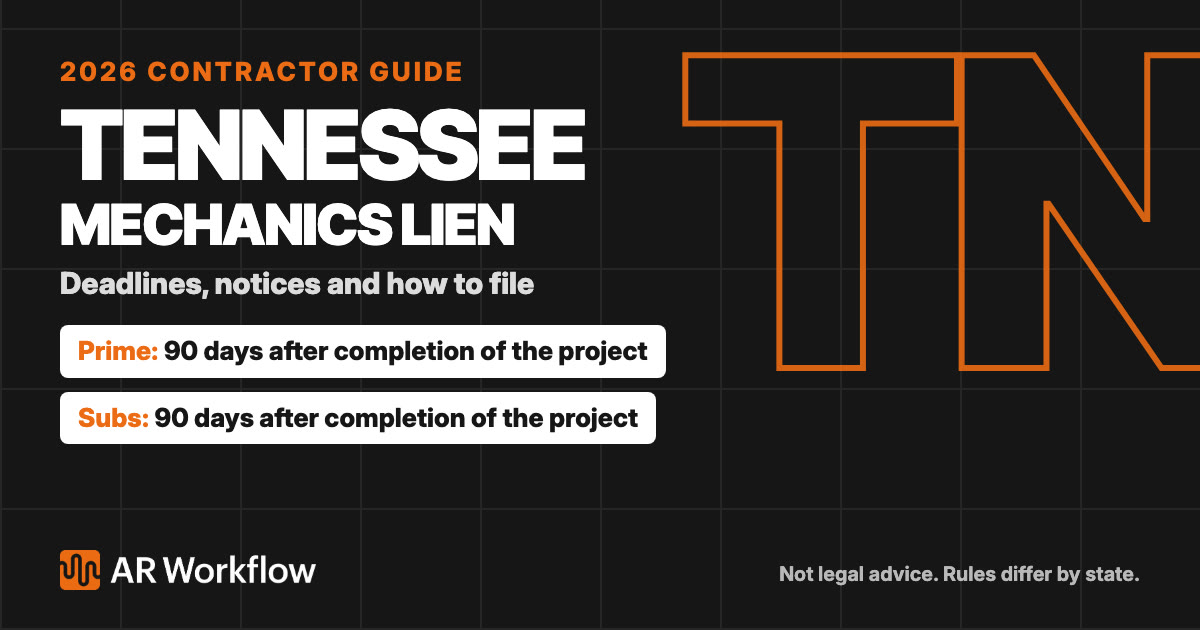
Quick answer: Tennessee mechanics lien deadlines
Prime: record the sworn statement within 90 days after completion/abandonment. Treat day 90 as a hard deadline: an unrecorded prime lien loses to a bona fide purchaser or lender (§ 66-11-112); the lien lasts 1 year after completion (§ 66-11-106). Remote contractors: BOTH serve the notice of lien on the owner and record it within 90 days after completion/abandonment (§§ 66-11-112, -115).
Last updated: November 23, 2026
This is not legal advice. Rules differ by state and change over time. We checked each rule below against the text of the Tennessee statute (Tenn. Code §§ 66-11-101 to -150) in November 2026. Read the current law or ask a Tennessee construction attorney before you file.
"Prime contractor" means you have a contract directly with the property owner. "Subcontractor" or "supplier" means you were hired by the prime contractor or by another sub. These rules are for private projects. Public projects use bond claims instead of liens.
| Rule | What Tennessee requires | Law |
|---|---|---|
| Preliminary notice: prime contractor | None. No lien-preserving preliminary notice applies to prime contractors. The § 66-11-145 notice of nonpayment applies only to remote contractors. Billd and Butler Snow mention a residential pre-work notice to the owner (Part 2, § 66-11-203). Butler Snow says omitting it does not defeat lien rights. Do not model it as a lien prerequisite. | Tenn. Code § 66-11-145(a) |
| Preliminary notice: subcontractor | A remote contractor (sub or sub-sub) must serve a notice of nonpayment on the owner and on the prime contractor it has privity with, if the account is in fact unpaid. The deadline is within 90 days of the last day of each month in which it furnished unpaid work or materials. This is a rolling notice per month. Without a compliant notice the remote 'shall have no right to claim a lien', except for retainage held to guarantee performance. The requirement does not apply to 1-, 2-, 3- or 4-family residential units of any occupancy. The notice must include: claimant name and address, a general description of the work, the amount owed as of the notice date, the last date work was performed, and a property description. | Tenn. Code § 66-11-145(a)-(c) |
| Preliminary notice: supplier | Same as prelim_sub. Suppliers to a prime or a sub are remote contractors and must give the monthly § 66-11-145 notice of nonpayment within 90 days after the end of each month of unpaid furnishing. Not required on 1-4 family residential. | Tenn. Code §§ 66-11-101(14), 66-11-145 |
| Notice of intent to lien | None. Tennessee has no pre-lien notice of intent. Do not confuse the monthly § 66-11-145 notice of nonpayment (remote) or the § 66-11-130 owner demand (which shortens enforcement) with a notice of intent. | Tenn. Code ch. 66-11, Part 1 (section list reviewed: §§ 66-11-101 to -150) |
| Lien filing deadline: prime contractor | The prime's lien exists without recording and lasts 1 year after the improvement is complete or abandoned (§ 66-11-106). To keep priority against later purchasers or encumbrancers for value without notice, the prime must do one of two things within 90 days after completion or abandonment: record its contract (§ 66-11-111) or record a sworn statement (notice of lien) with the county register of deeds. If it records late, priority runs from the recording date. The app should treat 90 days after completion as the RECORDING deadline (the practical hard date) and 1 year after completion as the SUIT deadline. Both can be cut short by a notice of completion (10/30 days, § 66-11-143(e)) or an owner demand (60 days, § 66-11-130). Abandonment means 90 days' cessation plus the owner's or prime's intent to cease permanently or indefinitely. | Tenn. Code §§ 66-11-106, 66-11-112(a)-(b) |
| Lien filing deadline: subcontractor and supplier | A remote contractor (sub, sub-sub or supplier) must do two things. First, comply with § 66-11-145 where it applies (not on 1-4 family). Second, within the § 66-11-112(a) period (90 days after the WHOLE improvement is complete or abandoned), serve a written notice of lien on the owner. Service is what creates the remote lien. Recording is not required by § 66-11-115 itself. However, § 66-11-112(a) applies to every 'lienor', so the remote must also record its sworn notice of lien within the same 90 days to keep priority against later purchasers and lenders. Law firm guidance (FBT, Billd, NCS, ALFA, Open Exam Prep) is to both serve AND record within 90 days. The app should require both. | Tenn. Code §§ 66-11-115(a)(2), (c); 66-11-112(a) |
| Residential projects | On 'residential real property' where the owner resides, or intends to reside, as a principal residence (1 unit, or 2-4 units with the owner in one unit), only the PRIME contractor has a lien (§ 66-11-146(a)). On a single-family residence where the owner and GC are the same person or commonly controlled, only lienors in privity with the owner or GC have a lien (§ 66-11-146(b)). Non-owner-occupied 1-4 unit properties keep remote lien rights, and no § 66-11-145 notice is needed there. The deadlines on 1-4 family jobs are the same as for other jobs (90 days / 1 year, remote 90-day suit). Only the notice-of-completion response window differs (10 days instead of 30). Unlicensed residential contractors have no lien where licensure is required (§ 66-11-150). | Tenn. Code §§ 66-11-146(a)-(b), 66-11-145, 66-11-143(e)(2)(A), 66-11-150 |
| Notice of completion: does it shorten the deadline? | Only after completion, the owner, a purchaser, or their agent may record a notice of completion with the register of deeds, or may require the contractor to record it. A notice recorded before completion is void (§ 66-11-143(f)). A copy must be served at the same time on the prime contractor, unless the owner or an entity it controls is the GC. A prime that is not served keeps its lien rights (a). A copy must also be served on every remote contractor that served a § 66-11-145 notice of nonpayment. Such a remote has 30 days to respond under (e), and an unserved remote keeps its rights (d). Under (e), any prime or remote claiming a lien that has not already recorded its contract (§ 66-11-111) or sworn statement (§ 66-11-112) AND served a copy on the owner must serve written notice of its claim amount. The notice must certify that it excludes amounts from other jobs. The deadline is not more than 10 days after recording for 1-4 family residential units, or 30 days for all other contracts. Otherwise its lien rights expire. Defense: record the sworn statement AND serve a copy on the owner early. That takes the claimant outside (e). | Tenn. Code § 66-11-143(a)-(g) |
| Serving the owner after you file | Except as provided in § 66-11-108, notices under ch. 66-11 are served in one of three ways: (1) registered or certified mail, return receipt requested; (2) hand delivery, proved by a notarized sworn statement of delivery; or (3) a commercial delivery service that gives written confirmation of delivery. Service is rebuttably presumed complete as follows: hand delivery on receipt; certified mail within 3 business days of mailing; commercial overnight one business day after delivery [per mirror; FBT reads it as within 1 business day of sending]. For § 66-11-145, names, addresses and the property description on the building permit are presumed correct, and service on a listed agent or listed owner is service on all principals or owners. The cite is § 66-11-149. § 66-11-148 is the liberal-construction / substantial-compliance section. | Tenn. Code § 66-11-149(a)-(d) (2007 ch. 189; 2008 ch. 811) |
| Deadline to sue (enforce the lien) | Remote: the lien lasts 90 days from the date the notice of lien is served on the owner. It continues only if a § 66-11-126 enforcement suit is brought within those 90 days. Prime: the lien lasts 1 year after completion or abandonment and continues if suit is brought within that year. Enforcement is only by a sworn complaint, petition or civil warrant seeking an attachment. A suit is timely if filed within the period even if the attachment issues later. The clerk requires an attachment bond of the lesser of $1,000 or the lien amount. If a bond was recorded under § 66-11-124, -136 or -142, suit is on the bond instead. Shortener: if the owner, the owner's agent or the prime serves a written demand, the lienor must sue (or file in a creditors' or foreclosure proceeding) within 60 days after service, or the lien is forfeited. | Tenn. Code §§ 66-11-106, 66-11-115(b), 66-11-126, 66-11-130 |
Roofing, restoration and remodeling work on homes often has extra rules. In Tennessee:
(1) Owner-occupied 1-4 units (principal residence): prime-only lien (§ 66-11-146(a)). (2) Single-family home where the owner is also the GC: only lienors in privity with the owner or GC (§ 66-11-146(b)). (3) § 66-11-145 monthly notice not required on any 1-4 family job (§ 66-11-145). (4) The notice-of-completion response window on 1-4 family jobs is 10 days, not 30 (§ 66-11-143(e)(2)(A)). (5) Licensure: § 66-11-102(a) says no lien is established if the lienor 'has not fully complied with title 62, chapter 6' (applies to all projects). § 66-11-150 separately bars liens on residential real property (single-family principal residence, as defined in § 66-11-146(b)(1)) for residential or home-improvement work by persons not licensed under Title 62 ch. 6 where the jurisdiction requires licensure. (6) Architect/engineer lien unavailable against owner-occupants of 1- or 2-family detached homes (§ 66-11-102(c)). (7) Non-contracting spouse: on a contract with one spouse, the other may object by serving written notice on the prime within 10 days after learning of the contract (§ 66-11-103). This is unchanged; the 2025 bill to make it 20 days did not pass.
On 'residential real property' where the owner resides, or intends to reside, as a principal residence (1 unit, or 2-4 units with the owner in one unit), only the PRIME contractor has a lien (§ 66-11-146(a)). On a single-family residence where the owner and GC are the same person or commonly controlled, only lienors in privity with the owner or GC have a lien (§ 66-11-146(b)). Non-owner-occupied 1-4 unit properties keep remote lien rights, and no § 66-11-145 notice is needed there. The deadlines on 1-4 family jobs are the same as for other jobs (90 days / 1 year, remote 90-day suit). Only the notice-of-completion response window differs (10 days instead of 30). Unlicensed residential contractors have no lien where licensure is required (§ 66-11-150).
A lien is a last resort. It costs time and money, and it can end the customer relationship. Most contractors get paid sooner with a clear follow-up plan:
Prime contractors: The prime's lien exists without recording and lasts 1 year after the improvement is complete or abandoned (§ 66-11-106). To keep priority against later purchasers or encumbrancers for value without notice, the prime must do one of two things within 90 days after completion or abandonment: record its contract (§ 66-11-111) or record a sworn statement (notice of lien) with the county register of deeds. If it records late, priority runs from the recording date. The app should treat 90 days after completion as the RECORDING deadline (the practical hard date) and 1 year after completion as the SUIT deadline. Both can be cut short by a notice of completion (10/30 days, § 66-11-143(e)) or an owner demand (60 days, § 66-11-130). Abandonment means 90 days' cessation plus the owner's or prime's intent to cease permanently or indefinitely. Subcontractors and suppliers: A remote contractor (sub, sub-sub or supplier) must do two things. First, comply with § 66-11-145 where it applies (not on 1-4 family). Second, within the § 66-11-112(a) period (90 days after the WHOLE improvement is complete or abandoned), serve a written notice of lien on the owner. Service is what creates the remote lien. Recording is not required by § 66-11-115 itself. However, § 66-11-112(a) applies to every 'lienor', so the remote must also record its sworn notice of lien within the same 90 days to keep priority against later purchasers and lenders. Law firm guidance (FBT, Billd, NCS, ALFA, Open Exam Prep) is to both serve AND record within 90 days. The app should require both.
Send any required notices first, then record your lien claim before the deadline and serve the owner. Prime contractors: 90 days after completion of the project. Subcontractors and suppliers: 90 days after completion of the project. Then sue to enforce it on time, or release it once you are paid. The step-by-step section above walks through each part.
A remote contractor (sub or sub-sub) must serve a notice of nonpayment on the owner and on the prime contractor it has privity with, if the account is in fact unpaid. The deadline is within 90 days of the last day of each month in which it furnished unpaid work or materials. This is a rolling notice per month. Without a compliant notice the remote 'shall have no right to claim a lien', except for retainage held to guarantee performance. The requirement does not apply to 1-, 2-, 3- or 4-family residential units of any occupancy. The notice must include: claimant name and address, a general description of the work, the amount owed as of the notice date, the last date work was performed, and a property description.
None. Tennessee has no pre-lien notice of intent. Do not confuse the monthly § 66-11-145 notice of nonpayment (remote) or the § 66-11-130 owner demand (which shortens enforcement) with a notice of intent.
(1) Owner-occupied 1-4 units (principal residence): prime-only lien (§ 66-11-146(a)). (2) Single-family home where the owner is also the GC: only lienors in privity with the owner or GC (§ 66-11-146(b)). (3) § 66-11-145 monthly notice not required on any 1-4 family job (§ 66-11-145). (4) The notice-of-completion response window on 1-4 family jobs is 10 days, not 30 (§ 66-11-143(e)(2)(A)). (5) Licensure: § 66-11-102(a) says no lien is established if the lienor 'has not fully complied with title 62, chapter 6' (applies to all projects). § 66-11-150 separately bars liens on residential real property (single-family principal residence, as defined in § 66-11-146(b)(1)) for residential or home-improvement work by persons not licensed under Title 62 ch. 6 where the jurisdiction requires licensure. (6) Architect/engineer lien unavailable against owner-occupants of 1- or 2-family detached homes (§ 66-11-102(c)). (7) Non-contracting spouse: on a contract with one spouse, the other may object by serving written notice on the prime within 10 days after learning of the contract (§ 66-11-103). This is unchanged; the 2025 bill to make it 20 days did not pass.
Remote: the lien lasts 90 days from the date the notice of lien is served on the owner. It continues only if a § 66-11-126 enforcement suit is brought within those 90 days. Prime: the lien lasts 1 year after completion or abandonment and continues if suit is brought within that year. Enforcement is only by a sworn complaint, petition or civil warrant seeking an attachment. A suit is timely if filed within the period even if the attachment issues later. The clerk requires an attachment bond of the lesser of $1,000 or the lien amount. If a bond was recorded under § 66-11-124, -136 or -142, suit is on the bond instead. Shortener: if the owner, the owner's agent or the prime serves a written demand, the lienor must sue (or file in a creditors' or foreclosure proceeding) within 60 days after service, or the lien is forfeited.
See mechanics lien deadlines for all 50 states
Get paid before it gets to a lien.
AR Workflow works with QuickBooks and follows up on every invoice for you, from the first friendly reminder to the final notice. Bring one overdue invoice to a demo and see what we would send, and when.
Sam owned and ran three restoration companies for more than 14 years and collected over $100 million in receivables. He built AR Workflow in 2020 to give contractors the collections system he wished he'd had.

AI writes the emails, sends the texts, and leaves the voicemails. Your team handles the conversations that matter, and your cash keeps moving.
 Keep QuickBooksStart with one invoiceStay in control

 Log in