How to improve your collections process in 9 steps: prioritize overdue invoices, set a reminder schedule, track DSO and CEI, and get paid on time.

If you are working out how to improve your collections process, start with an honest look at how it performs today. A collections process can look organized on paper while still producing disappointing results. Your team may already have payment terms, follow-up procedures, and people responsible for collecting outstanding invoices.
Yet late payments continue to increase, and the time employees spend managing them doesn't seem to decrease.
When that happens, the next step is to examine how well your existing procedures actually work. You need to understand which activities help move payments forward and which parts of the process create unnecessary delays.
Improving collections performance starts with identifying those weaknesses and making changes your team can maintain consistently. So, how do you determine what needs improvement, and which changes will have the greatest impact on your collection efforts? This guide walks through nine collections best practices, the KPIs that show whether they work, a collections strategy for each type of payer, and a 30-day plan to put it all in place.
KEY TAKEAWAYS
A collections process becomes inefficient when the work involved in collecting outstanding invoices doesn't consistently produce progress toward payment.
This doesn't necessarily mean employees aren't making enough customer calls or sending enough reminders. The issue often lies in how the company organizes those activities and whether employees have the information they need to decide what to do next.
Several operational weaknesses can contribute to this:
Employees may contact customers when an invoice first becomes overdue but lack a clear schedule for subsequent communication. This allows outstanding accounts to go without attention for extended periods, even when the team has already started collection efforts.
When employees treat every overdue invoice with the same urgency, they may spend time contacting accounts that need little attention while overlooking larger balances or accounts with unresolved payment issues. This makes it harder to direct collection efforts toward the accounts that require immediate action.
An accounts receivable (AR) aging report shows how long invoices have remained outstanding, but it doesn't necessarily explain what employees have done to collect them.
Without access to previous communications and payment commitments, employees must spend additional time determining each account's status.
When several employees share collection duties without clearly assigned accounts or tasks, they can duplicate work or assume someone else will handle the next follow-up. This creates gaps in the process that can go unnoticed until an invoice becomes significantly overdue.
Employees who rely on manual accounts receivable processes, such as spreadsheets or individual reminders, must continually check payment deadlines and update records. As outstanding invoices increase, these repetitive activities take time away from accounts that require more attention.
Routine reminders eventually become ineffective when an account has an unresolved dispute or requires additional documentation. Without clear escalation rules, employees may continue sending reminders without addressing the reason payment hasn't arrived.
These problems often affect one another. That's why improving the collections side of your accounts receivable process requires addressing these weaknesses together so that each collection activity has a clear purpose and leads to an appropriate next action.
The most effective way to improve collections is to examine how your team manages outstanding invoices from the moment payment becomes due until the account reaches resolution. Here are nine best practices to address different parts of that process.
| 1 | Review your current accounts receivable collections performance |
| 2 | Prioritize invoices with overdue payments |
| 3 | Establish a consistent payment reminder schedule |
| 4 | Assign clear responsibilities for collections |
| 5 | Improve payment tracking and recordkeeping |
| 6 | Set clear escalation procedures |
| 7 | Make it easier for customers to pay |
| 8 | Automate repetitive AR collection tasks |
| 9 | Track your accounts receivable performance and make adjustments |
Reviewing your current cash collections performance means examining how long invoices remain unpaid, how consistently your team contacts customers, and which issues prevent accounts from reaching resolution.
This step gives you a starting point for improving the process of collecting accounts receivable. Without understanding where delays occur, you could spend time changing procedures that already work while overlooking the activities that need attention.
Begin with your accounts receivable aging report to identify how much money sits in each aging category. Pay particular attention to invoices that have remained outstanding for 60 or 90 days because these balances can reveal recurring collection problems.
Next, review the collection history of those accounts. Determine whether employees contacted the payer according to schedule and whether the account has an unresolved issue.
You should also examine how much time your team spends on routine collection work. If employees spend a significant portion of their day checking spreadsheets or preparing reminders, that workload deserves attention.
Use these findings to identify the specific changes you need to improve accounts receivable collections. This gives your team a clearer basis for deciding which accounts to prioritize and which procedures to improve.
Prioritizing overdue invoices means determining which outstanding accounts need attention first based on their payment status and the circumstances behind the delay.
This step helps your team prioritize collection efforts toward past-due accounts that require action instead of treating every unpaid invoice as equally urgent.
To do this, start by grouping outstanding invoices according to how long they have remained unpaid. Then review the balance and payment history of each account to understand its collection priority.
Invoice age alone shouldn't determine the order. A recently overdue account with a large balance and an unresolved payment issue may deserve attention before an older invoice with a confirmed payment date.
For restoration companies, the reason for nonpayment also deserves consideration. An invoice awaiting insurance documentation requires a different action than an account where the payer has missed an agreed payment deadline.
Once you've identified your priorities, assign the appropriate next action to each account. Our guide to collecting unpaid invoices walks through those next actions step by step, including a call script and payment plan guidance.
Review those priorities regularly because a customer's payment behavior and account status can change. An account that required little attention last week may need immediate follow-up if the payer misses a commitment.
A payment reminder schedule defines when your team contacts customers about outstanding invoices and how communication should continue when payment doesn't arrive.
It gives employees a consistent approach to follow-up while reducing the chance that an overdue account receives attention only when someone happens to review it.
Start by reviewing your existing payment terms, including any early payment discounts your company offers to encourage customers to pay sooner. Then, set reminder intervals based on those terms so your team knows when to contact customers before their invoices become due and when to follow up if payment remains outstanding.
For instance, your team could use the following schedule as a starting point:
| Timing | Recommended action |
|---|---|
| 3 days before the due date | Send a courtesy reminder with the payment details |
| 1 day after the due date | Notify the payer that the invoice is overdue |
| 7 days overdue | Request an update on the expected payment date |
| 14 days overdue | Contact the payer directly to discuss the outstanding balance |
| 30 days overdue | Review the account and determine the appropriate next action |
Adjust the schedule based on your customer agreements and why payment remains outstanding.
Your team should also record responses and update the next follow-up date whenever a payer provides new information. This helps employees communicate in a timely manner without sending reminders that no longer reflect the account's circumstances.
For ready-to-use wording at each stage, copy our payment reminder email templates for contractors. Here is a short example of a 7-day collection follow-up:
TEMPLATE
Subject: Invoice #[number] is 7 days past due
Hi [Name], invoice #[number] for [job address] was due on [date] and still shows a balance of $[amount]. Can you reply with the date we should expect payment? If something on the invoice is holding it up, tell me what you need and I will send it today. You can pay here: [payment link].
Thanks, [Your name], [Company], [phone]
The question in the middle matters. Asking for a date turns a reminder into a commitment you can track, and asking what is holding the invoice up surfaces disputes early instead of at 60 days.
Tip: On insurance jobs, keep two tracks. Send status requests and documentation to the adjuster, and send payment reminders to the homeowner for their share, such as the deductible. Never send a payment link to an adjuster or carrier.
Assigning collection responsibilities means establishing who manages each account and who handles the different activities involved in collecting payments owed. This step prevents gaps in communication and gives employees a clear understanding of what they need to complete.
Start by determining who should manage routine collection activities, including payment reminders and account updates.
Then assign responsibility for reviewing accounts that require additional attention. Your AR manager or finance leader may need to handle disputed balances or approve payment arrangements, depending on your company's procedures.
Make sure every outstanding account has an identifiable owner. The person responsible should know the account's current status, the next action, and when that action needs to happen.
You should also establish how employees transfer responsibility when someone is unavailable or when an account requires escalation. Keep those changes documented so another employee can continue the collection process without repeating previous work.
Clear responsibilities also make it easier for managers to review collection activity and identify tasks that employees haven't completed.
Payment tracking supports accounts receivable management by maintaining accurate information about outstanding balances and the collection activities associated with each account. It helps employees understand what has already happened before deciding how to proceed with an overdue invoice.
Start by establishing a consistent way to record collection communications. Every meaningful interaction should include the contact date, the payer's response, and any action your team needs to take afterward.
If a customer promises to pay on a specific date, record that commitment and schedule a follow-up if payment doesn't arrive.
You should also document payment disputes and requests for additional information so employees can track whether those issues have reached resolution.
Keep these records in a system that authorized employees can access when managing collections. This helps protect customer relationships by reducing the need for employees to repeat questions while searching through individual emails or asking colleagues for account updates.
Accurate records also help managers identify overdue accounts that haven't received attention and review whether employees are completing their assigned collection activities.
Escalation procedures establish when routine collection activities should move to someone with the authority or expertise to address a more complicated payment issue. They prevent employees from repeatedly following the same reminder schedule when an account requires a different response.
Start by identifying the circumstances that should trigger an escalation. These may include repeated missed payment commitments, unresolved disputes, or delinquent accounts that exceed your company's established overdue threshold.
Then determine who should review each type of issue. An AR manager may handle repeated nonpayment, while a finance leader may need to approve payment arrangements or decisions involving significant outstanding balances.
Restoration companies should also account for insurance-related delays. If a payer requests additional documentation, your team needs to resolve that requirement before expecting the collection process to move forward.
Document the escalation decision and the next action so everyone handling the account understands what needs to happen.
If an account requires assistance from a collections agency, review the applicable contractual and legal requirements before proceeding.
Making payment easier means reducing unnecessary steps that customers must complete before settling an outstanding invoice. Even when a customer intends to pay, unclear payment instructions or inconvenient payment methods can delay the transaction.
Start by reviewing how customers receive payment information. Your invoices should clearly identify the customer's payment obligations, including the outstanding balance and payment deadline. They should also explain which payment methods the customer can use.
Consider offering multiple payment options, including card and ACH contractor payments, so customers can settle invoices without arranging a check or contacting your office for additional instructions.
Online payment options can also help your business collect funds directly from customers through a payment link. If your company offers payment plans, establish clear approval procedures and document the agreed payment schedule.
Make sure employees understand how to monitor those arrangements and when to contact customers about missed installments.
Review customer payment questions regularly. If employees repeatedly receive requests for the same information, improve the instructions your company provides.
The easier customers can understand and complete the payment process, the fewer obstacles your team needs to resolve to encourage timely payments.
Automating collection tasks means using software to handle routine activities that follow established rules or schedules. This helps your team maintain a consistent AR collections process without manually initiating every reminder or checking every account individually.
Start by reviewing which activities consume the most employee time. Scheduled payment reminders are a practical starting point because they follow predictable deadlines, and automated payment reminders can send them on schedule by email and text.
With collections automation software, your team can establish when reminders should go out and allow the system to send them according to those rules.
Depending on your system's capabilities, you can also use automation to organize outstanding accounts and track collection activity.
However, review which situations require employee involvement before automating communication. Disputed invoices and unresolved insurance-related issues often require someone to investigate the account and determine the next action.
Your goal should be to automate repetitive work while keeping employees responsible for decisions that require judgment. This gives your team more time to address collection issues that routine reminders cannot resolve.
Tracking collection performance supports cash management by helping you review whether your procedures collect outstanding balances efficiently. This step helps you determine which improvements are working and where additional changes are necessary.
Start by monitoring your aging report over time to identify payment trends. Compare the balances in each aging category to see whether your team is reducing older past-due receivables or allowing more invoices to remain unpaid for extended periods.
You should also track days sales outstanding (DSO), which measures the average time your company takes to collect receivables after making credit sales.
The accounts receivable turnover ratio provides another perspective by showing how frequently your business collects its average accounts receivable during a given period.
You can also monitor the collection effectiveness index to understand how much of the available receivables your team successfully collects.
These are the standard formulas. Calculate them the same way every month so the trend means something.
| KPI | Formula | What it tells you |
|---|---|---|
| Days sales outstanding (DSO) | (Ending AR / credit sales for the period) x days in the period | How many days, on average, it takes to turn an invoice into cash |
| Collection effectiveness index (CEI) | (Beginning AR + credit sales - ending total AR) / (beginning AR + credit sales - ending current AR) x 100 | What share of the money you could have collected this period you actually collected |
| AR turnover ratio | Net credit sales / average AR | How many times a year you collect your average receivables balance |
| Percent of AR over 90 days | AR older than 90 days / total AR x 100 | How much of your balance is at real risk of never being paid |
| Promise-to-pay kept rate | Payment promises kept on time / promises made x 100 | Whether your follow-up is producing commitments that turn into cash |
DSO is the headline number, but it moves with sales volume. A big month of new jobs can make DSO look worse even when collections are improving. CEI corrects for that because it compares what you collected with what was collectible, which makes it the better test of collection efficiency.
Together, these key metrics help you evaluate your collections performance, while your collection records provide more context on what's contributing to the results. AR reporting software can keep those numbers current without manual spreadsheets.
If older overdue balances continue increasing and contribute to cash flow issues, examine whether the delays come from inconsistent follow-up or payment problems that require additional attention.
Treat collection process improvement as an ongoing cycle. Use what you learn to adjust your collection procedures and monitor the results during the next review period.
One reminder schedule for every account is a common reason collections stall. Contractors usually bill several kinds of payers, and each one pays for different reasons. A collections strategy that works sets the channel, tone and escalation path by payer type.
| Payer | Why they pay late | What works |
|---|---|---|
| Homeowners | Forgetting, cash timing, confusion about what insurance covers | Short text and email reminders with a payment link, a plain explanation of what they owe and why, and a payment plan offer before 30 days |
| Commercial customers and property managers | Approval chains, missing PO numbers or lien waivers, net 30 to net 60 terms | Confirm the AP contact and required paperwork before you invoice, then follow up on the invoice status, not just the balance |
| Insurance carriers and adjusters | Missing documentation, scope disagreements, review queues | Status requests and supporting documents on a set schedule. Never a payment link |
| Mortgage companies | Loss draft departments hold claim checks until inspections and paperwork are done | Help the homeowner send the endorsement packet and track each release on its own follow-up date |
The same idea applies by trade. A roofing or restoration company with insurance work needs the two-track approach above. An HVAC or plumbing service company with many small residential tickets gets the most from fast, automated reminders right after the job. A remodeler or general contractor with large progress invoices needs fewer, more personal touches and a clear escalation path to the owner.
You do not need to fix everything at once. This plan gets the basics in place in a month without stopping day-to-day work.
| Week | Focus |
|---|---|
| Week 1: Baseline | Run the aging report, record DSO, CEI and percent over 90 days, and list every account over 60 days with its owner and reason for delay. |
| Week 2: Clean up | Work the oldest and largest balances first. Resolve disputes, send missing documents, and get a payment date or payment plan on each one. |
| Week 3: Standardize | Write down the reminder schedule, templates, escalation triggers and who owns which accounts. Add payment instructions and a payment link to every new invoice. |
| Week 4: Automate and measure | Move routine reminders into software, set a weekly 30-minute AR review, and compare your KPIs with the week 1 baseline. |
Tip: Keep the weekly AR review short and fixed on the calendar. Review only accounts that changed bucket, missed a promise or need escalation. A meeting that covers every invoice will stop happening within a month.
Bring one overdue invoice.
We'll show you how your team can keep collections moving without manually managing every part of the process.
The previous steps establish a more organized way to manage outstanding invoices. However, employees still need to maintain reminder schedules and update collection records as account statuses change.
When your restoration company handles more invoices, these activities can take up a growing portion of your team's time.
Accounts receivable automation helps reduce that workload by handling collection activities that follow established schedules. If you run on QuickBooks Online, QuickBooks collections automation works from the invoices already in your books, so there is no second system to keep in sync.
For example, employees can create reminder rules that trigger payment notifications at set intervals. The system can then manage those routine communications while employees focus on accounts that require investigation or direct contact.
Automation also helps teams maintain consistent collections management as invoice volume increases. Employees can spend less time checking individual payment deadlines and more time resolving issues that prevent customers from paying.
AR Workflow supports this approach through an accounts receivable automation and payments platform built for restoration companies and other contractors.
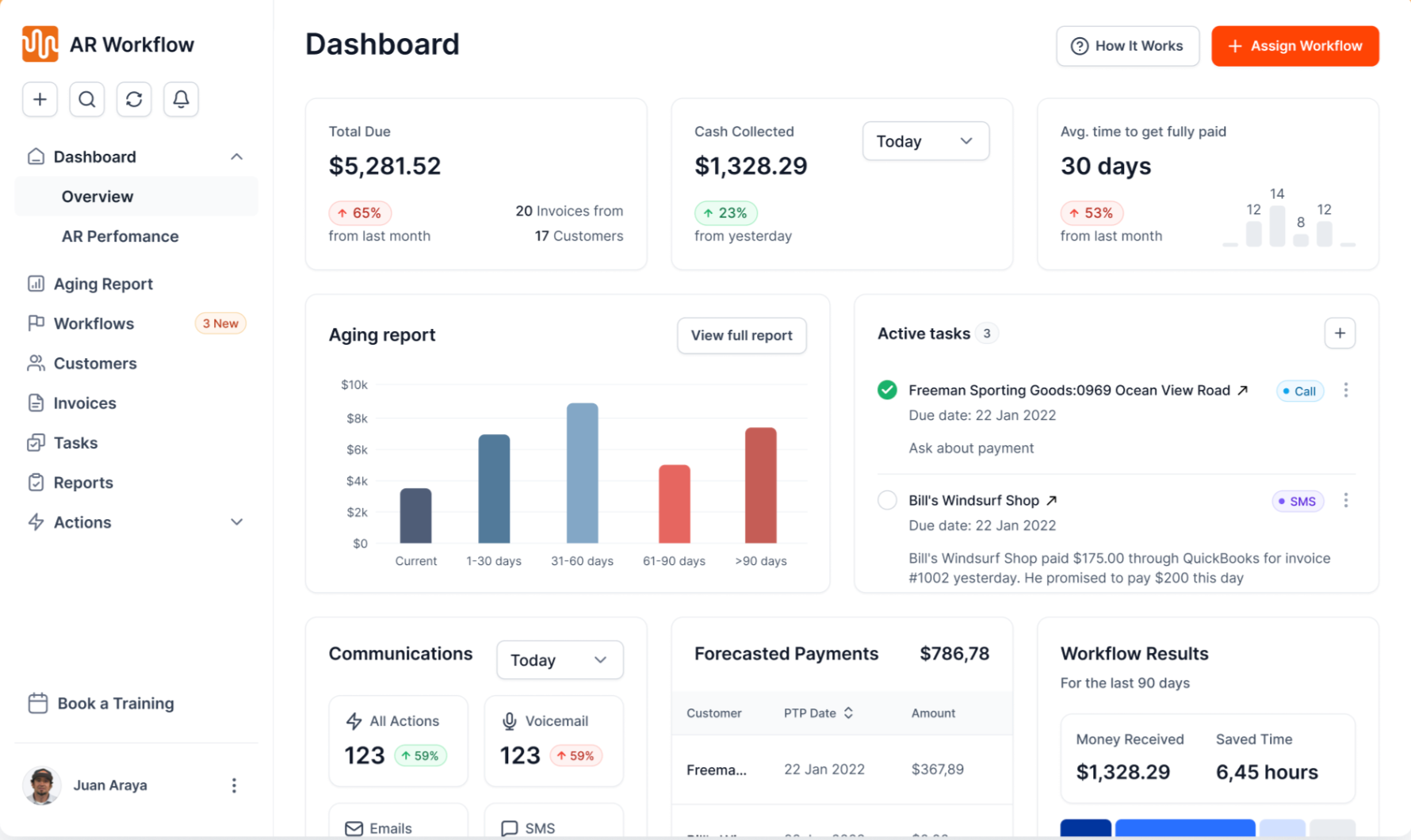
The AR Workflow dashboard shows outstanding receivables and what needs attention.
Its automated email and SMS reminders, with texts sent from a dedicated number, help teams maintain consistent communication with payers. Its collection workflows also help employees organize outstanding accounts and manage collection activity.
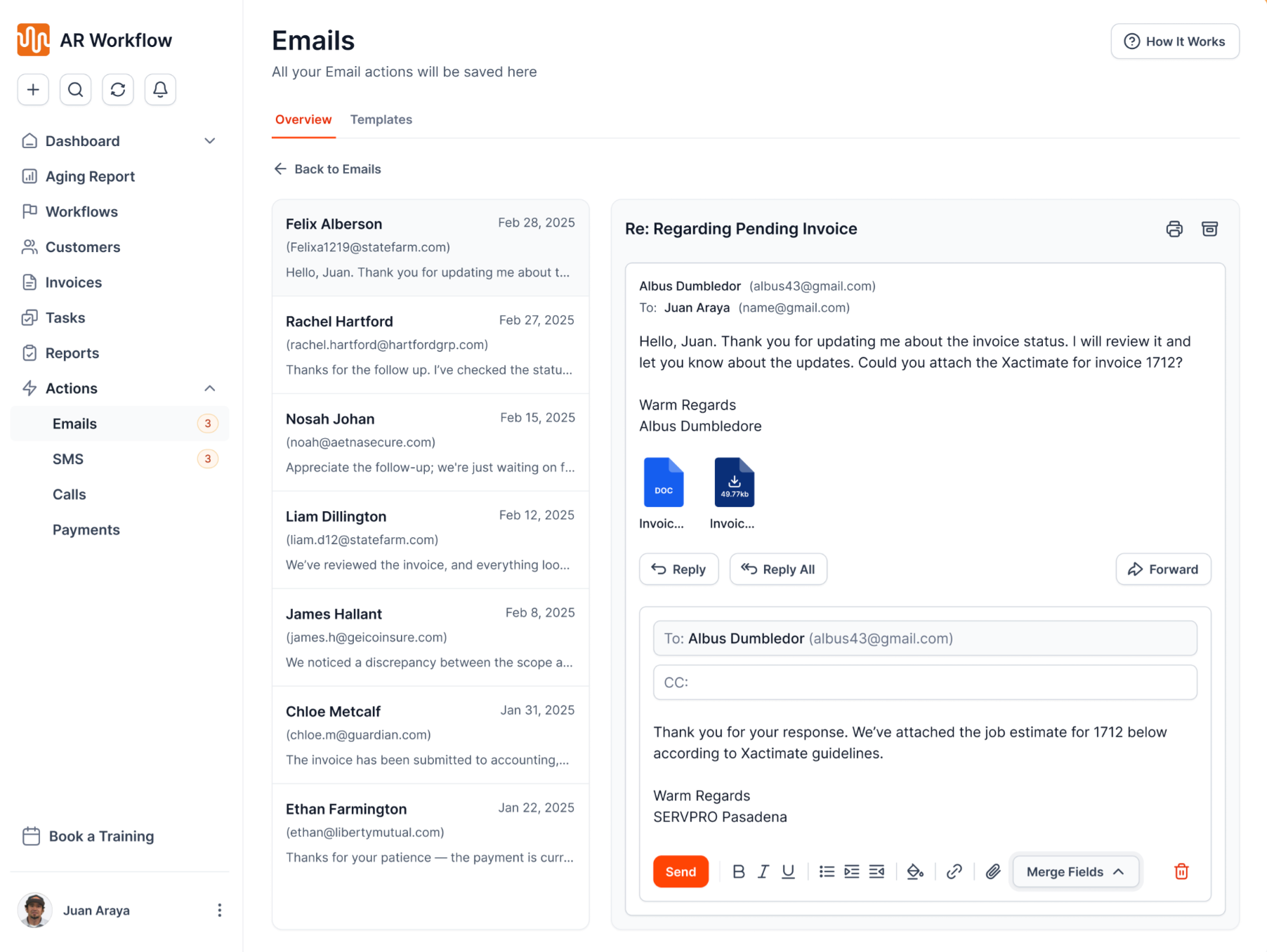
Scheduled email reminders go out according to your collection workflow.
With better visibility into unpaid invoices, finance leaders can identify which balances need attention and review how their collection efforts are progressing.
These capabilities help restoration companies manage collections without increasing administrative work at the same rate as outstanding invoices.
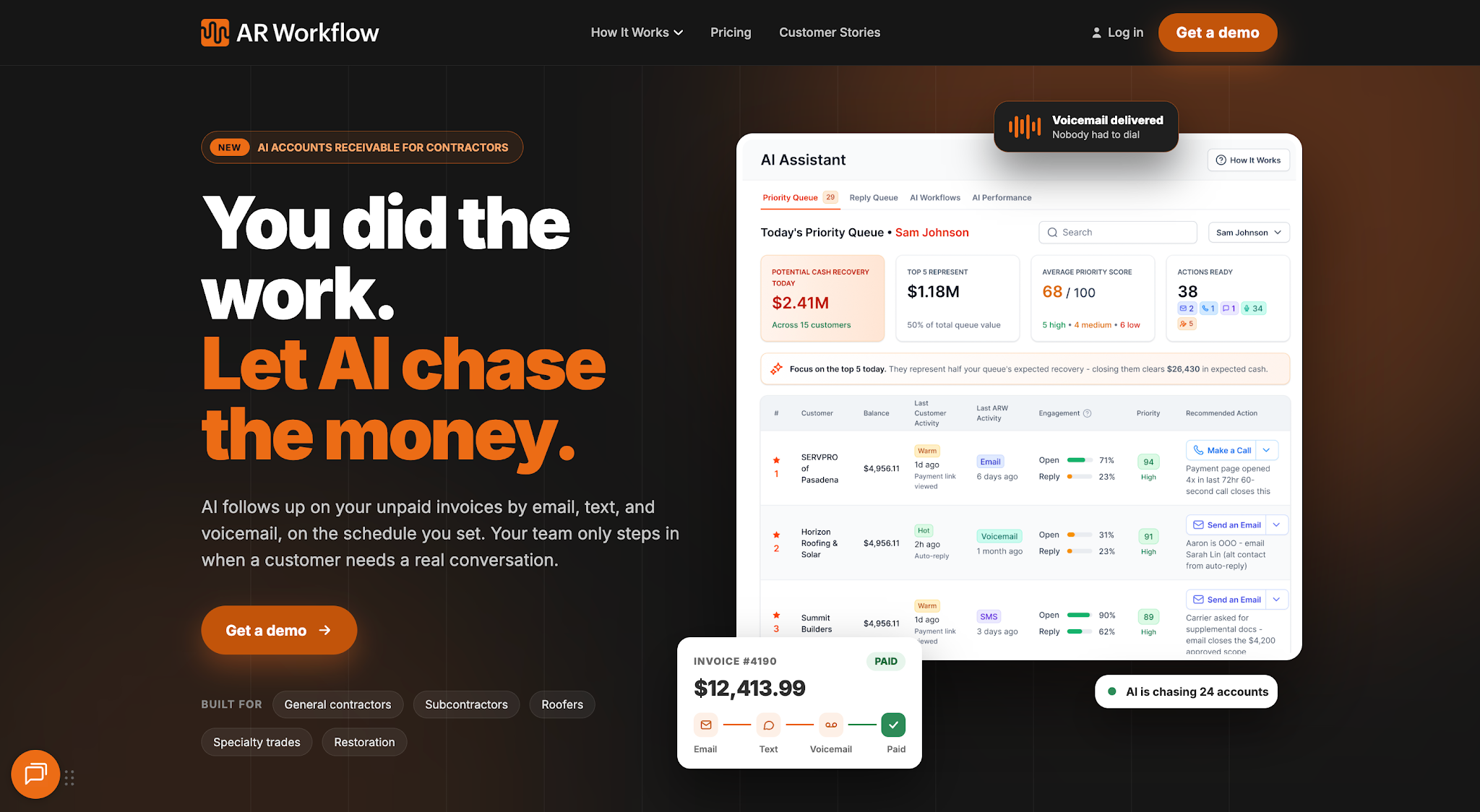
AR Workflow connects to QuickBooks Online and runs follow-up on your open invoices.
Improving collections requires understanding what causes delays and making sure your team has a consistent way to address them.
Clear responsibilities and organized records help employees manage outstanding accounts, while regular performance reviews show where the process still needs improvement.
AR Workflow helps contractors keep these improvements in place by automating routine collection activities and making outstanding receivables easier to manage. That way, employees can spend more time resolving payment issues that require their attention.
The goal is simple: the work your company has already completed should turn into cash on a predictable schedule, so you have money available to run and grow the business.
Start by finding where invoices stall. Review your aging report and collection notes, then rank overdue accounts by balance and reason for delay. Set a fixed reminder schedule, give every account an owner, and automate routine reminders. Review DSO and your aging buckets each month and adjust what is not working.
A proactive collections strategy that combines early payment reminders with consistent follow-ups is one of the most effective approaches. Segment it by payer type, because a homeowner, a commercial customer and an insurance carrier respond to different follow-up. Escalate on clear triggers, such as a missed payment promise, instead of waiting for an invoice to reach 90 days.
Send payment reminders before invoices become overdue, contact customers promptly after missed deadlines, and ask for a specific payment date on every call. Offer payment plans when a customer cannot pay in full. If an account still does not resolve, review your contract and the applicable rules before using an agency or filing a lien, since requirements vary by state.
CEI runs from 0 to 100, and the closer to 100, the more of your collectible receivables you collected in the period. There is no single benchmark that fits every industry, so the most useful comparison is your own CEI month over month. A falling CEI is an early warning that follow-up is slipping, often before DSO shows it.
Invoice the day the work is approved, put clear terms and a payment link on every invoice, and send the first reminder before the due date. Resolve disputes and missing documentation quickly, because those invoices age the fastest. Automating routine reminders keeps follow-up consistent when the office is busy.
The core accounts receivable collections best practices are clear payment terms, a written reminder schedule, an owner for every account, accurate notes on every contact, and defined escalation steps. Track DSO, CEI and the share of AR over 90 days so you can see whether the process is working. Review the process each quarter and adjust templates and timing based on what customers respond to.
Related reading
Your invoice, not a feature tour.
Bring one overdue invoice to a demo and see what AR Workflow would send, when, and how your customer would pay.
Sam owned and ran three restoration companies for more than 14 years and collected over $100 million in receivables. He built AR Workflow in 2020 to give contractors the collections system he wished he'd had.

AI writes the emails, sends the texts, and leaves the voicemails. Your team handles the conversations that matter, and your cash keeps moving.
 Keep QuickBooksStart with one invoiceStay in control

 Log in