Stop insurance price reductions on restoration invoices: why adjusters cut Xactimate lines, a pre-submission checklist, and how to dispute an underpayment.

When you submit an invoice to a customer's insurance company, you do not just want it to be paid. You want it to be paid in full. Unfortunately, insurance price reductions are a routine part of restoration billing, and every line an adjuster cuts comes straight out of your payment.
This guide explains why adjusters push back on restoration invoices, the most common types of Xactimate reductions, a pre-submission checklist, and how to submit bills that get paid without a price reduction: a working relationship with the adjuster, accurate invoices, and documentation that supports every line. It also covers what to do, step by step, when an insurance claim underpayment happens anyway.
KEY TAKEAWAYS
Insurers have a reason for asking you to justify your invoices. Insurance fraud is a real problem. In a 2012 survey of U.S. insurers by the Property Casualty Insurers Association of America (PCI) and FICO, insurers estimated that fraud accounts for 5 to 10 percent of their claims costs, and almost a third of them put it as high as 20 percent. With numbers like that, it is hard to blame adjusters for being skeptical.
Knowing that they are skeptical means you can take steps to avoid raising their suspicions. An invoice that is vague, late, or missing support gives an adjuster an easy reason to question a charge. An invoice that is clear, on scope, and documented gives them less to push back on. For the bigger picture on carrier billing, see our restoration insurance billing guide.
Carriers also manage claim costs through estimating software, desk reviews and third-party estimate audits. That means your invoice may be reviewed by someone who never saw the job site, comparing your lines against a price list and a set of carrier guidelines. Write the invoice for that reader: someone who needs to see, on paper, why every charge exists.
Most cuts to a restoration invoice fall into a handful of patterns. Knowing them tells you what to check before you submit and what to look for when the carrier's revised estimate comes back.
| Reduction | What it looks like | How to prevent it |
|---|---|---|
| Line item removed | A charge is deleted entirely, often a cleaning, protection or setup item | Photos and notes that show the item was needed and performed |
| Quantity cut | Fewer square feet, linear feet or hours than you billed | Measurements, sketches and room-by-room quantities |
| Unit price lowered | The same line at a lower rate, usually the Xactimate price list for the area | Bill from the correct price list, and attach supplier invoices when actual costs are higher |
| Equipment days cut | Fewer drying days for air movers or dehumidifiers | Daily moisture readings and equipment logs showing when materials reached dry standard |
| Overhead and profit removed | O&P is left off the estimate | An explanation of the trades involved and the coordination the job required |
| Scope not approved | Work outside the original estimate is denied | Signed change authorizations and a supplement sent as soon as extra damage is found |
Some carriers also apply depreciation to labor or hold back recoverable depreciation until the work is complete. Whether and how that is allowed depends on the policy, and the rules vary by state, so check the policy language and your state's regulations rather than assuming.
To submit bills that get paid in full, focus on three things you control.
| 1 | Forge a collaborative relationship with the adjuster |
| 2 | Do the job you are contracted to do and invoice it accurately |
| 3 | Support every invoice with solid documentation |
Be professional, trustworthy, and reliable. Adjusters handle a lot of files, and the contractors who make their job easier tend to get fewer questions. Respond quickly, keep them updated, and treat them as a partner in closing the claim rather than an obstacle. Our guide to collaborating with insurance adjusters goes deeper on building that relationship.
Stay within the agreed scope, and make sure the invoice reflects exactly what was done. Every line should match the work performed and the scope that was approved. Errors and unexplained charges are where price reductions start.
Many carriers write and review restoration estimates in Xactimate, so your line items are often checked against the Xactimate price list for your area. Xactimate reductions usually show up as a line item removed, a quantity cut, or a lower unit price than you billed, so make sure each line has the support to stand on its own.
Xactimate, from Verisk, is the estimating platform most property carriers use. Its price lists are built by region and updated regularly to reflect local material and labor costs. When an adjuster reviews your invoice, they often compare each line to the price list for the property's location and the date of the work.
Even if you bill outside Xactimate, expect your invoice to be checked against it. Building your invoice in the same structure removes a common reason for Xactimate reductions.
Submit accurate invoices that are supported by solid documentation. Photos, readings, notes and signed paperwork show the adjuster why each charge exists. See bulletproof documentation for what to capture on every job.
On water jobs, the drying record matters most: initial and daily moisture readings, the equipment placed in each room, and the date each area reached dry standard. Our guide to water mitigation adjuster billing covers how those records map to the invoice.
Run every insurance invoice through this checklist before it goes to the carrier:
CHECKLIST
Tip: With the carrier, follow up with status requests and documentation, not a payment link. Save payment links for the homeowner's portion, such as the deductible.
What if you run into an unreasonable adjuster? Thankfully, the same thorough documentation that paved the way for efficient collaboration can help you defend your invoice. Treat a cut like any other insurance claim underpayment: find out exactly which lines changed, then answer each one with the record behind it.
While the dispute is open, make sure the homeowner understands what is still owed and by whom. Our guide on collecting from carriers, adjusters and homeowners covers how to split that follow-up.
| If the adjuster questions | Respond with |
|---|---|
| Whether the work was needed | Photos, readings and notes from the job |
| Whether the work was in scope | The approved scope and any signed changes |
| A specific line item | A clear explanation of that charge and the supporting record |
| What was agreed earlier | Your saved communication history with the adjuster |
Keep the tone professional, answer the specific question, and send the record that backs it up. Here is a simple structure for that reply:
TEMPLATE
Subject: Claim [number], [property address]: response to revised estimate
Hi [Adjuster name],
Thank you for the revised estimate dated [date]. We have reviewed it line by line. We agree with the changes to [line items], and have updated our invoice. For the following items, we have attached the supporting records:
1. [Line item]: [what was changed]. Attached: [photos, readings, measurements or supplier invoice] showing [why the original charge is correct].
2. [Line item]: [what was changed]. Attached: [record].
Could you review these and let us know if you need anything else? We are happy to schedule a call or re-inspection.
Thank you,
[Name], [Company], [Phone]
For more on keeping claims moving, read how restoration contractors get paid faster on insurance claims and our insurance adjuster invoice guide.
Bring one overdue invoice.
We'll show you how its communications, notes and documents would stay together in AR Workflow.
How does AR Workflow make the process of dealing with adjusters easier? For starters, it stores your communications automatically. It also allows you to make notes so you do not forget details that matter.
The platform also lets you upload documents for your customers. It is easy to attach them to an email to support your invoice. You can even have them included automatically as part of a collection workflow.
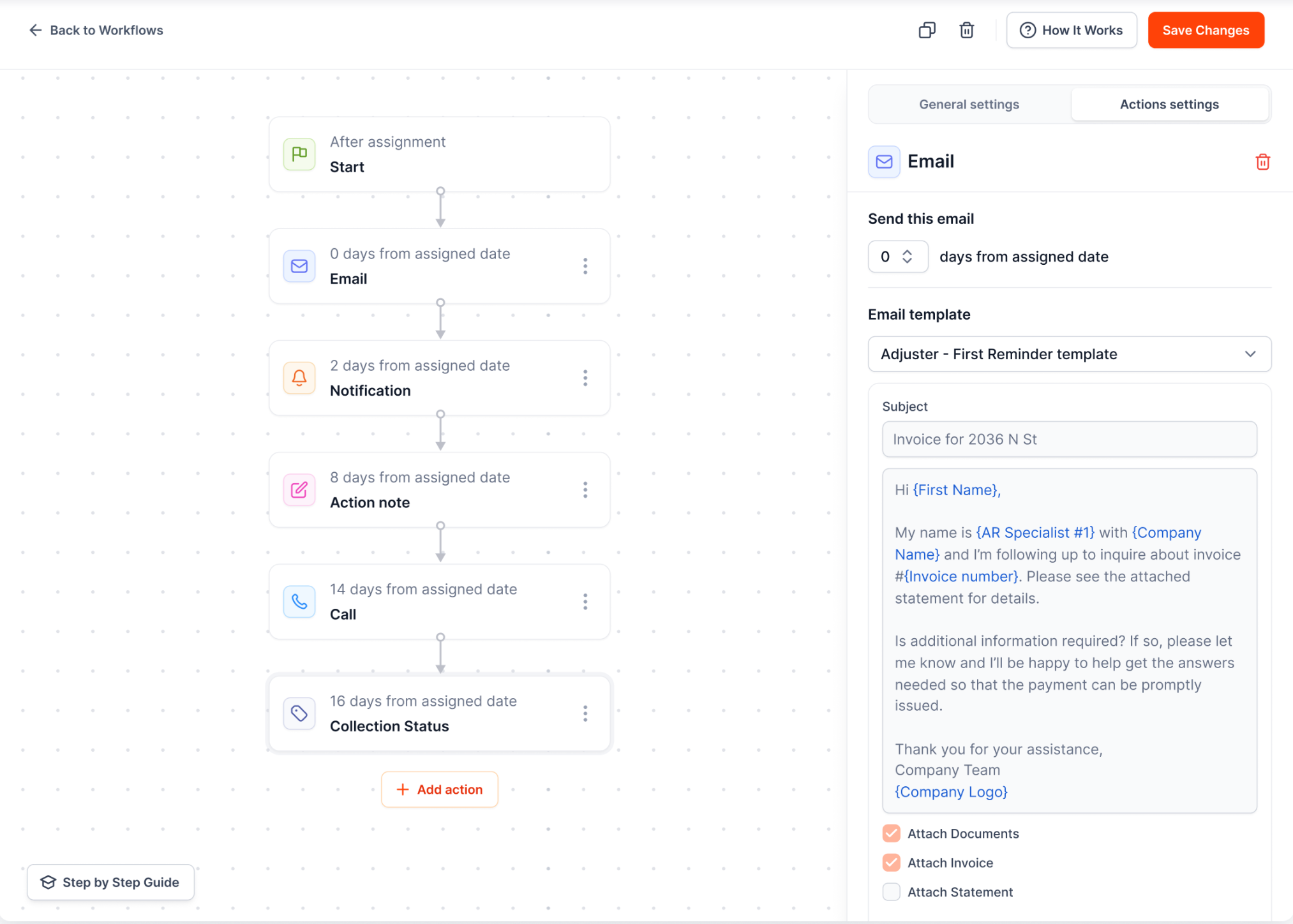
Collection workflows in AR Workflow decide when each follow-up goes out.
Do you have questions about AR Workflow? Contact us for help.
Adjusters are paid to verify that every charge on a claim is necessary and reasonable. Because insurance fraud is a real problem, invoices that are vague, out of scope, or missing documentation are the most likely to be reduced. The most common reasons are lines the adjuster sees as unnecessary, quantities that do not match measurements, and unit prices above the Xactimate price list for the area.
Work collaboratively with the adjuster, stay within the contracted scope, submit an accurate invoice, and back each charge with documentation such as photos, readings and job notes.
Ask which items were reduced and why, then respond to each one with the documentation that supports it. Keep the conversation professional and in writing so you have a record. If the balance still stalls, our guide to unpaid invoices covers next steps.
It is the regional pricing database inside Xactimate, the estimating software from Verisk that most property carriers use. Price lists are set by area and updated regularly, and adjusters often compare each line on a restoration invoice against the list for the property's location and date of work.
Yes. A contractor can respond to the adjuster with documentation, request a re-inspection and ask for a supervisor review. Some options, such as invoking an appraisal clause or filing a complaint with the state department of insurance, usually belong to the policyholder, and the rules vary by state.
Related reading
Your invoice, not a feature tour.
Bring one overdue invoice to a demo and see what AR Workflow would send, when, and how your customer would pay.
Sam owned and ran three restoration companies for more than 14 years and collected over $100 million in receivables. He built AR Workflow in 2020 to give contractors the collections system he wished he'd had.

AI writes the emails, sends the texts, and leaves the voicemails. Your team handles the conversations that matter, and your cash keeps moving.
 Keep QuickBooksStart with one invoiceStay in control

 Log in