
On a restoration job, one invoice can have three or four payers. The carrier owes the approved amount. The homeowner owes the deductible and anything outside scope. A mortgage company may need to endorse the check. And the adjuster controls the timing of most of it.
That is why restoration AR looks so different from other trades, and why generic collections advice falls flat. "Send a firm reminder with a payment link" works on a homeowner. Send the same thing to an adjuster and you have just made your file harder to approve. This guide breaks down who owes what, how a claim moves from first call to final payment, how to follow up with each payer, what documentation speeds things up, and what to automate.
KEY TAKEAWAYS
- Each payer on an insurance job needs a different follow-up.
- Ask carriers and adjusters for status and send documentation. Never send them a payment link.
- Explain the deductible at the start and bill it on its own line.
- Complete documentation is the fastest way to get an adjuster to yes.
- Group jobs under the carrier so you can see the total owed across all claims.
- Track promised dates and follow up the day after they pass.
Why restoration collections are different
Most contractors have one customer per invoice. Restoration contractors usually do not. Four things make it harder:
- The person who signs is not the person who pays. The homeowner authorizes the work, but the carrier pays most of it.
- Approval and payment are separate steps. The adjuster approves the estimate; the carrier issues the check, sometimes weeks later.
- Payments arrive in pieces. Mitigation, rebuild, supplements, contents and depreciation can each come separately.
- Checks are often two-party or three-party. The homeowner, your company and the mortgage company may all need to endorse.
Put together, a single water loss can have a dozen moving parts. If nobody owns each part, invoices drift past 60 and 90 days without anyone noticing which piece is stuck.
Who owes what on an insurance job
| Payer | What they owe | What moves them |
|---|---|---|
| Insurance carrier | The approved estimate, supplements, depreciation release | Complete documentation, the right claim number, steady status requests |
| Adjuster | Approval, not payment | Photos, moisture logs, drying records, signed authorizations, quick answers |
| Homeowner | Deductible, non-covered work, endorsed checks | A clear explanation up front, a payment link, a friendly tone |
| Mortgage company | Endorsement of two-party checks | Their specific forms, inspection requests, persistence |
| Property manager | The full invoice on non-claim work | Job and property references, AP contact by name, consistent follow-up |
How a restoration claim moves from first call to final payment
Knowing where a claim is in its life tells you who to chase and what to send. Here is the typical path for a water loss.
| 1 | First call and work authorization. Collect the claim number, carrier, adjuster contact, policyholder, mortgage company and the deductible amount. Get the signed authorization and, where allowed, a direction to pay. |
| 2 | Mitigation. Extraction, drying and monitoring. Keep daily moisture readings, equipment logs and photos. This is your evidence later. |
| 3 | Estimate and submission. Send the mitigation invoice and estimate with the full documentation package. Note the date you sent it. |
| 4 | Adjuster review. Expect questions, line item changes and requests for more photos. Answer fast. Every day you wait is a day added to payment. |
| 5 | Approval and payment issued. Find out who the check is made out to and where it was mailed. Many "unpaid" invoices are checks sitting on a homeowner's counter. |
| 6 | Endorsement. Two-party checks go to the homeowner and sometimes the mortgage company's loss draft department. |
| 7 | Rebuild, supplements and depreciation. Repeat the cycle for reconstruction, then submit proof of completion for any recoverable depreciation. |
| 8 | Deductible and non-covered work. Bill the homeowner with a payment link. Keep it friendly. |
The documentation package that gets files approved
Most adjuster delays come down to missing or messy paperwork. Send everything in one package, the first time.
CHECKLIST
- Signed work authorization (and direction to pay, where allowed)
- Itemized invoice that matches the estimate format the carrier uses
- Before, during and after photos, labeled by room
- Moisture maps and daily readings
- Equipment logs (placement and removal dates)
- Scope notes explaining anything unusual
- Certificate of completion, signed by the homeowner
- Claim number, policyholder and property address on every page
For invoice formats, see our restoration invoice template, water damage invoice sample and fire and smoke invoice template.
Following up with carriers and adjusters
- Ask for status, not payment. "Can you confirm where this stands?" gets a better response than a demand.
- Lead with the claim number in every subject line.
- Send the documentation before they ask. Drying logs, photos, the signed work authorization and the invoice in one message.
- Keep a steady rhythm. A short check-in every week or so, by email first and then by phone.
- Track promised dates. When an adjuster says "end of next week", follow up the day after.
- Escalate politely. If an adjuster goes silent, ask the carrier for their supervisor or the desk adjuster on the file.
ADJUSTER STATUS EMAIL
Subject: Claim [claim #], [property address]: status of invoice [#]
Hi [Adjuster name], I'm following up on our invoice [#] for [mitigation / reconstruction] at [property address], claim [claim #], submitted on [date]. Can you confirm where it stands and whether anything else is needed from us? The moisture logs, photos and signed authorization are attached again for convenience. Thank you.
Rule of thumb: never send an adjuster or carrier a payment link. It reads as a demand and slows the file down. Payment links go to homeowners.
For deeper guidance, read water mitigation adjuster billing and how to invoice an insurance adjuster.
Collecting the deductible from homeowners

The deductible is where most restoration contractors leave money on the table. The homeowner assumes insurance covers it, the job wraps up, and by the time the bill arrives they have moved on.
| 1 | Explain it at the start, in writing, as part of the work authorization. |
| 2 | Bill it as its own line, with a separate due date. |
| 3 | Make it easy to pay: card or ACH through a link, partial payments, or a payment plan. |
| 4 | Use text messages. Homeowners often answer a text long before they open an email from a business. |
| 5 | Keep the tone friendly. They just had a flood or a fire. You want a review, not a complaint. |
DEDUCTIBLE TEXT
Hi [First name], it's [Your name] at [Company]. Glad your home is back to normal. As we discussed at the start, your policy deductible of [amount] is due now. You can pay by card or bank here: [payment link]. If a payment plan would help, just reply.
Handling two-party checks and mortgage companies
When a check is made out to both the homeowner and the lender, it can sit for weeks. To keep it moving:
- Ask at the first call whether there is a mortgage on the property and who the servicer is.
- Call the loss draft department early to learn their forms, inspection rules and how they release funds.
- Tell the homeowner exactly what to do when the check arrives: endorse it, send it to the lender, or bring it to you, depending on the lender's process.
- Log every step with the date and the person you spoke to.
Bring one overdue claim.
We'll show you how the carrier, the adjuster and the homeowner would each be followed up.
Collections by restoration job type
| Job type | Where it usually stalls | What helps |
|---|---|---|
| Water mitigation | Equipment days and drying time questioned | Daily moisture logs and equipment records |
| Reconstruction | Supplements, depreciation, lender endorsements | Line-by-line match to the approved scope; proof of completion |
| Fire and smoke | Large scopes, multiple payment phases | Separate invoices per phase; clear contents vs structure split |
| Mold remediation | Coverage limits and exclusions | Confirm coverage before work; get homeowner sign-off on what is not covered |
| Contents | Inventory disputes, storage fees | Detailed inventory with photos; storage terms in writing |
| Commercial and property management | Approval chains, purchase orders | PO and work order numbers on every invoice; AP contact by name |
A worked example: one water loss, four payers
Harbor Restoration: burst pipe, finished basement
Mitigation invoice $9,800. Reconstruction invoice $22,400. Deductible $2,500. Mortgage on the property.
| Week 1 | Mitigation done. Invoice and documentation package sent to the adjuster with the claim number in the subject line. |
| Week 2 | Adjuster asks about two extra dehumidifier days. Office replies same day with the moisture readings that justify them. |
| Week 4 | Mitigation approved. Check issued to homeowner and lender. Office calls the homeowner and the lender's loss draft department the same day. |
| Week 6 | Lender releases funds after an inspection. Mitigation paid. |
| Week 10 | Reconstruction complete. Certificate of completion and final invoice sent. Deductible text sent to the homeowner with a payment link; she sets up two payments. |
| Week 13 | Reconstruction and depreciation paid after weekly status requests. Deductible plan finished. File closed. |
Example company, customer and amounts are made up for illustration.
Every step had an owner and a next date. That is the whole trick. Without it, the lender check alone could have sat for a month.
Organize AR by carrier, not just by customer
Most accounting systems list each job as its own customer. That hides the bigger picture: how much one carrier owes you across twenty open claims. Group jobs under the carrier so you can see the total owed, spot the slowest payers, and have one conversation about many files. In QuickBooks Online, the parent and sub-customer structure can help with this. See restoration insurance billing for more.
What to track every week
- Open balance by carrier, to see who is slowest and where to focus.
- Claims waiting on documentation from your side. These are fully in your control.
- Checks issued but not received or endorsed. Often the easiest money to collect.
- Deductibles outstanding on completed jobs.
- Invoices with no follow-up in the last week. These are the ones that quietly become write-offs.
Your aging report shows the first one. The rest need a system that tracks follow-up, not just balances.
What to automate
- A follow-up schedule for every open invoice, with different steps for carriers, adjusters and homeowners.
- Payment links for homeowners only.
- Status requests to adjusters on a weekly rhythm.
- Pausing follow-up when someone promises a payment date, and restarting if the date passes.
- A daily list of who to call, so the office manager spends time on the conversations that need a person.
Built for restoration
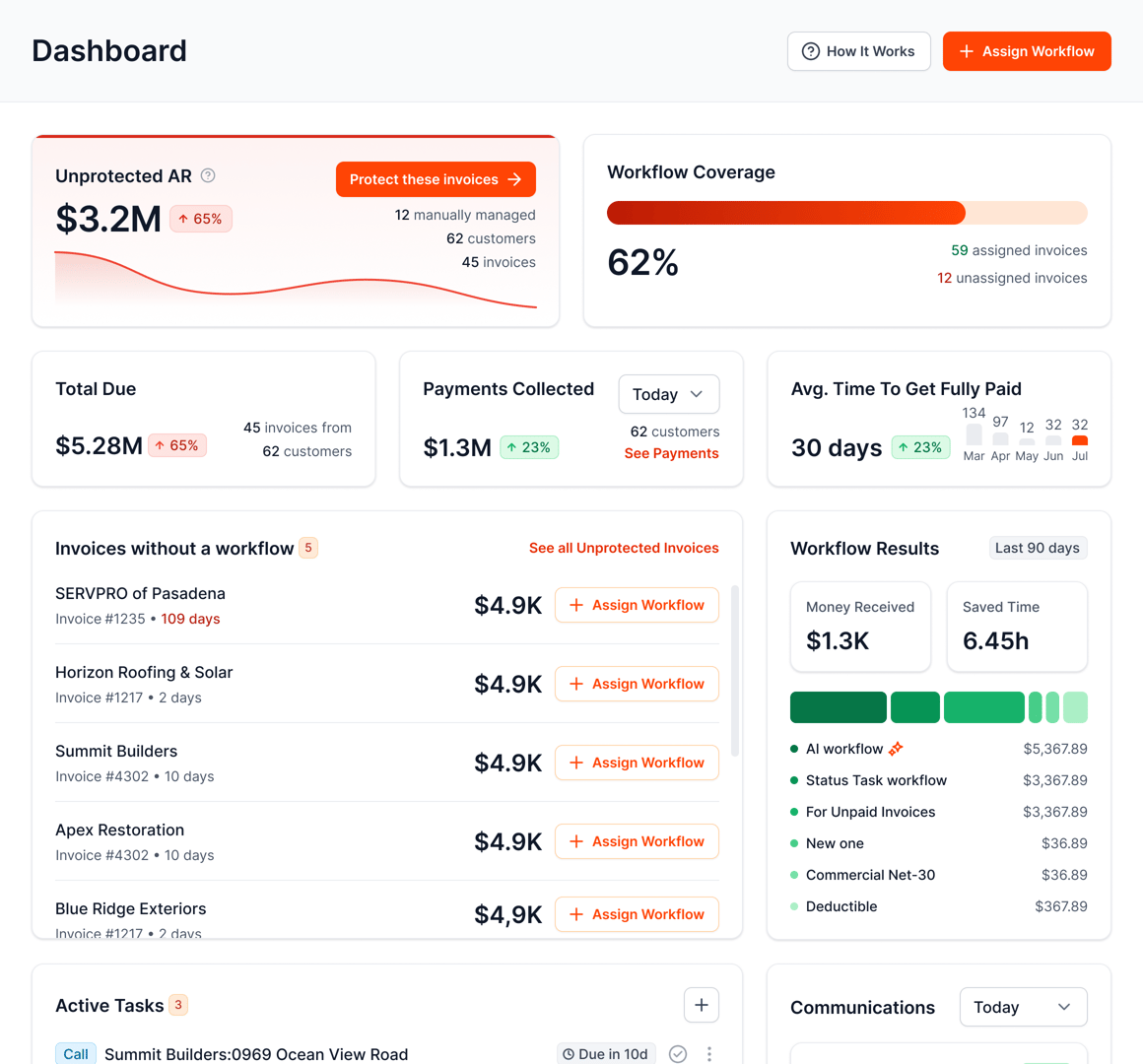
See which claims have no follow-up on them, and protect them in one click.
AR Workflow works with QuickBooks Online and was built around insurance-driven work. Jobs roll up under the carrier, each account holds adjuster, homeowner and project manager contacts, and it comes with 17+ preloaded restoration follow-up templates for deductibles, adjusters and major carriers. Follow-up runs by email, two-way text, ringless voicemail and recorded calls from a dedicated number. AI drafts messages by contact type and never adds a payment link for an adjuster, carrier or legal contact. Homeowners get a payment link for card or ACH, and payments post back to QuickBooks.
Frequently asked questions
How long do insurance companies take to pay restoration contractors?
It varies widely by carrier, claim size and how complete your documentation is. The parts you control are sending a complete package the first time, answering adjuster questions the same day, and following up on a steady rhythm.
Should I bill the carrier or the homeowner?
Usually both. Bill the carrier for the approved scope, and the homeowner for the deductible and anything outside scope. Your work authorization should make the homeowner responsible for any balance the carrier does not pay.
Can I send a payment link to an adjuster?
We recommend against it. Adjusters approve; carriers pay through their own process. Ask for status and offer documentation instead.
What is a direction to pay?
A document the homeowner signs asking the carrier to pay the contractor directly or include them on the check. Rules vary by state, so check with a construction attorney before using one.
How do I collect a deductible the homeowner did not expect?
Explain it at the start in writing, remind them when the job is done, make it easy to pay with a link, and offer a short payment plan. Stay friendly. They just went through a loss.
What do I do when a mortgage company holds the check?
Call the loss draft department, learn their requirements, schedule any inspection quickly, and follow up weekly. Keep the homeowner informed so they can help push.
Related reading
Built for restoration contractors.
Learn more on our restoration page, or bring one overdue invoice to a demo.
Photos: Unsplash. This article is general information, not legal advice.