A past-due invoice letter template can help you be ready to demand payment when it's past due. Explore our examples to improve your collections.

Following up on an overdue invoice can feel uncomfortable for many business owners, especially if they worry about the impact it has on customer relationships.
A past-due invoice letter template makes that conversation easier. It gives you a professional way to request payment while keeping your message clear and polite.
If you find yourself in this situation, this article will help you understand where to begin, what to say, and how to send reminders using four ready-to-use templates for different payment situations.
KEY TAKEAWAYS
A past-due invoice letter is a written notice telling a customer that an invoice has passed its due date and is still unpaid. It restates what is owed, refers to the original invoice, and asks the customer to pay or get in touch by a specific date.
For contractors, it does three jobs at once:
Here’s a quick breakdown:
|
Element |
Why It Matters |
|
Invoice number and job address |
Contractors bill many jobs to the same customer. Make this one impossible to confuse. |
|
Amount due and original due date based on the agreed payment terms |
State both plainly so there is nothing to look up. |
|
A payment link |
Providing a direct payment link helps encourage prompt action instead of requiring customers to call the office. |
|
A specific date |
"Please pay by Friday, March 14" encourages prompt payment more than "at your earliest convenience". |
|
A real person to contact |
Name, phone, and email. Disputes get solved faster when someone answers. |
|
The original invoice attached |
Saves the customer from searching their inbox, and removes "I never got it." |
Whether you use the templates below or write your own, an effective past-due notice that gets paid follows the same order. Keep it under 150 words for the first two letters. Longer letters read like a lecture and get skimmed.
The subject line decides whether the letter is opened at all. Clear beats clever every time:
Check out the templates below.
Use this overdue reminder in the first week after the due date. Assume good intent. Most customers at this stage simply forgot or are waiting on a payday.
1 TO 7 DAYS LATE
Subject: Invoice [#] for [job address] is past due
Hi [First name],
A quick reminder that invoice [#] for the work at [job address] was due on [due date]. The balance is [amount].
You can pay online here: [payment link]. If you have already sent payment, thank you, and please ignore this note.
If anything on the invoice needs a second look, reply to this email or call me at [phone].
Thanks,
[Your name]
[Company]
Use this second reminder around two to four weeks after the due date. The tone is still polite, but it names how late the invoice is, sets a date, and offers a payment plan so the customer has no reason to stay silent.
15 TO 30 DAYS LATE
Subject: Second notice: invoice [#] is [X] days past due
Hi [First name],
We have not yet received payment for invoice [#] ([job address]), which was due on [due date]. The balance of [amount] is now [X] days overdue.
Please pay by [date] using this link: [payment link]. If you need to set up a payment plan, reply and we will work it out.
If there's an issue with the work or invoice causing the late payment, let me know today so we can fix it.
Thanks,
[Your name]
Use this when several reminders have gone unanswered and prompt action is needed. It is the last letter before you take another step, so be specific about that step and the date.
45+ DAYS LATE
Subject: Final notice before further action: invoice [#]
Hi [First name],
This is our final notice for invoice [#] for [job address]. The balance of [amount] was due on [due date] and remains unpaid after several reminders.
We expect payment in full by [date] at [payment link], or you can contact me to agree on a payment plan. If we do not hear from you by then, we will move to the next step in our collections process, which may include [lien filing/referral to a collections agency / small claims].
We would much rather settle this directly. Call me at [phone].
[Your name]
In insurance work, the adjuster usually controls the timing of payment, but they are not the one paying. Treat this as a status request, not a demand.
INSURANCE JOBS
Subject: Payment status for claim [claim #], insured [name]
Hi [Adjuster name],
I am following up on our invoice [#] for claim [claim #] at [property address]. The approved amount of [amount] was submitted on [date], and we have not yet received payment.
Can you confirm the payment status, or let me know what documentation you still need from us? I have attached the invoice, the signed work authorization, and the completion photos.
Thanks,
[Your name]
Most homeowners read a text within minutes and an email within days, if at all. Pair each email with a short text that points to the same invoice. Keep texts under 300 characters, name your company, and only text customers who gave you their mobile number for the job.
TEXT VERSIONS
Friendly: Hi [First name], this is [Your name] at [Company]. Invoice [#] for [job address] was due [due date]. You can pay here: [payment link]. Reply with any questions.
Firm: Hi [First name], invoice [#] for [job address] is now [X] days past due ([amount]). Please pay by [date]: [payment link]. Need a payment plan? Just reply.
Final: Hi [First name], this is our final reminder for invoice [#] ([amount]). Please pay or call me at [phone] by [date] so we can avoid next steps. [payment link]
Calls and voicemails work best as the third touch, after an email and a text. Tools like ringless voicemail for collections can leave a short, consistent message without tying up your office.
For a full sequence of follow-up emails with friendly, firm, and final wording, use our payment reminder email templates for contractors. If you are writing the first email that carries the invoice, start with invoice email templates and samples.
To give you a better idea of how to use the email templates above, here's an example of the firm second notice filled in with sample customer and invoice details.
You can use this as a reference when preparing your own past due invoice letter.
From: Maria Lopez, Office Manager, Ridgeline Exteriors
To: David Chen
Subject: Second notice: invoice 2318 is 21 days past due
Hi David,
We have not yet received payment for invoice 2318 for the gutter and fascia replacement at 412 Oak Hollow Drive, which was due on October 10. The balance of $3,480.00 is now 21 days past due.
Please pay by Friday, November 7, using this link: [Pay invoice 2318]. You can choose your preferred payment method and pay by card or bank transfer. If you would like to split it into two payments, just reply, and we will set that up.
If anything about the job or the invoice is not right, let me know today, and I will get it sorted.
Best regards,
Maria Lopez
Ridgeline Exteriors · (555) 014-2290
Example company, customer, and amounts are made up for illustration.
While the past due invoice letter templates above give you a starting point, you may need to adjust certain details depending on your trade and how your customers typically pay.
Here are some ways to adapt the templates to fit these different payment situations.
Restoration invoices often have several payers. Send the carrier letter (Template 4) to the adjuster with the drying logs, moisture readings, and photos attached.
Send Templates 1 to 3 to the homeowner for the deductible and any non-covered work, and mention the claim number so they can connect it to their insurance paperwork.
If a check is made out to both the homeowner and their mortgage company, add a line asking the homeowner to start the endorsement process. For more on billing insurance work, see our guide to restoration insurance billing.
Roofing payments tend to arrive in pieces: the first insurance check, supplements, the depreciation release, and the deductible.
So, name the specific piece you are chasing in the subject line, for example, "Deductible for invoice 2318" or "Depreciation release, claim 0042-118".
That stops the homeowner from thinking they have already paid. Our roofing collections page shows how this can run automatically on insurance roofing jobs.
For residential service work, keep letters short and lead with the payment link, because most of these customers will pay from their phone.
For commercial and property management accounts, send the letter to the AP contact by name, include the PO or work order number, and copy the person who approved the work.
General contractors (GCs) usually pay on a schedule tied to pay applications and lien waivers. Before you send a past-due letter, confirm you submitted everything the GC needs: the pay app, conditional lien waiver, certificate of insurance, and any required backup.
After customizing your past due invoice letter, the next step is deciding how to send it. While email is often the easiest option, not all customers respond through the same communication channel.
Here's a quick comparison of the different ways to send your payment reminders and what to consider when using each one.
|
Channel |
Best For |
Watch Out For |
|
|
Every letter, with the invoice attached and a payment link |
Spam folders and old addresses. Send from a real person, not no-reply. |
|
Text message |
Homeowners and small business owners |
Keep it short, identify your company, and honor STOP requests. |
|
Phone call or voicemail |
Larger balances and anything that might be a dispute |
Log what was said and any promised date. |
|
Certified mail |
Final notices and any notice your state's lien law requires in writing |
Slow. Use it alongside email, not instead of it. |
This is general information, not legal advice. Rules vary by state, so check with a local attorney before you send anything that mentions legal action.
Aside from following the legal requirements when sending past-due letters, it's also important to make sure your reminders are not only clear, but also reach the right person.
Even small mistakes in how you prepare or send your letters can delay payment or discourage customers from responding.
Here are the six common mistakes to avoid when sending past-due invoice letters.
Even a well-written past due invoice letter may not lead to payment if the contractor doesn't send further reminders. Someone gets busy, the invoice slips into the 60- and 90-day buckets, and by then the customer has stopped answering.
|
Day 1 |
Template 1 by email with a payment link |
|
Day 4 |
Text message with the same link |
|
Day 8 |
Phone call or voicemail |
|
Day 15 |
Template 2 by email and text |
|
Day 30 |
Call from the owner or office manager |
|
Day 45 |
Template 3 by email and certified mail |
Stop the sequence the moment the customer pays or promises a date, and pick it back up if the promise is missed.
On insurance jobs, run Template 4 weekly with the adjuster in parallel with the homeowner schedule. Reviewing an aging report every Monday is the simplest way to catch invoices that slipped off the schedule.
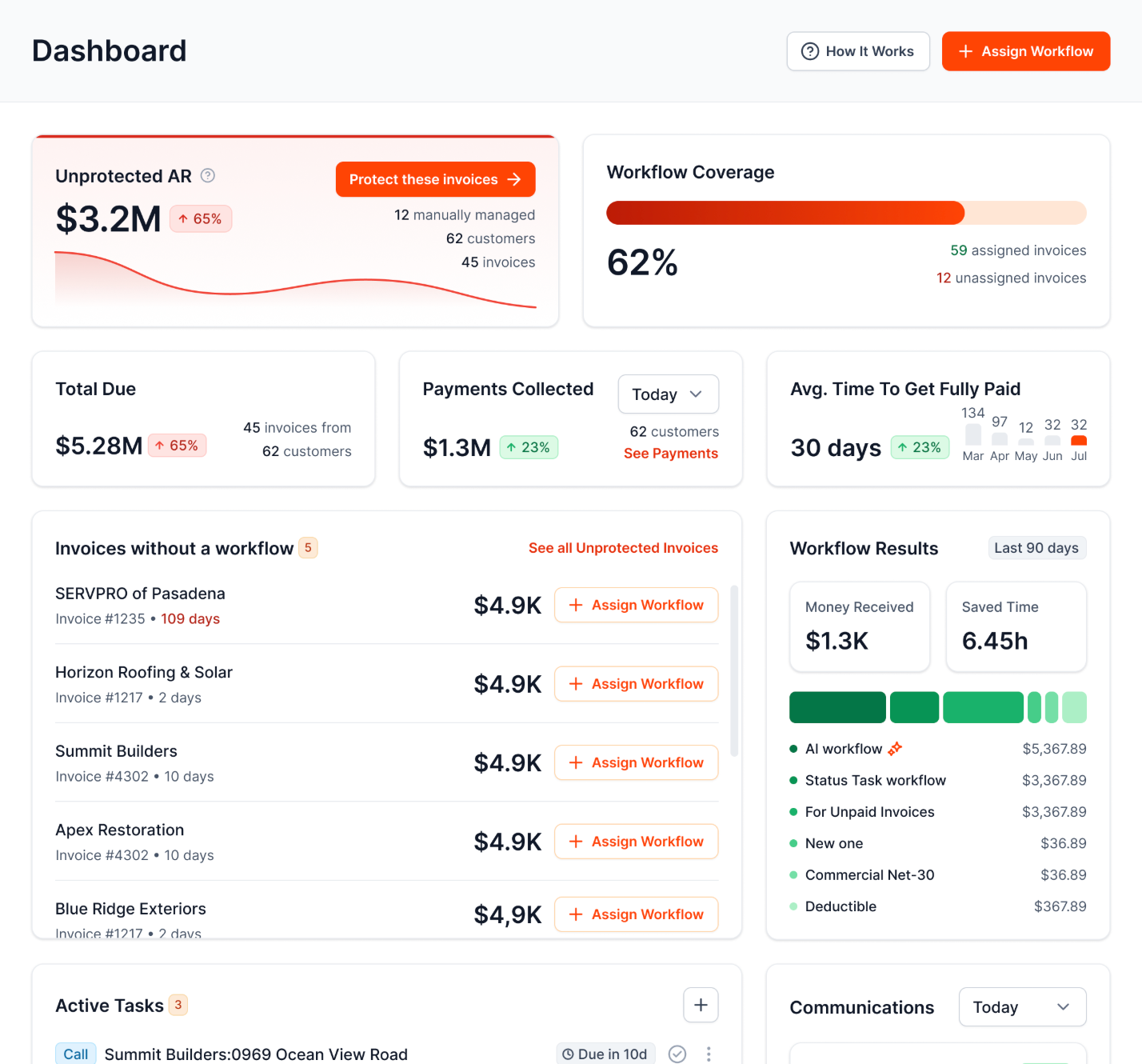
Following a payment reminder schedule is manageable when you're dealing with a few overdue invoices. But once the number of overdue accounts grows, tracking every reminder and customer response can take up more of your team's time.
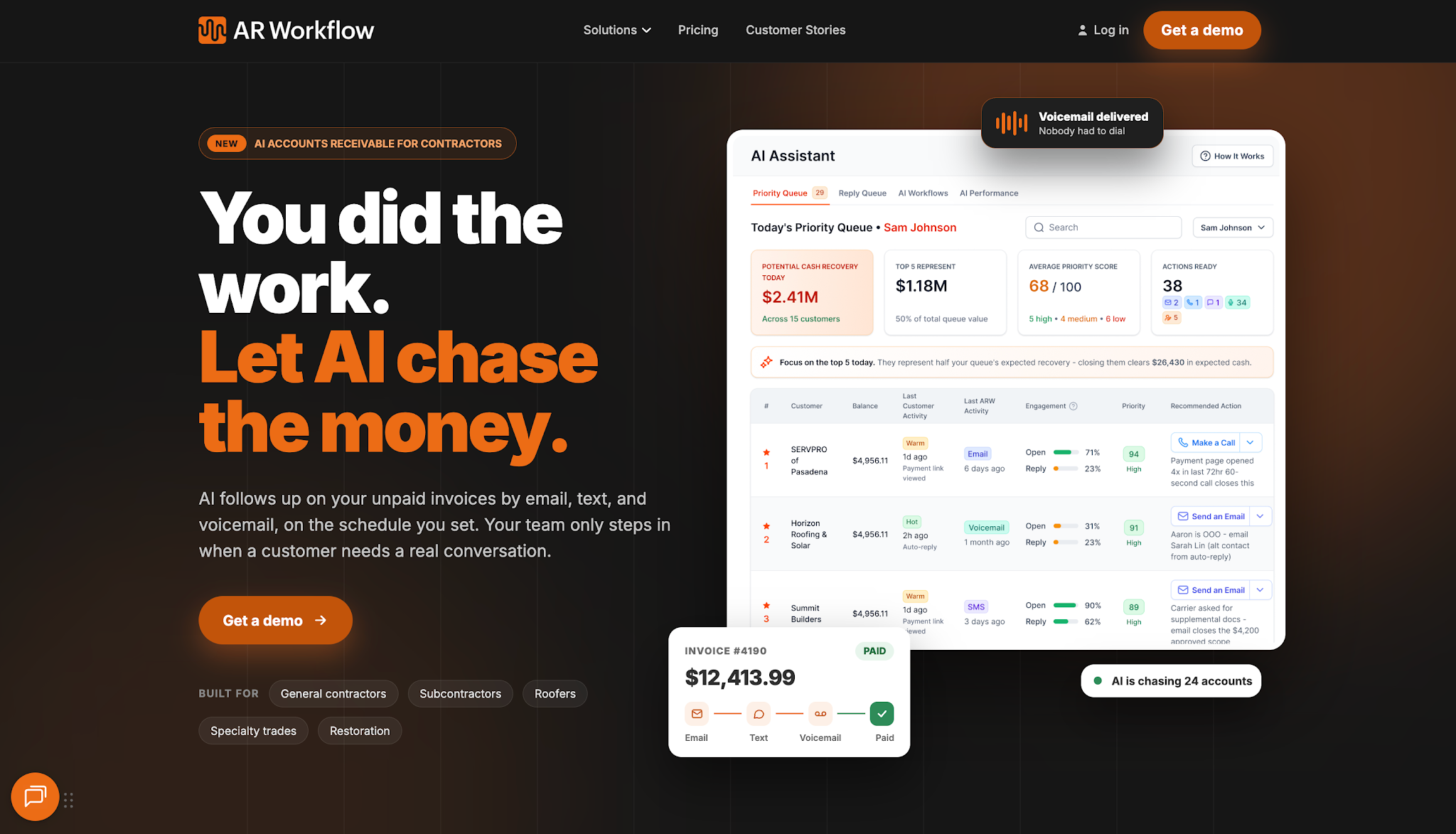
AR Workflow helps restoration companies manage this process by connecting with QuickBooks Online and putting each open invoice on a scheduled follow-up workflow.
It can automatically send payment reminders through email, SMS, and voicemail, along with payment links that make online payments easier for customers.
The platform also tracks collection activity for each invoice. It can stop reminders when a customer pays and pause follow-ups when a customer promises to pay, helping your team avoid unnecessary messages.
AR Workflow can also help with insurance-related jobs by managing communication with insurance adjusters differently than with homeowners, especially since adjuster messages usually focus on payment status and documentation rather than requesting payment through a link.
The past-due invoice letter templates we've shared give you a starting point for handling different payment situations. You can customize them based on how overdue an invoice is and use the suggested schedule to keep your reminders consistent.
If you're looking for a more efficient way to manage those follow-ups without adding more work for your team, investing in an automated platform like AR Workflow is a great place to start.
After all, requesting overdue payments shouldn't have to strain your customer relationships.
With a professional approach and a consistent follow-up process, you can collect the payments your business is owed, improve cash flow, and avoid making customers feel unnecessarily pressured.
Schedule a demo with AR Workflow and get paid faster for your overdue payments with ease!
Send the first one within a day or two of the due date. Waiting a few weeks to "be nice" usually backfires, because the invoice slips down the customer's list and becomes harder to collect.
Most contractors send three letters (friendly, firm, and final) over about six weeks, with texts and calls in between. If the customer has not paid or responded after the final notice, it is time to decide on a lien, a collections agency, or small claims.
You can only charge late fees if your contract or invoice terms allow them and your state permits them. You cannot add one for the first time in a past-due letter.
Pause the reminders, call them, and find out exactly what they disagree with. Fix what is fair, document what you agreed, and send an updated invoice. Then restart the schedule if it is still unpaid.
Related reading
Your invoice, not a feature tour.
Bring one overdue invoice to a demo and see what AR Workflow would send, when, and how your customer would pay.
Photos: Unsplash. This article is general information, not legal advice.
Sam owned and ran three restoration companies for more than 14 years and collected over $100 million in receivables. He built AR Workflow in 2020 to give contractors the collections system he wished he'd had.

AI writes the emails, sends the texts, and leaves the voicemails. Your team handles the conversations that matter, and your cash keeps moving.
 Keep QuickBooksStart with one invoiceStay in control

 Log in