
Construction invoice collection email templates save you from writing the same hard email from scratch every month. A late pay app, a retainage balance nobody has released, a change order that was approved but never paid: each one needs a clear message to the right person, with the right documents attached, before a deadline slips by.
Below are 13 templates built for construction, not for a generic small business. They cover pay app follow-up, owner payments, change orders, missing lien waivers, retainage release requests, a final notice, a notice of intent to lien letter and a payment bond claim notice. Copy them from this page or download them all as a Word file. If you bill homeowners for smaller jobs, our payment reminder email templates for contractors cover friendly, firm and final reminders for that kind of work.
KEY TAKEAWAYS
- Most late construction payments are stuck on paperwork or approval, so the first emails should ask what is missing, not demand payment.
- Write to a named AP contact and cc the project manager. Reference the pay app number, project, period and amount every time.
- Treat retainage and change orders as their own receivables, with their own requests.
- Lien and bond claim notices have strict, state-specific rules. Use the right form and talk to a construction attorney.
- Every template below is in a free Word download.
FREE DOWNLOAD
Get all 13 construction collection templates in one Word file
Edit them once with your company name, terms and signature, then copy and send.
Why construction invoice collection emails are different
A generic "your invoice is overdue" email does not work well in construction, because the person you write to often cannot pay you on their own. A pay app may need sign-off from the GC's project manager, the architect, the owner and a lender before anyone cuts a check. A subcontractor may be waiting on a GC who is waiting on the owner. And payment can stop over a single missing lien waiver.
So good construction collection emails do three things. They make it easy to find the invoice (project, pay app number, period, amount). They ask a specific question (is anything missing, which pay run, what date). And they leave a paper trail that will matter if you ever need to file a lien, make a bond claim or rely on a prompt payment law.
| Situation | Template to use | Typical timing |
|---|---|---|
| Pay app just submitted | 1. Received and approval check | 3 to 5 days after submitting |
| Pay app due, no payment date | 2. Due today reminder | On the due date |
| Pay app late | 3. First notice, then 4. Firm follow-up | About 1 week, then 2 to 3 weeks late |
| GC waiting on the owner or lender | 5. GC to owner | 7 to 10 days late |
| Approved change order unpaid | 6. Change order payment email | When the billed CO is late |
| Pay app returned for documents | 7. Missing lien waiver or backup | The same day |
| Your scope is complete | 8. Retainage release request letter | When retainage is releasable |
| Retainage still unpaid | 9. Retainage follow-up | About 30 days after the request |
| Seriously past due | 10. Final notice, 11. Notice of intent to lien, 12. Bond claim | Before your state deadlines, with an attorney |
| Someone promises a date | 13. Confirming a promise to pay | The same day |
The timings are starting points. Your contract terms, the GC's pay run calendar and your state's rules come first. Our guide to construction accounts receivable explains pay apps, retainage and lien waivers in more detail.
Before you send: get these details right
| 1 | Find the right person. Ask at the start of the job who processes pay apps, and get a name, email and phone number. "accounts@" inboxes are where pay apps go to wait. |
| 2 | Know the pay run calendar. Many GCs pay on fixed dates once the owner pays them. If you know the cutoff, you can follow up before it, not after. |
| 3 | Reference everything. Project name, pay app or invoice number, billing period, amount and due date belong in the subject line or the first sentence. |
| 4 | Attach the backup. Include the pay app, conditional lien waiver and any documents the contract requires, even if you sent them before. |
| 5 | Log every send. Write down the date, recipient and what was said. You may need this record later. |
Pay app follow-up email templates
These four templates walk a pay app from submission to past due. The first two are friendly on purpose. Most pay apps that are paid late were held up by a question nobody asked, so a pay app follow-up email sent before the due date is the cheapest collection step you have.
Pay app follow-up
Template 1: Pay app received and approval check
When: Send 3 to 5 days after you submit a pay app, before it is due.
To: GC or owner's AP contact, cc the project manager
Subject: Pay app #[number] for [project name]: received and approved?
Hi [first name],
I submitted pay application #[number] for [project name] on [date], for work through [period end date]. The amount this period is $[amount], net of retainage.
Could you confirm it was received and let me know if anything is missing before it goes to approval? The package included the G702/G703 (or your format), our conditional lien waiver, sub waivers and backup for stored materials.
If it is approved, which pay run will it be on?
Thanks,
[Your name]
[Company] | [phone]
Pay app follow-up
Template 2: Pay app due today: friendly reminder
When: Send on the due date if you have no remittance or payment date.
To: GC or owner's AP contact
Subject: Pay app #[number] for [project name] due today
Hi [first name],
A quick reminder that pay application #[number] for [project name], $[amount], is due today under our contract terms.
If it has already been released, thank you. Could you send the check number or ACH reference so we can match it? If it is still in approval, please let me know where it is and if you need anything from us.
Thanks,
[Your name]
Pay app follow-up
Template 3: Pay app past due: first notice
When: Send 5 to 7 days after the due date.
To: GC or owner's AP contact, cc the project manager
Subject: Past due: pay app #[number], [project name], $[amount]
Hi [first name],
Pay application #[number] for [project name] was due on [due date] and is now [X] days past due. The open amount is $[amount].
Is anything holding it up on your side, such as a missing waiver, a disputed line on the schedule of values or an owner payment that has not come in yet? If you tell me what is needed, I will get it to you today.
Please reply with the expected payment date. Remittance details are attached.
Thank you,
[Your name]
Tip: If the GC is waiting on the owner, ask when the owner's payment is expected and when the GC's next pay run is after that. Then put both dates on your calendar. Your contract and state law decide whether pay-when-paid or pay-if-paid terms apply, so check them before you accept the answer.
Pay app follow-up
Template 4: Pay app past due: firm follow-up and escalation
When: Send 14 to 21 days past due if the first notice got no answer or no date.
To: GC project manager and AP, cc your project manager or owner
Subject: Second notice: pay app #[number], [project name], [X] days past due
Hi [first name],
I have not yet received payment or a payment date for pay application #[number] on [project name]. It was due on [due date] and the balance of $[amount] is now [X] days past due. I followed up on [date of first notice].
Our crew is still scheduled on the job and we want to keep it that way. To do that, we need either payment or a firm payment date by [date, 5 business days out].
If there is a problem with the pay app, please tell me what it is so we can fix it. I am also happy to set up a short call with you and [GC project manager name] this week.
Regards,
[Your name]
[Title], [Company]
If a pay app is now more than 30 days late, a formal letter can carry more weight than another email. See our past due invoice letter templates for printable versions.
Owner payment and change order payment emails
General contractors collect from owners and lenders, and everyone collects on change orders. Both need their own messages, because the questions are different. With an owner, the question is usually about the draw: has the lender received what it needs? With a change order, it is about paperwork: is it signed, and was it billed the way the GC expects?
Owner payment
Template 5: GC to owner: progress payment past due
When: For general contractors billing the owner directly. Send 7 to 10 days past due.
To: Owner, owner's representative or construction lender contact
Subject: [Project name]: progress payment #[number] past due
Hello [first name],
Progress payment #[number] for [project name], $[amount], was due on [due date] and has not yet been received. The pay application was certified by [architect or owner's rep] on [date].
Our subcontractors and suppliers are paid from this draw, so a delay on this payment affects the whole job. Could you confirm the payment date, or let me know if the lender needs anything else to release the draw?
I can send updated lien waivers, an inspection report or photos the same day.
Best regards,
[Your name]
[Company]
Change order
Template 6: Change order payment email
When: Send when an approved change order has been billed and is unpaid, or when billed extra work is being held back.
To: GC or owner AP contact, cc the person who approved the change
Subject: Payment for approved change order #[CO number], [project name]
Hi [first name],
Change order #[CO number] for [short description of the work] was approved by [name] on [date] for $[amount]. We billed it on pay application #[number], dated [date].
That amount is still open. A copy of the signed change order and the invoice are attached.
Could you confirm it is approved for payment and on the next pay run? If the change order still needs a signature on your side, please tell me who to follow up with.
Thanks,
[Your name]
Tip: Do not wait for a change order to be paid to find out it was never signed. Send the change order payment email as soon as the billed amount is late, and keep the signed CO attached to every follow-up.
Missing backup
Template 7: Missing lien waiver or backup: resubmission
When: Send the same day a pay app is returned for missing documents.
To: GC or owner AP contact
Subject: Updated pay app #[number] for [project name], with [document]
Hi [first name],
Thanks for letting me know pay application #[number] was missing [the conditional waiver / sub waivers / stored materials invoices / certified payroll]. The corrected package is attached.
Can you confirm this completes it, and that it can still go on the [date] pay run? If anything else is missing, I would rather hear it now than after the cutoff.
Thank you,
[Your name]
Bring one overdue invoice.
We'll show you how AR Workflow would follow up on it from QuickBooks Online, with the right message to the right contact.
Retainage release request letter templates
Retainage is easy to forget because it is not due for months. By the time your scope is complete, the GC's team may have moved on, and nobody remembers to release it. Send a retainage release request letter the day retainage becomes releasable under your contract, and list every closeout document you are attaching so there is nothing left to ask for.
Retainage
Template 8: Retainage release request letter
When: Send when your work is complete, or when the contract says retainage is releasable (often substantial or final completion).
To: GC or owner, cc the project manager
Subject: Retainage release request: [project name]
Dear [first name],
Our work on [project name] was completed on [date], and [substantial completion / final completion / acceptance of our scope] was reached on [date]. Under [section number] of our contract, retainage is now due for release.
Retainage held to date: $[amount]
Attached: final pay application or retainage invoice, conditional final lien waiver, [punch list sign-off, warranties, O&M manuals, as-builts, certificate of occupancy or other closeout documents the contract requires].
Please confirm what, if anything, is still needed from us to release retainage, and the date we can expect payment.
Sincerely,
[Your name]
[Title], [Company]
Retainage
Template 9: Retainage past due: follow-up
When: Send if retainage has not been paid 30 days after you requested it.
To: GC or owner, cc your company owner
Subject: Second request: retainage for [project name], $[amount]
Dear [first name],
On [date of first request] we requested release of $[amount] in retainage for [project name], with the closeout documents listed in that letter. We have not received payment or a list of open items.
If there are open punch list items or documents you still need, please send them so we can close them out. If not, please let us know the payment date.
Many states have rules on when retainage must be released on private and public projects. We would like to settle this directly, and we would appreciate a reply by [date].
Sincerely,
[Your name]
Retainage rules, including when it must be released and whether interest applies, depend on the contract, whether the job is public or private, and the state. Check yours before you cite them.
Final notice, notice of intent to lien and bond claim letters
When friendly and firm emails have not worked, the next step is to protect your rights. The three templates below are general examples only. Lien and bond claim notices often must follow a state form, be sent by a specific method (such as certified mail) and reach specific people by a specific deadline. Deadlines are often counted from your last day of work or delivery, and they vary widely by state. Talk to a construction attorney before you send any of them.
Final notice
Template 10: Final notice before lien or bond claim
When: Send when an invoice is seriously past due and you are preparing to protect your rights. Check your deadlines with a construction attorney first.
To: GC and owner (as your contract and state rules allow)
Subject: Final notice: [project name], $[amount] past due
Dear [first name],
This is a final notice about the unpaid balance of $[amount] for work performed by [Company] on [project name] at [project address]. The amount has been past due since [date]. We sent reminders on [dates].
If payment, or a written payment plan we agree on, is not received by [date], we intend to protect our rights, which may include [a mechanic's lien / a claim against the payment bond / other remedies under the contract].
We would much rather resolve this directly. Please call me at [phone] or reply to this email.
Sincerely,
[Your name]
[Title], [Company]
A notice of intent to lien letter tells the owner and GC that you will file a mechanic's lien if you are not paid. In some states it is required before you can file. In others it is optional but often gets a response, because owners do not want a lien on their property.
Lien notice
Template 11: Notice of intent to lien letter
When: Some states require or allow a notice of intent before a lien is filed. Use your state's required form if there is one, and have a construction attorney review it.
To: Property owner and GC, by the delivery method your state requires
Subject: Notice of intent to file a mechanic's lien: [project address]
To: [Property owner name and address]
Cc: [General contractor name and address], [Lender, if required]
Re: [Project name], [Project address and legal description if required]
Notice is given that [Company], [address], furnished [labor / materials / equipment] for the improvement of the property above, at the request of [contracting party], from [first date] to [last date].
The amount of $[amount] remains unpaid. If this amount is not paid by [date], [Company] intends to file a mechanic's lien against the property as permitted by [state] law.
To resolve this before a lien is filed, please contact [name] at [phone] or [email].
[Company]
By: [Name, title]
Date: [date]
On public projects, and on some private jobs, you usually cannot lien the property. A payment bond takes its place, and your claim goes to the surety. Federal projects fall under the Miller Act, and state and local public projects under state laws often called "Little Miller Acts". Each has its own notice rules.
Bond claim
Template 12: Payment bond claim notice
When: For public or bonded private projects where a lien is not available. Federal and state bond rules differ, so confirm the notice, timing and recipients with a construction attorney.
To: Surety, principal (GC) and owner or public agency, as required
Subject: Notice of claim on payment bond #[bond number], [project name]
To: [Surety name and address]
Cc: [General contractor / principal], [Owner or public agency]
Re: Payment bond #[bond number], [Project name and contract number]
[Company] furnished [labor / materials] for the project above under a contract with [contracting party]. The last day we furnished labor or materials was [date].
The amount of $[amount] remains unpaid. Copies of the contract, invoices and statement of account are attached.
[Company] makes claim against the payment bond for this amount. Please acknowledge receipt and advise what further information you need to process the claim.
[Company]
By: [Name, title]
Date: [date]
Confirm every promise to pay
When someone gives you a date, write it down and send it back to them the same day. A short confirmation turns a phone call into a record, and it gives you a clear reason to follow up if the date passes.
Promise to pay
Template 13: Confirming a promise to pay
When: Send the same day someone gives you a payment date or agrees to a payment plan.
To: Whoever made the promise
Subject: Confirming payment for [project name] on [date]
Hi [first name],
Thanks for the call today. To confirm what we agreed: [GC / owner] will pay $[amount] for pay application #[number] on [date], by [check / ACH / card].
[If a payment plan: The remaining $[amount] will be paid in [number] payments of $[amount] on [dates].]
I will hold further follow-up until then. If anything changes, please let me know before [date].
Thanks again,
[Your name]
Tone and timing tips for construction collections
- Stay specific, not emotional. Amounts, dates and documents get answers. Frustration gets forwarded.
- Change channels when email stalls. If two emails go unanswered, call the AP contact or the project manager, then send a short email that confirms the call.
- Escalate one level at a time. AP contact, then project manager, then the GC's controller or owner. Copy your own project manager so the field team knows.
- Do not threaten what you will not do. Only mention a lien or bond claim if you have the right to file and intend to.
- Watch the aging report weekly. Our guide to the AR aging report shows how to spot pay apps that are slipping.
Example: Ridgeback Drywall, one pay app from submission to payment
A drywall subcontractor on a mid-size commercial job, net 30 terms.
| Day | What happened | Template |
|---|---|---|
| Day 0 | Pay app #6 submitted for $84,500, net of retainage | None |
| Day 4 | AP contact replies that the sub waiver for the framing supplier is missing | 1 |
| Day 4 | Corrected package resent the same afternoon | 7 |
| Day 30 | No payment date yet, reminder sent | 2 |
| Day 31 | PM confirms the owner paid late; GC will pay on its next pay run | 13 |
| Day 38 | Payment received | None |
Because the missing waiver was caught on day 4, it was fixed before the due date instead of after it.
Example company, project and amounts are made up for illustration.
Put the templates on a schedule
Templates only help if someone sends them on time. On a busy month, that is the step that slips. A few practical options: put each pay app's follow-up dates on a shared calendar the day you submit it, review open pay apps in a weekly AR meeting, or use software that follows up for you. Our guide on how to improve your collections process covers how to set up a routine that holds.
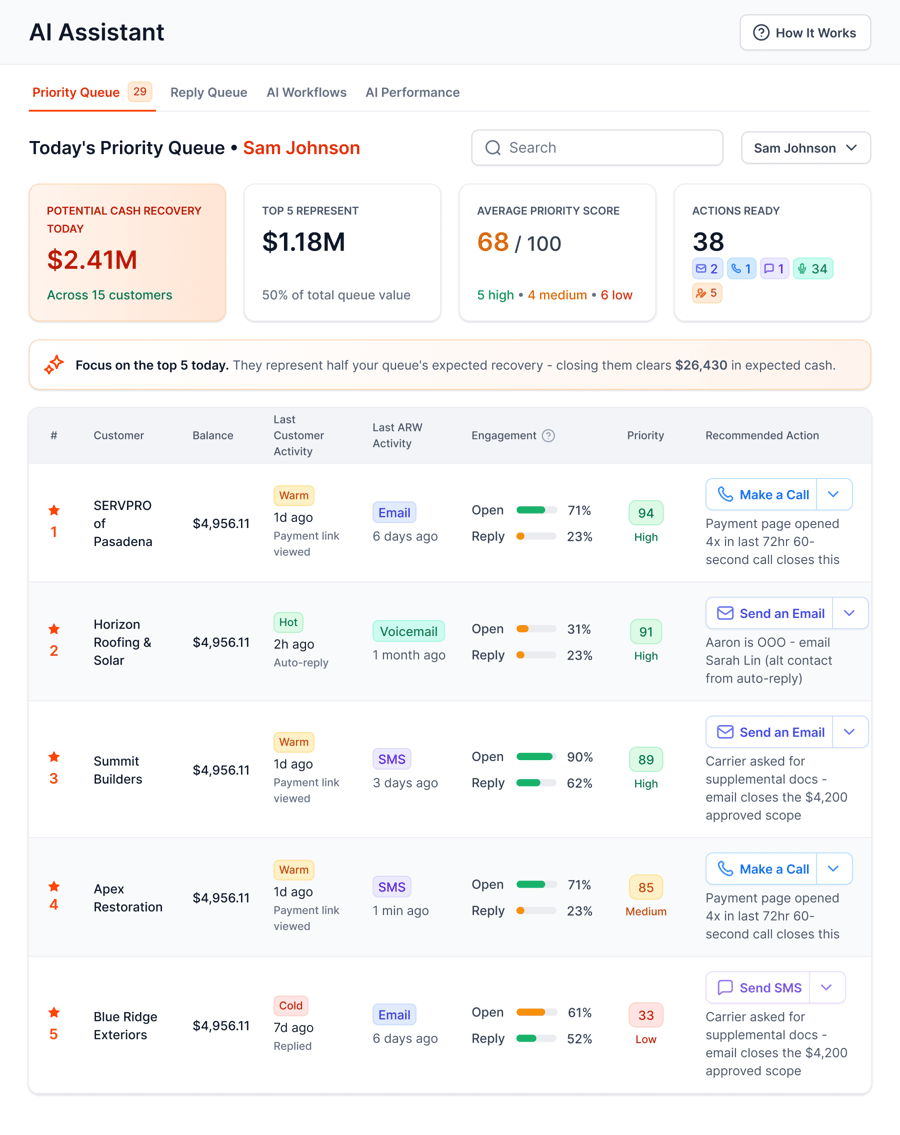
The Priority Queue shows who to contact today.
AR Workflow connects to QuickBooks Online and follows up on open invoices by email, two-way text and ringless voicemail from a dedicated number. Owners and commercial customers can pay by card or ACH from a payment link, including partial payments and payment plans. Follow-up pauses when someone promises to pay and stops when the invoice is paid. Every touch is logged, payments post back to QuickBooks, and the dashboard shows the open balance with no follow-up. AI-drafted replies are reviewed before they are sent, and AI drafts never add a payment link for adjuster, carrier or legal contacts. Lien notices and bond claims still belong with you and your attorney.
Frequently asked questions
How soon should I follow up on a pay app?
Send a short check-in three to five days after you submit it, while there is still time to fix a missing waiver or document before approval. Then follow up on the due date, about a week late, and two to three weeks late, adjusting to the GC's pay run calendar and your contract terms.
What should a retainage release request letter include?
Include the project name, the date your work or the project reached the completion point your contract names, the contract section that covers release, the retainage amount held, and every closeout document attached. Close by asking what else is needed and when payment will be made. A clear list leaves little room for delay.
Is a notice of intent to lien required before filing a lien?
It depends on the state. Some states require a notice of intent, or a preliminary notice early in the job, before a mechanic's lien can be filed, and many set strict delivery methods and deadlines. Others do not require one. Talk to a construction attorney about the rules for your state and project type.
Can I send a collection email directly to the owner if I am a subcontractor?
Often you can, and preliminary notices are designed to keep owners informed. But it can strain the relationship with the GC, and some contracts limit direct contact. Start with the GC, document every follow-up, and talk to a construction attorney before going to the owner or filing a lien or bond claim.
Are these construction invoice collection email templates free to use?
Yes. Copy any template from this page or download the Word file, then edit it with your company details, contract terms and signature. The lien and bond claim examples are general information, not legal advice, so have a construction attorney review those before you use them on a real project.
FREE DOWNLOAD
Get all 13 construction collection templates in one Word file
Edit them once with your company name, terms and signature, then copy and send.
Related reading
Templates are a start. Follow-up is the job.
Bring one overdue invoice or pay app to a demo and see what AR Workflow would send, to whom, and when.
Photos: Unsplash. This article is general information, not legal, tax or accounting advice. Lien, bond claim, retainage and prompt payment rules vary by state; talk to a construction attorney.