Learn how to ask for payment professionally with our five tips. Discover how AR Wokrflow can improve your collections process.

Ideally, transactions between businesses and customers should be straightforward. You provide a product or service, send an invoice, and the customer pays by the agreed due date.
But if you've been in business for quite some time, you know things don't always go according to plan. Sometimes, customers miss their payment deadlines, leaving you with the uncomfortable task of asking for money they already owe.
So, what is the best way to ask for payment professionally without sounding demanding or putting unnecessary strain on your client relationship?
Here are five practical tips you can start applying today.
Schedule a demo with AR Workflow to see how we can help you collect payments more efficiently!
KEY TAKEAWAYS
How you communicate with customers can influence how they respond to your payment requests. It also shows how seriously your business takes its payment terms and customer relationships.
For example, sending an invoice without clearly explaining when payment is due leaves room for confusion. If the customer doesn't understand the payment terms or has questions about the charges, that confusion can cause further payment delays.
On the other hand, a clear payment request tells the customer exactly what they owe and when you expect payment. It also gives them an opportunity to raise any concerns that might prevent them from settling the invoice.
While it's important to understand your customers' circumstances, your business also has its own financial obligations to meet. Just as customers expect you to deliver your services on time and honor your agreements, it's reasonable to expect them to respect the agreed-upon terms.
The key is communicating those expectations without damaging your customer relationships. By being polite but firm when requesting payment, you show customers that your business takes its commitments seriously while maintaining a positive relationship with them.
But knowing how to ask for payment politely involves more than choosing the right words. You also need to consider when to contact customers, how to approach different payment situations, and what to do when your initial request doesn't get a response.
The following five tips can help you handle these situations more effectively.
The first step toward helping ensure timely payments happens before you send the invoice.
When you onboard a new customer, especially for larger projects, make sure you explain your payment schedule and process, including any late fees that may apply if they miss the agreed due date.
This gives them an opportunity to understand the terms before any signed contract, as you begin working together.
For example, you might say:
"We're committed to completing your project on schedule, and our payment terms are net 30. That means payment is due within 30 days of the invoice date. Does that work for you?"
This approach gives the customer a clear understanding of when you expect payment and allows you to address questions early.
Once you define payment terms with the customer, continue reinforcing those expectations throughout the relationship.
Include the agreed and clear payment terms on your initial invoices. When you send a reminder, include the payment details, such as the original due date and outstanding balance.
If an invoice becomes overdue, you can say:
"I'm following up on invoice #1042 for $3,480, which was due on June 14. Could you confirm when we can expect payment?"
Notice how the message makes the request clear without accusing the customer of deliberately withholding payment.
You don't need to apologize for requesting money your business has earned. Instead, keep your message factual and give the customer a clear next step.
Not every customer approaches payment the same way.
You may have customers who consistently pay their invoices on time. Others have a history of late payments, while some have less predictable payment habits.
Since their payment behavior differs, your approach to requesting payment should also reflect those differences.
Start by reviewing your customers' payment histories. You can generally group them into three categories to help determine how to communicate with each one.
|
Customer Segment |
Payment Behavior |
Recommended Approach |
|
On-time payers |
Customers who consistently pay their invoices by the agreed due date |
Send friendly reminders when necessary |
|
Habitual late payers |
Customers who regularly miss payment deadlines |
Use direct payment requests with clear deadlines and consistent follow-ups |
|
Inconsistent payers |
Customers who sometimes pay on time but miss deadlines on other occasions |
Review their payment history and tailor reminders to their current situation |
For on-time payers, a short, polite reminder is usually enough. Since these customers have a history of meeting their payment obligations, you can keep your messages friendly and straightforward.
Habitual late payers, on the other hand, may need firmer communication. Remind them of the agreed payment terms and ask them to confirm when they'll settle their overdue payments.
If a client consistently delays payment, maintain a regular follow-up schedule rather than waiting for them to respond on their own.
With inconsistent payers, it's important to understand what's causing the delay before deciding how to approach them. Review your previous conversations to see whether they've mentioned payment concerns or other issues.
This helps you address their situation directly instead of sending another generic reminder.
A customer's previous payment behavior doesn't always explain their current situation. Even someone who consistently pays on time can encounter an unexpected delay, so consider their circumstances when deciding how to communicate.
Now, sending an occasional payment reminder isn't difficult. But keeping up with reminders for dozens of outstanding invoices is another matter.
Your team needs to remember when each invoice becomes due and which customers haven't responded. Employees also need to continue following up while handling their other responsibilities.
That's why automating routine payment reminders is a great place to start if you want to reduce that workload and get paid faster.
Instead of manually writing each message, you can set up a schedule to send payment reminders based on your payment terms.
For example, you might send the first reminder a few days before the due date, followed by another on the due date itself. If the invoice remains unpaid, your team can continue sending reminders at appropriate intervals.
Automation doesn't mean every customer needs to receive an impersonal message.
Include the customer's name and invoice details in each reminder. When appropriate, reference the completed project so the recipient can easily recognize what the payment request concerns.
You should also account for customer responses. If someone raises a payment dispute or confirms a payment arrangement, your team needs to review the situation before continuing with routine reminders.
This allows employees to maintain consistent communication while spending more time on accounts that require personal attention.
Here are some examples of payment reminder automation schedules you can follow:
|
When |
Channel |
Tone |
Goal |
|
5 days before the due date |
|
Friendly |
Confirm receipt of the invoice |
|
On the due date |
Email or text |
Friendly |
Remind the customer that payment is due |
|
3 days overdue |
Text |
Friendly but direct |
Address simple oversights |
|
7 days overdue |
|
Polite and specific |
Ask for a payment update or identify concerns |
|
14 days overdue |
Phone call |
Calm and solution-focused |
Discuss the delay and agree on the next action |
|
30 days overdue |
Email or formal letter |
Firm and professional |
Communicate the payment deadline and applicable next steps |
The exact schedule will still depend on your customer agreements and the circumstances surrounding each invoice. Still, defined schedules like these help your team maintain regular communication without relying on someone to remember every follow-up date.
Even when you send clear payment requests and follow a consistent reminder schedule, some invoices will remain unpaid.
A customer might overlook your emails or have questions they haven't communicated. Some may also be waiting for money from another party before they can settle the outstanding balance.
Whatever that is, if repeated reminders aren't getting a response, consider contacting the customer directly. A phone conversation gives you an opportunity to understand what's delaying payment instead of continuing to send the same message.
Start by identifying yourself and the invoice you're calling about.
For example:
"Hi Dana, this is Mike from Summit Restoration. I'm calling about invoice #1042, which is now overdue. I wanted to check whether there's anything holding up payment and see how we can resolve it."
Give the customer time to explain their situation.
If they overlooked the invoice, confirm when they can make payment. If they have questions about the charges, identify what your team needs to clarify.
For customers experiencing financial difficulties, you can discuss a payment plan when your company's policies allow it.
The goal is to finish the conversation with a clear next step.
If the customer commits to a payment date, document that agreement and follow up when necessary. If the issue remains unresolved, determine what information your team needs before taking further action.
Keep your tone professional throughout the conversation. You can communicate the importance of timely payment without making threats or creating unnecessary tension.
Sending payment requests consistently is important, but your team also needs to know whether those requests are helping collect overdue payments.
That's why it's also just as important to keep a record of your communication with each customer.
Document when employees send reminders, whether the customer responds, and any updates to the payment status. If someone promises to pay on a specific date, record that agreement so the next employee handling the account knows what to expect.
These records help prevent situations where multiple employees contact the same customer without knowing what someone else has already discussed.
Beyond individual conversations, review your collection performance to understand which approaches work best.
Here are three metrics worth monitoring:
|
Metric |
What It Helps You Understand |
|
Payment timelines |
How long customers typically take to settle their invoices |
|
Email open and response rates |
Whether customers receive and engage with your reminders |
|
Dispute resolution times |
How long your team takes to address issues delaying payment |
For example, you might notice that customers frequently respond to text reminders but rarely reply to follow-up emails.
That information can help you adjust your communication approach instead of continuing to use the same channel without results.
You may also discover that invoices remain overdue because employees don't have a clear record of the customer's previous responses.
When you understand where these delays occur, you can make more informed decisions about how to manage future payment requests.
So how can your restoration team put these tracking and follow-up practices into action without spending more time on collections? By investing in automated platforms like AR Workflow that are built to give restoration teams a structured way to manage these processes.
Instead of checking your invoicing software, multiple spreadsheets, or old emails to find out which invoices need attention, you can use its AR health dashboard and aging report to see outstanding balances and identify overdue accounts easily.
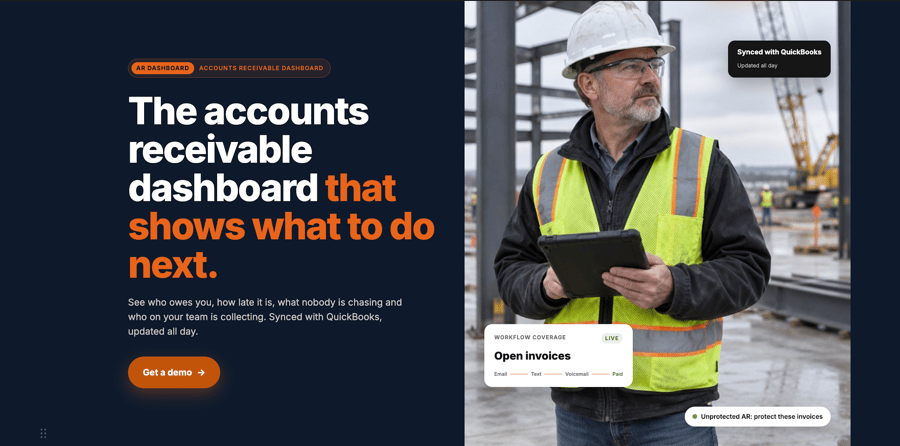
Once you know which invoices need attention, you can review each customer's communication history to see when your team last contacted them and what they discussed.
This helps employees decide whether to send another reminder, address an unresolved concern, or contact the customer directly.
You can also use AR Workflow to automate reminders by email and SMS, maintaining a consistent follow-up schedule without manually sending every message.
Customers can then use the platform's secure online payment platforms, including card payments and ACH bank transfers, to make full or partial payments.
With these processes in place, your team can spend less time checking records and managing routine reminders. They can focus more on resolving payment issues while keeping outstanding invoices moving toward payment collection.
Get a demo with AR Workflow and simplify payment follow-ups today!
To make payment requests easier, we've compiled five templates you can use in your next payment request email or message.
Subject: Invoice #1042 is due Friday
Hi Dana,
Just a friendly reminder that invoice #1042 for $3,480 is due this Friday, June 14.
You'll find the invoice attached, along with the payment link below. Please let us know if you have any questions about the invoice.
Thank you!
Hi Dana, this is Mike from Summit Restoration. Our records show invoice #1042 for $3,480 was due yesterday. Here's the payment link if you'd like to pay online. Let me know if you have any questions.
Subject: Following up on invoice #1042
Hi Dana,
I'm following up on invoice #1042 for $3,480, which was due on June 14.
Could you confirm when we can expect payment at your earliest convenience? If there's an issue with the invoice, please let us know so we can help resolve it.
Thank you!
"Hi Dana, this is Mike from Summit Restoration. I'm calling about invoice #1042, which is now two weeks overdue. Is there anything holding up payment on your end?"
If the customer explains the delay, ask when they expect to make payment and confirm the next step.
Subject: Payment required for overdue invoice #1042
“Hi Dana,
Invoice #1042 for $3,480 is now a month overdue.
Please arrange payment by [Date] or contact us to discuss the outstanding balance. If we don't receive payment or hear from you by that date, we'll proceed according to the collections terms in our agreement, including any applicable late payment fees.
We'd appreciate your prompt attention to this matter.”
These examples show how you can adjust your tone as an invoice becomes more overdue.
Each request identifies the payment and tells the customer what to do next. You can also include a copy of the original invoice to help them review the outstanding charges.
For more examples, see our payment reminder email templates for contractors.
Keep in mind that even small wording changes can affect how professional your payment request sounds.
Remember, the goal is to communicate directly without making the customer feel personally criticized. That said, here are a few examples of phrases you should and should not use when requesting payment:
|
Instead of Saying |
Try Saying |
|
"Sorry to bother you, but..." |
"I'm following up on invoice #1042." |
|
"Just checking in to see if you maybe..." |
"Could you confirm when payment will be sent?" |
|
"You still haven't paid." |
"Our records show that invoice #1042 remains outstanding." |
|
"Pay as soon as possible." |
"Please arrange payment by Friday, June 14." |
|
"Let me know." |
"Please confirm the expected payment date or let us know if there's an issue with the invoice." |
The difference is that each revised phrase gives the customer a clear reason for your message.
Instead of questioning why they haven't paid, you're referring to the invoice and asking for a specific action.
This approach helps you remain polite while keeping the conversation focused on collecting the outstanding payment.

Knowing how to ask for payment professionally is an essential skill that helps you approach customer conversations with greater confidence.
Clear expectations and polite follow-ups give customers the information they need to understand their payment obligations and respond appropriately.
However, applying these practices consistently takes time, especially when your restoration company manages a growing number of unpaid invoices.
That's why having a structured collections process that helps your team stay organized without manually doing everything matters just as much.
So, if you're looking for a way to make professional payment requests easier to manage while improving your overall collections process, AR Workflow can help you do exactly that.
Through the platform, your team can automate email and SMS payment reminders, track customer communication, and monitor outstanding invoices in one place.
You can even offer multiple payment options through secure online links, making every payment process as efficient and smooth as possible.
Ready to see how that could work for your restoration business? Book a demo with AR Workflow today!
Politely reference the invoice number, amount, and due date, then ask when you can expect payment. Keep your tone friendly and direct.
For example: "Hi [Name], I'm following up on invoice #[Number] for [Amount]. Could you confirm when you'll be making the payment?"
Use a clear subject line and briefly explain which invoice needs attention. Include the due date and payment instructions.
For example: "Hi [Name], just a friendly reminder that invoice #[Number] for [Amount] is due on [Date]. You can make your payment using the link below. Thank you!"
Keep your message short and specific. Include the invoice number, outstanding balance, and due date, then clearly ask the customer to pay or confirm their payment date. Add a payment link if you're sending the request by email or text.
Remind the customer about the outstanding balance for the services provided and ask when you can expect payment.
For example: "Hi [Name], I'm following up on the outstanding payment of [Amount] for [Service]. Could you let me know when I can expect it?"
If they don't respond, send another reminder or contact them directly.
Related reading
Your invoice, not a feature tour.
Bring one overdue invoice to a demo and see what AR Workflow would send, when, and how your customer would pay.
Sam owned and ran three restoration companies for more than 14 years and collected over $100 million in receivables. He built AR Workflow in 2020 to give contractors the collections system he wished he'd had.

AI writes the emails, sends the texts, and leaves the voicemails. Your team handles the conversations that matter, and your cash keeps moving.
 Keep QuickBooksStart with one invoiceStay in control

 Log in