AR Workflow vs Upflow for contractors: follow-up channels, QuickBooks sync, payments, pricing and who each one fits, compared side by side.


Upflow and AR Workflow both automate accounts receivable, and both connect to QuickBooks Online. But they were built for very different businesses. Upflow grew up serving B2B software and service companies with finance teams. AR Workflow was built inside the restoration industry for contractors whose customers are homeowners, insurers and small businesses.
If you're a contractor comparing the two, here's an honest side-by-side.
Full disclosure: I'm the founder of AR Workflow, so read this knowing which side I'm on. I've stuck to facts from Upflow's own website and pricing page as of November 2026, and I say plainly where Upflow is the better choice.
THE SHORT ANSWER
Pick AR Workflow if you're a contractor on QuickBooks Online and your customers are homeowners, insurance carriers, property managers or small businesses. You get email, two-way text, ringless voicemail and call tasks at a published price.
Pick Upflow if you're a larger B2B company with a finance team, you bill other businesses on NetSuite, Xero or Sage, and you want multi-entity reporting.
| AR Workflow | Upflow | |
|---|---|---|
| Built for | Contractors: restoration, roofing, HVAC, plumbing and more | B2B software and service companies |
| Follow-up channels | Email, two-way text, ringless voicemail, call tasks | Email-led sequences, with other channels on some plans |
| Insurance and multi-payer jobs | Yes: adjuster, homeowner, mortgage company on one job | No |
| Accounting | QuickBooks Online, two-way | QuickBooks Online, Xero, NetSuite, Sage |
| Payments | Card and ACH links, plans, partial payments | Card and ACH portal: cards 3.5% + $0.30, ACH 0.8% capped at $5 |
| Pricing | $295 to $495 a month, published | Quoted by revenue, plus a $390 a month platform fee |
| Setup | Done with you by a US-based team | Onboarding varies by plan |
TABLE OF CONTENTS
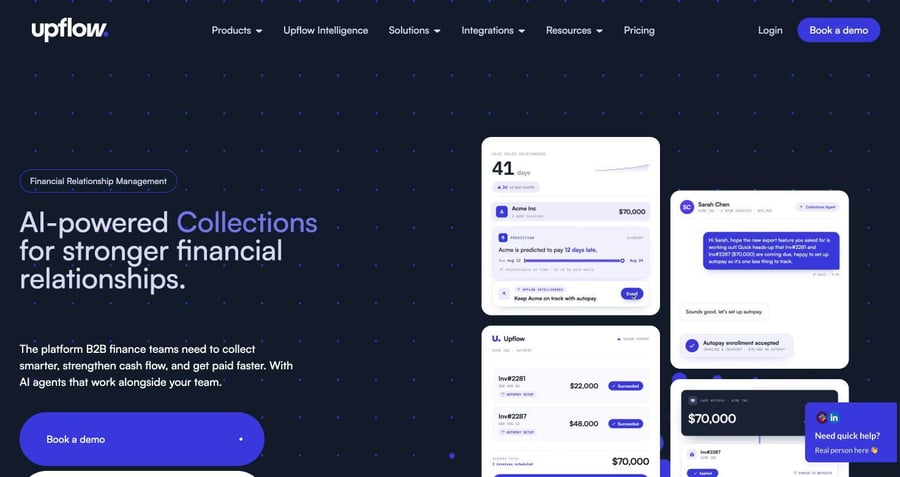
Upflow's homepage, November 2026.
This is the biggest difference. Upflow's strength is well-built email sequences and a payment portal. That works when your customers are AP departments who live in their inbox.
Contractors' customers usually don't. A homeowner who owes $8,400 for a roof will ignore three emails and answer one text. AR Workflow puts email, two-way texting from a business number, ringless voicemail and call tasks into one workflow on every invoice.
Insurance work breaks most AR tools because more than one party pays. AR Workflow lets you add the adjuster, homeowner and mortgage company to a job and run insurance-specific follow-up. Upflow is designed around one business customer per account.
If you do restoration or storm work, read how to collect from carriers, adjusters and homeowners.
Upflow wins on breadth: QuickBooks Online, Xero, NetSuite, Sage and more. AR Workflow connects only to QuickBooks Online, but goes deep, syncing invoices in and payments and fees back out automatically. If you're on QuickBooks Online, both work. If you're on NetSuite or Sage, Upflow is the option of the two.
AR Workflow publishes its prices: $295, $395 or $495 a month (or $278, $370, $462 billed yearly). Every feature on every plan. Texts, calls and payment processing are billed by usage.
Upflow quotes plans by annual invoiced revenue and lists a $390 a month platform fee on its pricing page. For a contractor doing a few million a year, expect Upflow to cost more, and to need a sales call to find out how much. Compare it with the alternatives in Upflow alternatives for contractors.
Both offer card and ACH. Upflow lists card fees of 3.5% + $0.30 and ACH at 0.8% capped at $5. AR Workflow supports card and ACH links, payment plans and partial payments, and lets you pass card fees to the customer where your state allows it.
Here's a made-up but typical example. A restoration company finishes a $14,200 water mitigation job. The homeowner owes a $1,000 deductible, the carrier owes the rest, and the mortgage company is on the check.
The invoice syncs in from QuickBooks with one customer attached: the homeowner. Upflow's email sequence starts. The homeowner, who is waiting on the carrier, ignores it. The adjuster isn't in the system, so nobody follows up there unless someone in your office remembers. The mortgage company endorsement isn't tracked at all.
The invoice syncs in, and your office adds the adjuster and mortgage company as contacts on the job. The insurance workflow emails the adjuster with the documents, texts the homeowner about the deductible with a pay link, and creates a call task at day 3 to confirm the claim status. When the carrier check arrives, the mortgage endorsement step is on the list. The homeowner pays the deductible by text in two minutes.
Upflow wasn't designed for this situation, and that's fine; most of its customers never face it. Contractors face it every week. Read how to collect from carriers, adjusters and homeowners.
A made-up contractor with $4 million in revenue, 90 open invoices and 3 office users. Upflow's plan fee is quoted, so we show only the published platform fee.
| AR Workflow (Grow) | Upflow | |
|---|---|---|
| Subscription | $4,740 a year | Quote by revenue |
| Platform fee | None | $4,680 a year ($390 a month) |
| Card fees on $500,000 of card payments | Your processor rate; can pass fees to customer where allowed | 3.5% + $0.30 per payment, about $17,500+ |
| ACH on $1,000,000 | Your processor rate | 0.8% capped at $5 per payment |
| Texts and voicemails | Usage-based | Varies by plan |
Check Upflow's current quote for your company. The point is that Upflow's published fees alone match AR Workflow's full subscription before its plan price is added.
Upflow has strong dashboards for finance teams, including cash forecasting and team views, which suit a CFO managing many B2B accounts.
AR Workflow's dashboard shows total due, cash collected, the aging buckets and "unprotected AR": open invoices with no follow-up scheduled. User performance reports show what each person on your team did and collected, and scheduled email reports land in the owner's inbox every week. The AR reporting page has examples.
Upflow onboarding varies by plan and is designed for finance teams who will run the system themselves.
AR Workflow sets up your account with you: a US-based team connects QuickBooks, builds your first workflows from proven templates and trains your office. There's no free trial; every plan starts with a demo so the first messages that go to your customers are right.
Not sure either one fits? Compare more options:
Here's how the two compare on the seven things that decide whether a contractor gets paid faster, with a winner for each.
| What matters | AR Workflow | Upflow | Edge |
|---|---|---|---|
| Reaching homeowners | Email, two-way text, voicemail, calls | Email-led sequences | AR Workflow |
| Insurance and multi-payer jobs | Yes | No | AR Workflow |
| Daily call list | Priority Queue | Partial | AR Workflow |
| Accounting choice | QuickBooks Online | QuickBooks Online, Xero, NetSuite, Sage | Upflow |
| Multi-entity finance reporting | Basic | Strong | Upflow |
| Published price | Yes, $295 to $495 | Quote plus $390 platform fee | AR Workflow |
| Setup help | Done with you | Varies | AR Workflow |
More than 3,200 users rely on AR Workflow. Customers report getting paid an average of 21 days faster and saving about 18 hours a week of office time.
| Customer | Before | After |
|---|---|---|
| SERVPRO of Northeast San Diego | 105 days to get paid | 52 days |
| Horizon Roofing | 45 days | 25 days |
Read more customer stories.
"Partial" means limited, an add-on or higher plans only. Check Upflow's current plans before you buy.
| Feature | AR Workflow | Upflow |
|---|---|---|
| Email reminders | Yes | Yes |
| Two-way texting | Yes | Partial |
| Ringless voicemail | Yes | No |
| Call tasks and daily call list | Yes | Partial |
| Card and ACH pay links | Yes | Yes |
| Payment plans and partial payments | Yes | Partial |
| Multiple payers per job (insurance) | Yes | No |
| Two-way QuickBooks Online sync | Yes | Yes |
| Other accounting systems | No | Yes: Xero, NetSuite, Sage |
| Late fees | No | Partial |
| Published pricing | Yes | Partial |
| Free trial | No | No |
| Done-with-you setup | Yes | Varies |
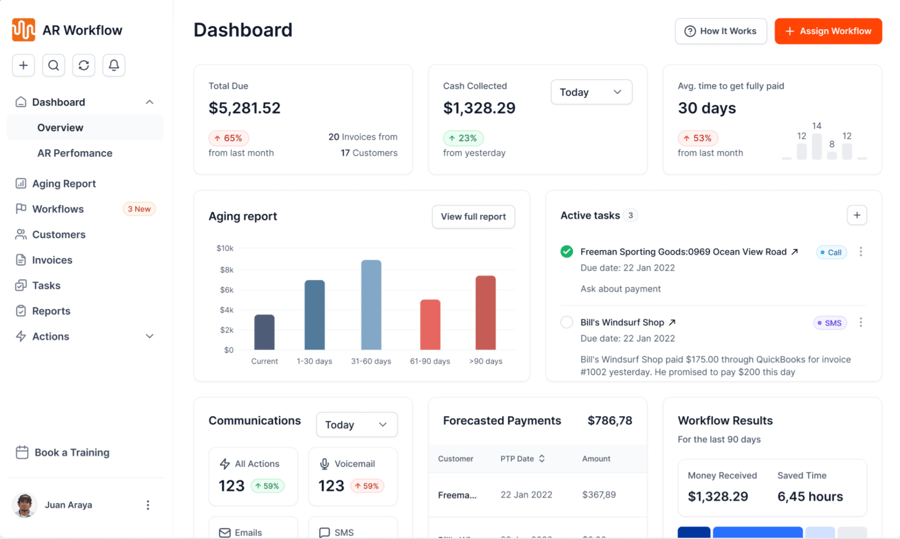
The AR Workflow dashboard: what's owed, what came in and who to contact next.
AR Workflow syncs two ways with QuickBooks Online and puts every open invoice on a follow-up workflow of emails, two-way texts, ringless voicemails and call tasks. Customers pay by card or ACH from a link in every message, and payments post back to QuickBooks on their own. The Priority Queue gives your office a short list of who to contact today, and the dashboard shows "unprotected AR": money nobody is chasing yet.
More than 3,200 users rely on it. Customers report getting paid an average of 21 days faster and saving about 18 hours a week. SERVPRO of Northeast San Diego cut its average days to pay from 105 to 52, and Horizon Roofing went from 45 days to 25.
Pick Upflow if
Pick AR Workflow if
Bring one overdue invoice to a demo.
We'll show you exactly how AR Workflow would chase it, from the first text to the payment posting in QuickBooks.
Get a demoUpflow is a strong product for B2B finance teams. Contractors who bill homeowners and insurers usually find it a weaker fit because it's email-led, has no voicemail and uses quote-based pricing with a platform fee.
Upflow quotes plans by annual invoiced revenue and lists a $390 a month platform fee on its pricing page, as of November 2026. Payment fees are extra.
$295, $395 or $495 a month, or $278, $370 and $462 a month billed yearly. Every plan has every feature; plans differ by open invoices and users.
No. AR Workflow works with QuickBooks Online only.
Yes. Connect QuickBooks Online, build your workflows with our team, and turn off Upflow reminders the same day. Most contractors are running within a week.
AR Workflow starts with a demo and guided setup, not a free trial. Check Upflow's site for its current options.
Upflow is email-led. Check its current plans for SMS options. AR Workflow includes two-way texting from a dedicated business number on every plan.
For most contractors, no. Upflow lists a $390 a month platform fee before its quoted plan price, while AR Workflow's published plans run $295 to $495 a month.
Yes. You can add the adjuster, homeowner, mortgage company or property manager as contacts on a job and run insurance-specific workflows.
Companies on Xero, NetSuite or Sage, businesses with only a handful of invoices, and B2B firms that don't need text or voicemail.
It can send reminders, but it isn't built for insurance jobs with several payers, which is most of restoration billing.
Bring one overdue invoice to a demo and see what AR Workflow would send, when, and how your customer would pay.
Book a demo
Sam owned and ran three restoration companies for more than 14 years and collected over $100 million in receivables. He built AR Workflow in 2020 to give contractors the collections system he wished he'd had.

AI writes the emails, sends the texts, and leaves the voicemails. Your team handles the conversations that matter, and your cash keeps moving.
 Keep QuickBooksStart with one invoiceStay in control

 Log in