Free electrical invoice template for electricians: every field, a filled-in example, payment terms, change orders, permits, and how to follow up to get paid.

An electrical invoice template is the document that turns a finished panel swap, service call or rough-in into money in the bank. Most electricians lose time on invoices not because the work was wrong, but because the invoice left room for questions: what was the trip charge for, why is the wire line so high, was the permit included, which job is this. Every question is a reason for the customer to wait.
I owned three restoration companies over 14 years and spent a lot of that time chasing receivables, including plenty of electrical subcontractor invoices that crossed my desk. The ones that got paid first were never the prettiest. They were the clearest. This guide gives you a full electrical invoice template you can copy, a filled-in example, the payment terms wording to use, how to bill deposits, progress payments and change orders, and the follow-up schedule that gets electrical contractor invoices paid without awkward phone calls.
KEY TAKEAWAYS
An electrical invoice has to work for very different customers. A homeowner who just had an EV charger installed wants a simple total and a way to pay from their phone. A property manager wants a work order number and a PDF their AP team can process. A general contractor wants the invoice to match the schedule of values and arrive with a lien waiver. One template can handle all three if it has the right fields.
Copy the template below into your invoicing tool, Word, Google Docs or QuickBooks custom form. Replace everything in brackets. Delete any section that does not apply to the job, but keep the order: customers read top to bottom, and the total and pay link should never be hard to find.
ELECTRICAL INVOICE TEMPLATE
[Company name]
[Street address, city, state ZIP]
[Phone] | [Email] | [Website]
Electrical contractor license #: [number] ([state])
| Invoice # | [number] |
| Invoice date | [date] |
| Due date | [date] |
| Bill to | [Customer name, billing address, email, phone] |
| Job address | [Service address, unit or suite] |
| PO / work order # | [number, if the customer uses one] |
| Date(s) of service | [dates] |
| Technician(s) | [names] |
| Permit # and inspection | [permit number], [passed / scheduled / not required], [inspection date] |
Scope of work: [One to three sentences in plain language. What you found, what you did, what is left.]
| Description | Qty / hrs | Rate | Amount |
|---|---|---|---|
| Service call / trip charge | 1 | [$] | [$] |
| Labor: journeyman / master electrician | [hrs] | [$/hr] | [$] |
| Labor: apprentice / helper | [hrs] | [$/hr] | [$] |
| Flat-rate task: [e.g. replace 200A panel] | 1 | [$] | [$] |
| Materials: [item, size, brand] | [qty or ft] | [$ each] | [$] |
| Permit and inspection fee | 1 | [$] | [$] |
| Change order #[number]: [description] | 1 | [$] | [$] |
| Disposal / haul-away | 1 | [$] | [$] |
| Subtotal | [$] |
| Sales tax ([rate]% on [materials / taxable items]) | [$] |
| Less deposit received [date] | -[$] |
| Less previous progress payments | -[$] |
| Balance due | [$] |
Pay online: [payment link] (card or bank transfer). Checks payable to [Company name], [mailing address]. Please write invoice # on the check.
Terms: [Due on receipt / Net 15 / Net 30]. [Late fee wording, see below.]
Warranty: Labor warranted for [period] from completion. Materials carry the manufacturer's warranty.
Questions about this invoice: [Name], [direct phone], [email]
Tip: Put the balance due and the payment link above the fold in the email that carries the invoice, not just inside the PDF. A lot of residential customers pay from the email preview on their phone and never open the attachment.
Every field in the template is there because, at some point, its absence cost a contractor a week of waiting. Here is what each one prevents.
| Field | Why it matters on electrical work |
|---|---|
| License number | Many states and cities expect licensed electrical contractors to show their license number on contracts and invoices. Check your state licensing board's rules. It also reassures customers who have been burned by unlicensed work. |
| Job address and unit | Property managers and GCs pay dozens of electrical invoices a month. Without the exact address and unit, yours goes into the "find out what this is" pile. |
| PO or work order number | Commercial AP teams often cannot pay an invoice that does not match an open PO. Missing it can mean the invoice is rejected without anyone telling you. |
| Permit number and inspection status | Panel upgrades, new circuits, service changes and EV chargers often need a permit. Showing the permit and a passed inspection answers "is it legal and is it done" before the customer asks. |
| Scope of work in plain words | "Replaced failed 20A GFCI in kitchen, traced fault to loose neutral at first receptacle, retorqued and tested" beats "electrical repair." Specific scope is the best defense against disputes. |
| Labor split from materials | Sales tax often applies differently to materials and labor depending on the state, and customers judge labor and materials separately. One lump number invites a haggle. |
| Payment link | The fastest invoices to clear are the ones a customer can pay in the moment they read them. |
Here is the template filled in for a typical residential job: a 100A to 200A service upgrade with a new panel and a dedicated circuit for a Level 2 EV charger. The company and customer are made up.
EXAMPLE
Brightline Electric LLC
2200 Commerce Way, Springfield, [State] | (555) 014-7730 | billing@brightline-example.com
Electrical contractor license #: EC-000000 (example)
Invoice # 1047 | Date Oct 21 | Due Nov 4 (Net 14)
Bill to: Jordan Reyes, 88 Maple Court, Springfield
Job address: 88 Maple Court | Service dates: Oct 16 to Oct 17
Permit: E-24-1183, final inspection passed Oct 20
Scope: Upgraded 100A service to 200A. Replaced main panel, new meter base coordinated with utility, new grounding electrode system. Installed 60A dedicated circuit and NEMA 14-50 receptacle in garage for customer-supplied EV charger.
| Description | Amount |
|---|---|
| 200A service upgrade, flat rate (labor, panel, meter base, breakers, grounding) | $3,950.00 |
| EV circuit: 60A breaker, 45 ft 6 AWG copper, 14-50 receptacle, labor | $780.00 |
| Change order #1 (signed Oct 16): replace corroded service entrance cable | $420.00 |
| Permit and inspection fee (at cost) | $185.00 |
| Disposal of old panel and meter base | $45.00 |
| Total | $5,380.00 |
| Less 30% deposit received Oct 9 | -$1,488.00 |
| Balance due | $3,892.00 |
Pay online: [Pay invoice 1047]
Terms: Net 14. Balances unpaid after the due date accrue a late charge of 1.5% per month, as agreed in the signed proposal.
Warranty: Workmanship warranted for 1 year. Panel and breakers carry the manufacturer's warranty.
Questions: Dana Price, office manager, (555) 014-7731
Example company, customer, license number, permit number and amounts are made up for illustration. Tax is omitted for simplicity; how sales tax applies to electrical work depends on your state. The deposit was 30% of the original $4,960 quote, before the change order.
Notice what the customer does not have to ask: what the extra $420 was (signed change order, dated), whether the work passed (inspection date), what they already paid (deposit shown and subtracted) and how to pay the rest (one link).
Payment terms only work if they were agreed before the work started. Put them in your proposal or work authorization, then repeat them on the invoice. Here is wording you can adapt. Have your attorney review anything you plan to enforce, because late fee and interest limits vary by state.
TERMS YOU CAN COPY
Residential service calls: "Payment is due on completion of work. We accept card, bank transfer and check. Pay online at [link]."
Residential projects: "A deposit of [X]% is due on acceptance of this proposal. The balance is due within [14] days of final inspection. Approved change orders are billed with the final invoice."
Commercial and property management: "Net 30 from invoice date. Please reference PO [#] on payment. Invoices not disputed in writing within 10 days of receipt are considered accepted."
Late fee: "Balances not paid by the due date accrue a late charge of [rate] per month, or the maximum allowed by law if lower, as agreed in the signed contract."
For a deeper look at choosing terms that actually change customer behavior, see our guide to payment terms that get contractors paid.
For anything bigger than a service call, take a deposit. It covers your materials, which on a service upgrade or a generator install can be a big share of the job, and it confirms the customer is serious. Show the deposit as its own invoice when you collect it, then subtract it on the final invoice with the date received. Some states cap how much a home improvement contractor can collect up front on residential jobs, so check your state's home improvement or contractor licensing rules before setting a percentage.
On new construction, remodels and commercial tenant improvements, electrical work happens in phases: rough-in, trim-out, final. Bill at each phase rather than waiting until the end. Tie each progress invoice to a milestone the customer can see, like "rough-in complete and inspected." If you work for a GC who uses AIA-style pay applications, match your invoice to their schedule of values and send your conditional lien waiver with it, or the pay app will sit.
Electrical jobs reveal surprises: aluminum branch wiring, an undersized service, a buried junction box, a panel brand with known problems. When the scope changes, write a short change order, get a signature or a written "approved" by text or email before you do the work, and number it. On the invoice, show each change order as its own line with its number and date. Change orders added after the fact, without a signature, are the most common reason I have seen a customer refuse part of an electrical invoice.
Bring one overdue invoice.
We'll show you exactly how it would be followed up, and what your customer would see.
Many residential electrical shops have moved to flat-rate pricing for common tasks: replace a breaker, add a circuit, install a fixture, swap a panel. The customer sees one price per task and does not watch the clock. Time and materials (T&M) still makes sense for troubleshooting, older homes with unknowns, and commercial work where the scope is loose.
| Method | How to show it on the invoice | Watch out for |
|---|---|---|
| Flat rate | One line per task with a clear name and what it includes | Customers asking for a labor breakdown. Have a one-line answer ready: the price covers labor, standard materials and warranty. |
| Time and materials | Hours by tech level and rate, then materials itemized | Unexplained hours. Note start and end times, and what took the time. |
| Fixed bid | Contract amount, billed by milestone, plus change orders | Scope creep. Every addition needs a numbered change order. |
If you charge a trip or diagnostic fee, put it on its own line and say whether it is credited toward the repair. If the call was after hours, a weekend or an emergency, label the rate as such ("Emergency rate, Saturday 9:40 pm").
Itemize major materials with size and brand: panel, breakers, meter base, wire by gauge and footage, conduit, devices. If you mark up materials, that is normal, but do not show your cost and your markup side by side; just show the sell price.
Show the permit fee as a separate line, ideally at cost. If the utility had to disconnect and reconnect service, note the date. If the inspection is still scheduled, say so and set the due date from the inspection, not from the invoice date, or you will be chasing a customer who is waiting on the inspector.
Electrical contractor invoices to a GC or owner usually need more paperwork: the PO, the schedule of values line, retainage withheld, a conditional lien waiver, and sometimes certified payroll on public jobs. Find out what the GC's AP team requires before your first billing, put it on a checklist and send it all in one package every time. For more on the commercial side, see our contractor's guide to construction accounts receivable.
| 1 | Invoicing days after the job. The day the work is done is the day the customer is happiest. Every day after that, the job matters less to them. |
| 2 | "Electrical work" as the only description. Vague invoices get questioned. Specific ones get paid. |
| 3 | Unsigned change orders. If it is not signed or approved in writing before the work, expect pushback. |
| 4 | Missing PO or work order number. Commercial AP will park it, often without telling you. |
| 5 | Adding a late fee that was never agreed. A late fee that shows up for the first time on an overdue invoice starts an argument and is often unenforceable. |
| 6 | No follow-up plan. Sending the invoice is step one. Most of the money is collected in the reminders. |
Construction has a slow-pay problem. Rabbet's 2024 Construction Payments Report found that 82% of contractors surveyed wait more than 30 days to get paid. Electrical shops that do a lot of residential service work can do much better than that, but only if follow-up happens on a schedule instead of when someone in the office has a spare hour.
Send the invoice the same day the job is finished, by email with the PDF attached and a payment link in the body. Then follow a schedule like this one:
| Day 0 | Invoice by email with payment link. Short text that it has been sent. |
| Due date | Friendly reminder by email and text. |
| +3 days | Voicemail or call. Ask if anything on the invoice needs a second look. |
| +10 days | Firm second notice with a pay-by date and an offer of a payment plan. |
| +21 days | Call from the owner or office manager. |
| +30 days | Final notice by email and certified mail. Check your state's lien deadlines before you mention a lien. |
If you need the words for each step, our payment reminder email templates for contractors and past due invoice letter templates cover the friendly, firm and final versions. Keep an eye on the whole picture with an aging report every week, so a $400 service call does not quietly turn 90 days old.
The schedule above works. The problem is that nobody in a busy electrical shop has time to run it for every open invoice, every week. That is the gap AR Workflow for electrical contractors fills.
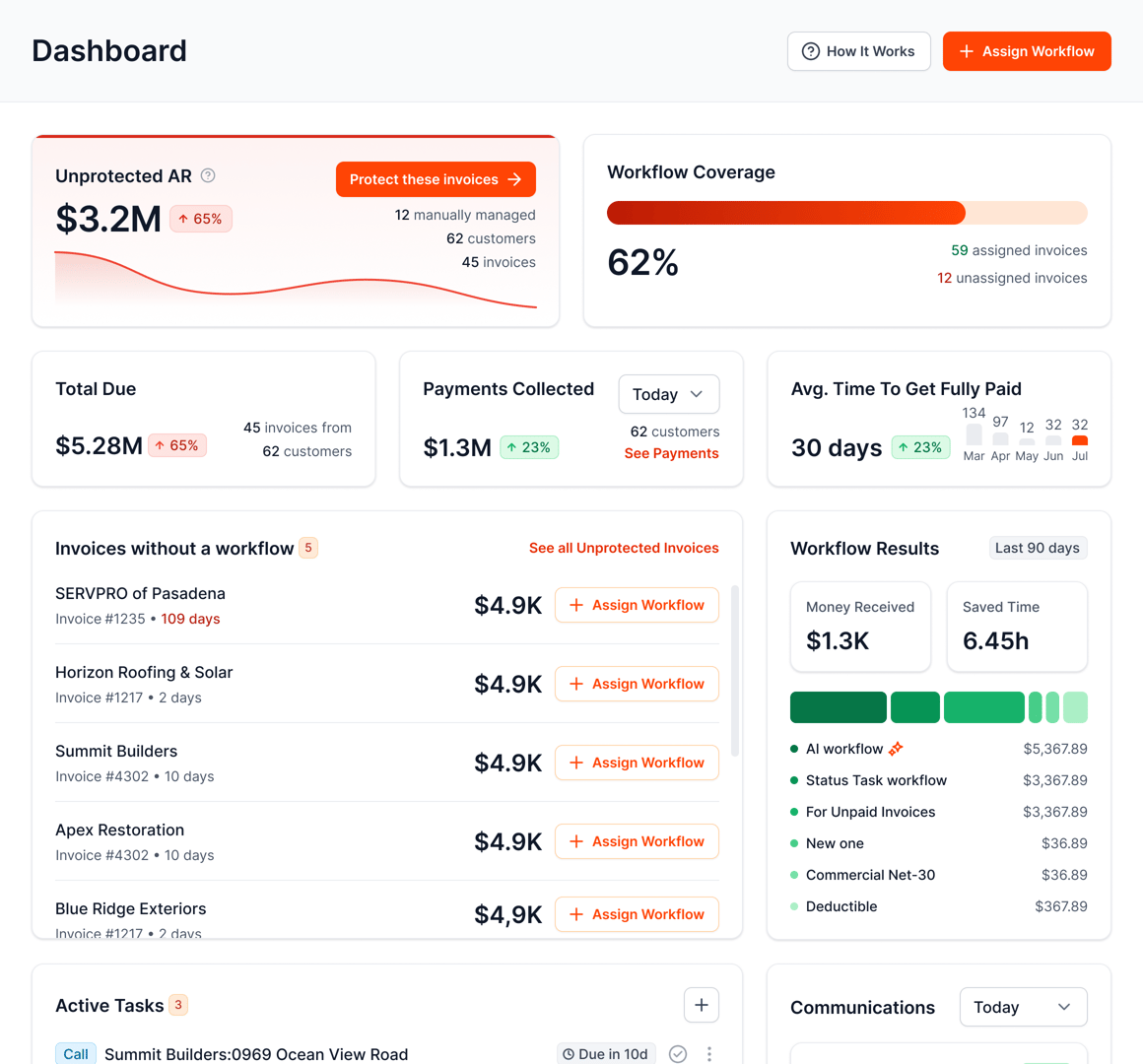
AR Workflow shows the invoices nobody is following up on, and puts them on a schedule in one click.
It syncs with QuickBooks, picks up each open invoice, and runs automated payment reminders by email, text and ringless voicemail from a dedicated number. Every reminder carries a payment link so homeowners can pay by card or bank transfer from their phone. Reminders stop when the customer pays and pause when they promise a date. An aging dashboard shows the office what is overdue and who needs a call. You keep your invoice template; AR Workflow handles what happens after it is sent.
Your company name and license number, the customer and job address, invoice number and date, due date, permit number and inspection status where one applies, a plain-language scope of work, labor and materials listed separately, permit and other fees, any change orders, deposits subtracted, the balance due, payment terms and a payment link.
Both. Many residential service shops use flat-rate pricing for common tasks and hourly time and materials for troubleshooting and unknowns. Commercial and new construction work is usually fixed bid billed by milestone or through pay applications. Whatever method you use, show it consistently on the invoice so customers know what they are paying for.
Only if the customer agreed to it before the work, usually in your proposal or work authorization, and only within the limits your state allows. Show the agreed late fee wording on every invoice. Do not add one for the first time on an overdue invoice.
It depends on your state and sometimes on whether the job is a repair, an installation or a capital improvement. Some states tax materials only, some tax labor too, and some treat contractors as the end consumer of materials. Check your state department of revenue's guidance for contractors and ask your accountant.
Related reading
Your invoice, not a feature tour.
Bring one overdue invoice to a demo and see what AR Workflow would send, when, and how your customer would pay.
Photos: Unsplash. Source: Rabbet, 2024 Construction Payments Report. This article is general information, not legal or tax advice.
Sam owned and ran three restoration companies for more than 14 years and collected over $100 million in receivables. He built AR Workflow in 2020 to give contractors the collections system he wished he'd had.

AI writes the emails, sends the texts, and leaves the voicemails. Your team handles the conversations that matter, and your cash keeps moving.
 Keep QuickBooksStart with one invoiceStay in control

 Log in