
If you need to collect unpaid construction invoices, you are not alone, and you are probably not dealing with a simple late payer. Construction money moves through owners, general contractors, lenders and subs. It is tied to pay apps, lien waivers, retainage and change orders. Whether it is an unpaid contractor invoice for a kitchen remodel or a six-figure pay app on a commercial job, when an invoice stalls the reason is often a document, a dispute or a deadline, not just a customer who forgot.
This is a step-by-step collection playbook for general contractors, owners' reps and subcontractors. It covers how to find out why an invoice is unpaid, how to follow up without burning the relationship, when to send a construction demand letter, and how mechanic's liens, payment bond claims and prompt payment acts fit in. For the bigger picture on billing and tracking, see our construction accounts receivable guide.
KEY TAKEAWAYS
- Find out why the invoice is unpaid before you push. Most stalled construction invoices have a missing document, an open dispute or an approval gap behind them.
- Follow up on a fixed schedule, with a named contact, across more than one channel.
- Put your lien notice, lien filing and bond claim deadlines on the calendar for every job. They can expire while you are still being polite.
- Escalate in order: reminders, a direct call, a formal letter, a demand letter, then lien, bond claim or legal action.
- Legal remedies vary by state. Treat this guide as general information and talk to a construction attorney before deadlines pass.
Why construction invoices go unpaid
Before you send another reminder, work out which of these is really holding the money. The fix is different for each one.
| Reason | What it looks like | What usually fixes it |
|---|---|---|
| Missing paperwork | Pay app sent back for a waiver, a sub waiver, a stored materials invoice or a certified payroll report | Send the missing item the same day and ask for the next pay run date |
| Approval gap | The architect, owner's rep or lender has not signed off | Ask the AP contact who is holding it and what they need |
| Disputed scope or quality | Punch list items, a backcharge or a claim of defective work | Separate the disputed amount and push for payment of the undisputed balance |
| Unsigned change order | Extra work billed without written approval | Get the change order signed, or bill it separately with your backup |
| Pay-when-paid or pay-if-paid | The GC says the owner has not paid them yet | Read the clause, ask when the owner pay app was submitted, and watch your lien and bond deadlines |
| Cash flow trouble | Slow replies, partial payments, new excuses every week | Ask for a written payment plan and move faster on legal deadlines |
| Simple neglect | Nobody has followed up, so nobody has paid | A consistent follow-up schedule |
The last row is more common than most contractors admit. An aging report shows you what is owed. It does not show which invoices nobody has touched in three weeks. Our guide to the AR aging report explains how to read each bucket and spot the ones that are slipping.
How to collect unpaid construction invoices: the step-by-step playbook
Use the same sequence on every unpaid invoice. A consistent process is easier to run, easier to hand off, and gives you a clean record if the invoice ends up in front of an attorney.
| 1 | Confirm the invoice is correct and complete. Check the amount against the contract, the schedule of values and any approved change orders. Make sure the pay app has every required waiver and attachment. If something is missing, fix it first, because a reminder about an incomplete pay app just restarts the clock. |
| 2 | Find the right person. Payments in construction often stall because the reminder goes to a general inbox. Get the name, email and phone number of the AP contact and the project manager on the paying side. On larger jobs, also know who approves pay apps for the owner. |
| 3 | Ask a direct question. Instead of "just checking in", ask: "Is pay app 6 approved, and which pay run is it scheduled for?" A specific question gets a specific answer, and that answer tells you whether you have a paperwork problem, an approval problem or a cash problem. |
| 4 | Follow up on a fixed schedule. A simple rhythm works: a reminder a few days before the due date, one on the due date, then every five to seven days. Switch channels when email goes quiet: a call, a text, a voicemail. Log every contact with the date and what was said. |
| 5 | Separate disputed and undisputed amounts. If the customer disputes part of the invoice, put the disputed portion in writing and ask for the undisputed balance now. Many prompt payment laws treat undisputed amounts differently, and it keeps a small disagreement from holding up the whole payment. |
| 6 | Offer a way to pay. For owners, homeowners and commercial customers, make paying easy with a payment link for card or ACH. A written payment plan with dates is better than an open-ended promise. Never send a payment link to an insurance adjuster or carrier on a restoration job; ask them for claim status instead. |
| 7 | Send a formal past-due letter. Once the invoice is about 30 days late with no firm answer, send a written notice that states the amount, the invoice numbers, the history and a date for payment. Our past due invoice letter templates give you wording you can adapt. |
| 8 | Check your lien and bond deadlines. Before you go further, confirm the dates for any preliminary notice, notice of intent to lien, lien filing, bond claim or prompt payment notice. If a deadline is close, protect your rights first and keep negotiating second. |
| 9 | Send a construction demand letter. A demand letter is the final written request before legal action. It names the remedy you will pursue and a firm deadline. On many jobs, a notice of intent to lien does the same job and carries more weight. |
| 10 | Escalate to a lien, bond claim, attorney or collection agency. If payment still does not arrive, file within your deadlines with help from a construction attorney, or hand the file to counsel or a collection agency with your full contact log. |
Tip: Write the next step and its date on every open invoice, not just the last contact. "Called AP, waiting" is a note. "Call AP Thursday, then send notice of intent to lien on the 15th" is a plan.
Who you are collecting from changes the approach
Subcontractors collecting from a general contractor
Your payment often depends on the GC's pay app to the owner. Ask when the GC submitted the owner pay app and whether your line was included. Keep your lien waivers current and conditional until funds clear. If the GC points to a pay-when-paid clause, read it carefully. In many states it only delays payment for a reasonable time, and your lien or bond rights usually keep running in the background.
General contractors collecting from an owner or developer
You are often carrying your subs while you wait. Track owner receivables and sub payables by job, so you can see the gap clearly. Escalate through the owner's rep, the architect and, where there is one, the construction lender. A lender's draw process has its own inspection and paperwork steps, so ask what they are still waiting on.
Contractors collecting from homeowners
Residential balances are usually smaller and more personal. The homeowner may be unhappy with a finish detail, waiting on a loan draw or simply short on cash. A friendly text with a payment link, an offer to walk the punch list and a written payment plan often work better than a formal letter. Our guide to collecting unpaid invoices without burning the relationship covers that tone in more detail.
Restoration and roofing contractors with insurance work
Insurance jobs split the balance across the carrier, the homeowner and sometimes the mortgage company. Ask the adjuster or carrier for claim and payment status, and send the homeowner their portion, such as the deductible or upgrades, with a payment link. See how this works for roofing contractors.
Bring one overdue invoice.
We'll show you how AR Workflow would follow up on it with the GC, the owner or the homeowner, straight from QuickBooks Online.
Handling a construction payment dispute
A construction payment dispute does not have to mean a lawsuit. Most disputes are about scope, quality, timing or a backcharge, and most are settled by people who still want to work together. A few habits keep a dispute small:
- Get the objection in writing. Ask the customer to list exactly what they are disputing and why. Vague complaints are hard to resolve and easy to stretch.
- Split the money. Agree on the undisputed amount and ask for it now, while you work on the rest.
- Bring the documents. The contract, the schedule of values, signed change orders, daily logs, photos and emails usually settle more than arguments do.
- Offer a fix, not a fight. If a punch list item is real, schedule it and connect the payment to its completion.
- Read the dispute clause. Many contracts require notice, negotiation, mediation or arbitration before a lawsuit. Skipping a step can hurt your position.
- Do not let the dispute stop the clock on your rights. Lien and bond deadlines usually keep running while you negotiate.
Sending a construction demand letter
A construction demand letter tells the customer, clearly and in writing, that you expect payment by a set date and what you will do if it does not arrive. It is usually the last step before a lien, a bond claim or a lawsuit, and it often works because it shows you are organized and serious.
| Include | Why it matters |
|---|---|
| Project name and address | Connects the debt to a specific property or public job |
| Contract date and parties | Shows who owes whom under which agreement |
| Invoice or pay app numbers and amounts | Removes any doubt about what is owed |
| Payments received to date | Shows you are being fair and accurate |
| A short follow-up history | Proves the customer has had notice and time |
| A firm deadline | Gives a clear date, such as 10 business days, to respond |
| How to pay | Makes it easy to say yes |
| The next step | States the remedy you will pursue, such as a lien or bond claim, only if you are prepared to follow through |
Keep the tone factual. Do not threaten anything you have no right to do or no intention of doing. If you have an attorney, a letter on their letterhead can carry more weight. For the earlier, friendlier messages that come before a demand letter, use our payment reminder email templates for contractors.

Mechanic's liens, payment bond claims and prompt payment acts
These are the tools that make construction collections different from most industries. They are powerful, but they are also technical and deadline driven. The overview below is general information only. Rules, forms and deadlines vary by state and by type of project, so talk to a construction attorney about your job.
Mechanic's lien
A mechanic's lien (sometimes called a construction lien) is a claim against the property you improved. It can make it hard for the owner to sell or refinance until the debt is resolved. Many states require a preliminary notice early in the job, and some require a notice of intent to lien before filing. Filing deadlines are often counted from your last day of work or last delivery of materials, and they are strict. Lien rights generally do not apply to public property.
Payment bond claim
On public projects, and on some private ones, the GC usually provides a payment bond. If you are an unpaid sub or supplier, you make a claim against that bond instead of filing a lien. On federal jobs this comes from the Miller Act, and most states have similar laws for state and local projects, often called Little Miller Acts. Bond claims have their own notice requirements and deadlines, and who can claim depends on how far down the payment chain you are.
Prompt payment acts
The federal Prompt Payment Act covers federal contracts, and many states have their own prompt payment laws for public work, private work or both. These laws generally set time limits for paying approved invoices and may allow interest on late payments. Some also cover retainage release or the right to suspend work after notice. Coverage, timelines and remedies vary widely, so check the rules that apply to your project.
Tip: Build a deadline calendar for every job at the start, not when the invoice is already late. Record the first day of work, the expected last day, and every notice and filing date your attorney says applies.
A made-up example: one unpaid pay app, start to finish
Example: Ridgeback Drywall and pay app 7
A drywall subcontractor on a private commercial job, owed by the GC.
| Pay app 7 submitted | Day 0 |
| Amount due this period, after retainage | $84,600 |
| Day 5: AP says the sub lien waiver is missing | Waiver sent same day |
| Day 12: pay app approved, scheduled for next pay run | Confirmed in writing |
| Day 35: payment not received; GC cites owner delay | Past-due letter sent |
| Day 40: disputed backcharge separated | $6,200 disputed |
| Day 44: undisputed balance paid | $78,400 |
| Remaining disputed amount | Resolved at the next job meeting |
Ridgeback kept its lien deadline on the calendar the whole time and spoke with its attorney at day 35, so it would have been ready to send a notice of intent to lien if the undisputed balance had not arrived.
Example company, customer and amounts are made up for illustration.
Common mistakes when collecting construction invoices
- Waiting too long to ask why. The sooner you find the missing waiver or the open dispute, the sooner you get paid.
- Chasing the wrong person. The PM who loves your work may not be the person who releases payment.
- Signing unconditional waivers early. Give up lien rights only after the money has cleared.
- Letting one dispute hold up the whole invoice. Split the disputed amount and collect the rest.
- No written record. Calls you cannot prove did not happen, as far as a court is concerned.
- Missing a lien or bond deadline. Once it passes, your strongest tool may be gone.
- Threats you will not carry out. They cost you credibility on the next job and the next invoice.
If your team runs into these regularly, the fix is a repeatable system, not more effort from one person. And the best collection is the one you never have to make: see how to reduce late payments in construction for the prevention side.
How AR Workflow helps contractors collect unpaid invoices
The hard part of collecting is not knowing what to do. It is doing it on every invoice, every week, while you also run jobs. AR Workflow connects to QuickBooks Online and puts every open invoice on a follow-up schedule by email, two-way text and ringless voicemail from a dedicated number.
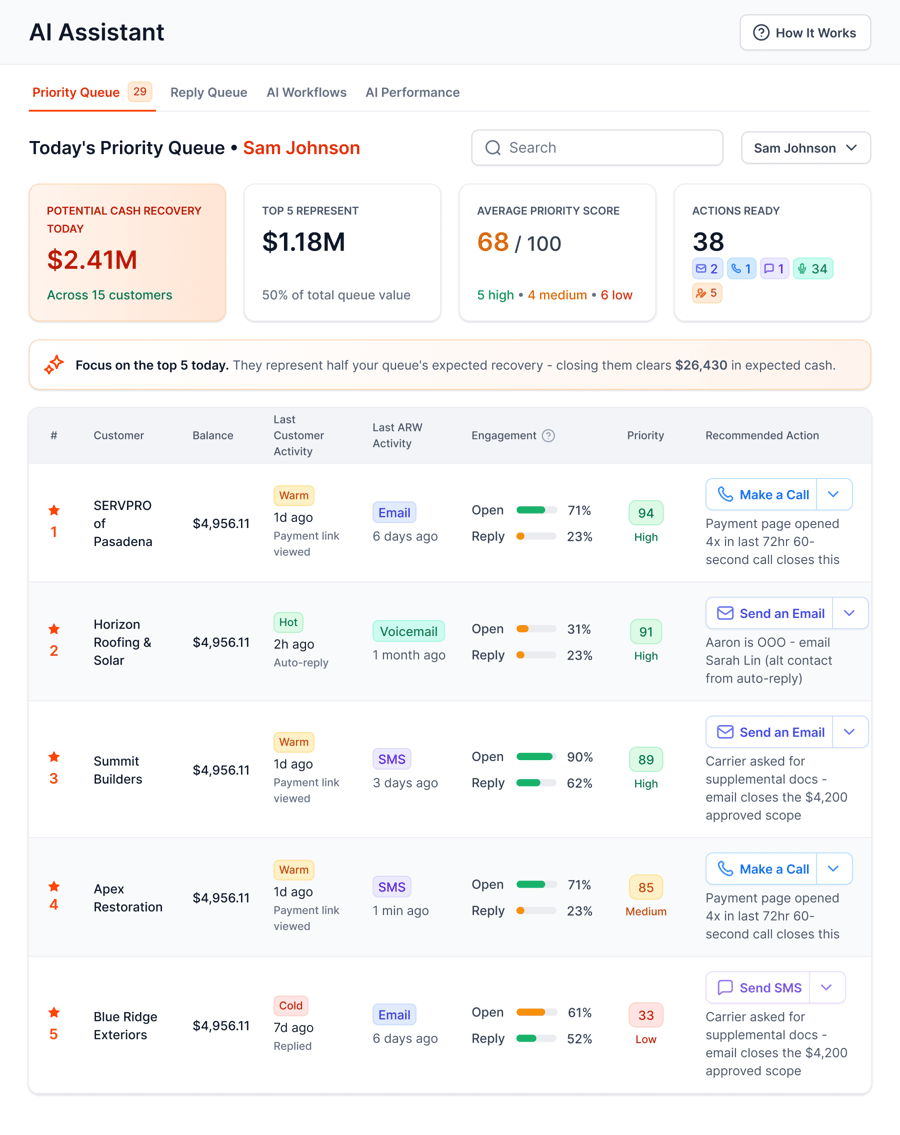
The Priority Queue shows who to contact today, by invoice and by payer.
- The Priority Queue shows who to contact today.
- The dashboard shows the open balance that has had no follow-up, so nothing sits untouched.
- Customers get payment links for card and ACH, with partial payments and payment plans.
- Follow-up pauses on a promise to pay and stops when the invoice is paid.
- Every touch is logged, which gives you a clean record if you need to escalate.
- Payments post back to QuickBooks.
- AI-drafted replies are reviewed before sending, and AI drafts never add a payment link for adjuster, carrier or legal contacts.
AR Workflow handles the follow-up. Liens, bond claims and legal steps stay with you and your attorney.
Frequently asked questions
How long should a contractor wait before escalating an unpaid invoice?
Escalate based on your deadlines, not your patience. Once an invoice is 30 days past due with no clear answer, move from reminders to a formal letter and a call with a decision maker. Before that, check when your lien notice or bond claim window closes, because those dates can arrive long before you feel ready to escalate.
What is the difference between a mechanic's lien and a payment bond claim?
A mechanic's lien is a claim against the property you improved, used mostly on private jobs. Public property usually cannot be liened, so public jobs typically require a payment bond, and unpaid subs and suppliers make a claim against that bond instead. Both have strict notice and filing rules that vary by state, so talk to a construction attorney.
Can a general contractor refuse to pay a subcontractor because the owner has not paid?
Sometimes. Pay-when-paid clauses usually only delay payment for a reasonable time, while pay-if-paid clauses try to make owner payment a condition. Many states limit or refuse to enforce pay-if-paid language, and lien and bond rights may still apply. Read the exact clause and ask a construction attorney how your state treats it.
Should I stop work if I am not getting paid?
Only if your contract and state law allow it, and only after giving the notice they require. Stopping work without that right can put you in breach, even when you are owed money. Some prompt payment laws give a right to suspend work after nonpayment and written notice. Confirm with a construction attorney before you pull a crew.
What should a construction demand letter include?
Include the project name and address, contract date, invoice or pay app numbers, the amount due, what has already been paid, the original due date, a short history of your follow-up, a firm deadline to pay, how to pay, and the next step you will take if payment does not arrive. Keep it factual and avoid threats you cannot carry out.
When should I send an unpaid construction invoice to collections or an attorney?
Send it when direct follow-up has stalled, the customer has stopped responding, or a lien, bond or prompt payment deadline is getting close. An attorney can file liens, make bond claims and sue. A collection agency suits smaller residential balances. Either way, hand over a clean file: contract, change orders, invoices, waivers and your full contact log.
Related reading
Your unpaid invoices, not a feature tour.
Bring one overdue invoice or pay app to a demo and see what would be sent, to whom, and when.
Photos: Unsplash. This article is general information, not legal, tax or accounting advice. Lien, bond claim and prompt payment rules vary by state and by contract, so talk to a construction attorney about your situation.