Reduce late payments in construction with clear contract terms, clean pay apps, a billing calendar and a follow-up schedule. Includes a pay app checklist.

The best way to reduce late payments in construction is to stop them before the invoice is ever sent. Most late payments in construction are not surprises. They come from a contract term nobody read, a pay app that missed the cutoff, a change order that was never signed, or a lien waiver that was missing. Each of those is a process problem, and process problems can be fixed.
This guide is about prevention. It covers the contract terms, billing practices, pay app habits and follow-up process that keep construction payment delays to a minimum, so your cash flow depends less on chasing. If an invoice is already overdue, start with our playbook on how to collect unpaid construction invoices.
KEY TAKEAWAYS
Before you change anything, it helps to see where delays come from. Nearly every cause has a matching fix, and most of the fixes happen early.
| Cause of the delay | Where it starts | How to prevent it |
|---|---|---|
| Pay app sent back | Missing waivers, backup or signatures | Use a pay app checklist and submit early |
| Missed billing cutoff | Pay app submitted a day late | Put every customer's cutoff on a billing calendar |
| Unsigned change orders | Work done on a verbal approval | No signed change order, no extra work, unless the contract says otherwise |
| Disputed line items | A vague or front-loaded schedule of values | Build a clear schedule of values the owner or GC can verify |
| Slow approvals | Architect, owner's rep or lender review | Know every approver and their timeline at kickoff |
| Pay-when-paid terms | Contract language passing the owner's delay down | Read and negotiate the clause before signing |
| Forgotten retainage | Nobody invoices it at closeout | Track retainage by job with a release date |
| Weak customer cash flow | No check on the customer before the job | Ask about funding and payment history up front |
| No follow-up | Invoices sent and then left alone | A fixed follow-up schedule and one owner for AR |
The contract decides when you get paid, what has to happen first, and what you can do if payment is late. Ten minutes of attention here saves months of chasing later. Our guide to contractor payment terms covers the common options in more depth.
| 1 | Define the payment terms in plain language. State the billing period, the pay app due date, the approval period and the payment due date. "Net 30" is not enough on its own. Net 30 from what: submission, approval or the owner's payment to the GC? |
| 2 | Ask for a deposit or mobilization payment where you can. On residential and smaller commercial work, a deposit covers early materials and shows the customer is ready to pay. Some states limit deposit amounts on certain residential jobs, so check the rules that apply to you. |
| 3 | Spell out retainage and its release. Write down the retainage rate, whether it drops at a milestone such as substantial completion, and exactly what triggers release. Retainage rules vary by state and by public or private work. |
| 4 | Lock down the change order process. Who can approve a change, in what form, how it is priced, and when it can be billed. Unsigned change orders are one of the most common sources of construction payment disputes. |
| 5 | Read the pay-when-paid or pay-if-paid clause. These clauses can shift the owner's payment delays onto you. Negotiate a time limit where you can, and understand how your state treats them. A construction attorney can tell you whether a clause is enforceable. |
| 6 | Include late payment interest and suspension rights. If the contract allows interest on late payments, or a right to stop work after written notice, say so clearly. Both must follow state law, so have an attorney review the wording. |
| 7 | Agree on a dispute process. A clear notice and negotiation step keeps a disagreement over one line item from freezing the whole payment. |
Tip: Keep a one-page contract summary for every job: billing cutoff, pay app format, required documents, approvers, payment due date, retainage terms and the AP contact. Whoever prepares the pay app should have it open every month.
Good billing is consistent billing. Customers pay faster when invoices arrive on time, look the same every month, and are easy to check.
Break the contract into line items the owner, architect or GC can verify against work in place. Very large or vague lines invite questions and cuts. Heavy front-loading may look good for cash flow, but it can damage trust and lead to closer review of every pay app that follows.
Put each customer's billing cutoff on a shared calendar with a reminder several days before. On many commercial jobs, missing a cutoff by one day pushes payment a full cycle. For residential and service work, invoice the day a milestone is reached, while the work is fresh in the customer's mind.
Do not let approved changes pile up for the final invoice. Add them to the next pay app with the signed change order attached. The longer a change sits unbilled, the more likely someone disputes it.
Offer the payment methods your customers actually use. Commercial customers may pay by ACH or check on a set pay run. Homeowners and smaller commercial customers often pay faster when the invoice includes a payment link for card or ACH. Contractor payments that accept partial payments and payment plans also remove the "I can't pay it all this week" reason for waiting.
Use projects or jobs, progress invoicing and a separate retainage receivable account. Clean books make it obvious which invoices are late, and they make month-end much faster. Our guide to QuickBooks for contractors walks through a setup that supports this.
Bring one overdue invoice.
We'll show you how AR Workflow would follow up on it, from QuickBooks Online, before it turns into a late payment.
On commercial jobs, a pay app that comes back for one missing page can lose you weeks. Run this checklist before every submission.
| Item | What to check |
|---|---|
| Pay app forms | Correct format (for example AIA G702 and G703, or the GC's own form), signed and notarized if required |
| Schedule of values | Percent complete matches work in place, and totals tie to the contract plus approved changes |
| Change orders | Only signed change orders included, each with its number and amount |
| Retainage | Calculated at the contract rate, and any reduction applied only if it has been approved |
| Your lien waiver | Conditional waiver for this payment, on the form the contract or state requires |
| Sub and supplier waivers | Waivers from your own subs and suppliers for the previous payment |
| Stored materials | Invoices, photos and proof of insurance or bonded storage if you bill for them |
| Other required documents | Certified payroll, insurance certificates or updated schedules, if the contract calls for them |
| Submission | Sent to the right person, before the cutoff, with a request to confirm receipt |
Many GCs and owners will review a draft, sometimes called a pencil copy, before the formal submission. If yours does, use it. Fixing a number on the draft is far faster than resubmitting the whole pay app.
Prevention does not stop when the invoice goes out. The earlier you hear about a problem, the cheaper it is to fix. A simple, repeatable process does most of the work.
| 1 | Confirm receipt within a few days. Ask the AP contact by name whether the pay app or invoice was received and is complete. |
| 2 | Confirm approval and the pay run. Ask when it will be approved and which payment run it is scheduled for. Write the answer down. |
| 3 | Remind before the due date. A friendly note a few days before the due date catches problems while there is still time to fix them. Automated payment reminders make sure this step happens on every invoice, not just the big ones. |
| 4 | Follow up on a fixed schedule after the due date. For example: on the due date, a few days later, then weekly. Use more than one channel if email goes quiet. |
| 5 | Hold a weekly AR review. Fifteen minutes with your aging report: every invoice over 30 days gets a next step, a date and an owner. |
| 6 | Watch your notice deadlines. Preliminary notices, lien deadlines and bond claim windows vary by state. Put them on the calendar at the start of the job and talk to a construction attorney about the ones that apply. |
If your current process depends on one person remembering everything, it will break the week that person is out. Our guide on how to improve your collections process covers how to turn this into a system the whole team can run.
The first reminder after the due date should ask a question, not just repeat the balance. Here is a version that works for GCs, owners and property managers. For a full sequence, copy our construction invoice collection email templates.
TEMPLATE
Subject: Pay app #[number] for [project]: payment status
Hi [Name], pay app #[number] for [project] was due on [date] and we have not received payment yet. Can you confirm it was approved and which pay run it is scheduled for? If anything is missing, such as a waiver or backup for a line item, tell me and I will send it today.
Thanks, [Your name], [Company], [phone]
Asking for the pay run gives you a date to hold them to. Asking what is missing surfaces the real problem, which on construction jobs is usually paperwork, not money.
Prompt payment laws set deadlines for paying contractors and, in many cases, interest when those deadlines are missed. Knowing which rules apply gives you leverage before a payment is late, because you can put the right terms in your contract and cite them politely in your follow-up.
Rules vary by state and by project type, and they change, so confirm the details with a construction attorney before you rely on them. What does not vary: a contract that states the payment due date, the interest rate and the notice process makes every follow-up easier.
The basics are the same for everyone, but where payments get stuck depends on how you bill.
| Trade or role | Where payments usually stall | Best prevention step |
|---|---|---|
| General contractors | Owner and lender approvals, architect review, retainage at closeout | Map every approver and their timeline at kickoff, and start closeout documents before substantial completion |
| Electrical, plumbing and HVAC subs | The GC's billing cutoff, pay-when-paid terms, missing waivers | Get the GC's cutoff and document list in writing and submit a pencil copy early |
| Remodelers and residential builders | Homeowners waiting on financing draws or disputing change orders | Collect a deposit where state rules allow, bill at each milestone, and get every change signed |
| Roofing and exterior contractors | Insurance claim timing and mortgage company check endorsements | Send documentation to the adjuster on a schedule and bill the homeowner only for their share |
| Specialty trades on service work | Small invoices nobody follows up on | Invoice on completion with a payment link and automate the reminders |
Late payments hurt because construction cash flow runs in one direction first. You pay crews weekly, buy materials up front and pay your subs, while your own payment arrives weeks later, minus retainage. A few habits reduce the strain:
Example: Cedar Point Builders, one month on one job
A general contractor on a private commercial build, paying subs while waiting on the owner.
| Work billed to the owner this month | $240,000 |
| Retainage held by the owner (10%) | $24,000 |
| Payment expected from the owner, about 45 days after billing | $216,000 |
| Paid out to crews, materials and subs before that payment arrives | $190,000 |
| Cash Cedar Point is financing for about six weeks | $190,000 |
| If the pay app is sent back once and misses a cycle | Another 30 days |
One missing lien waiver turns a six-week gap into a ten-week gap on $190,000. The fix was not more chasing. It was a pay app checklist and a calendar reminder three days before the owner's cutoff.
Example company, customer and amounts are made up for illustration.
Prevention needs consistency, and consistency is hard when the same people are also running jobs. AR Workflow connects to QuickBooks Online and puts every open invoice on a follow-up schedule by email, two-way text and ringless voicemail from a dedicated number, so reminders go out before and after the due date without anyone having to remember.
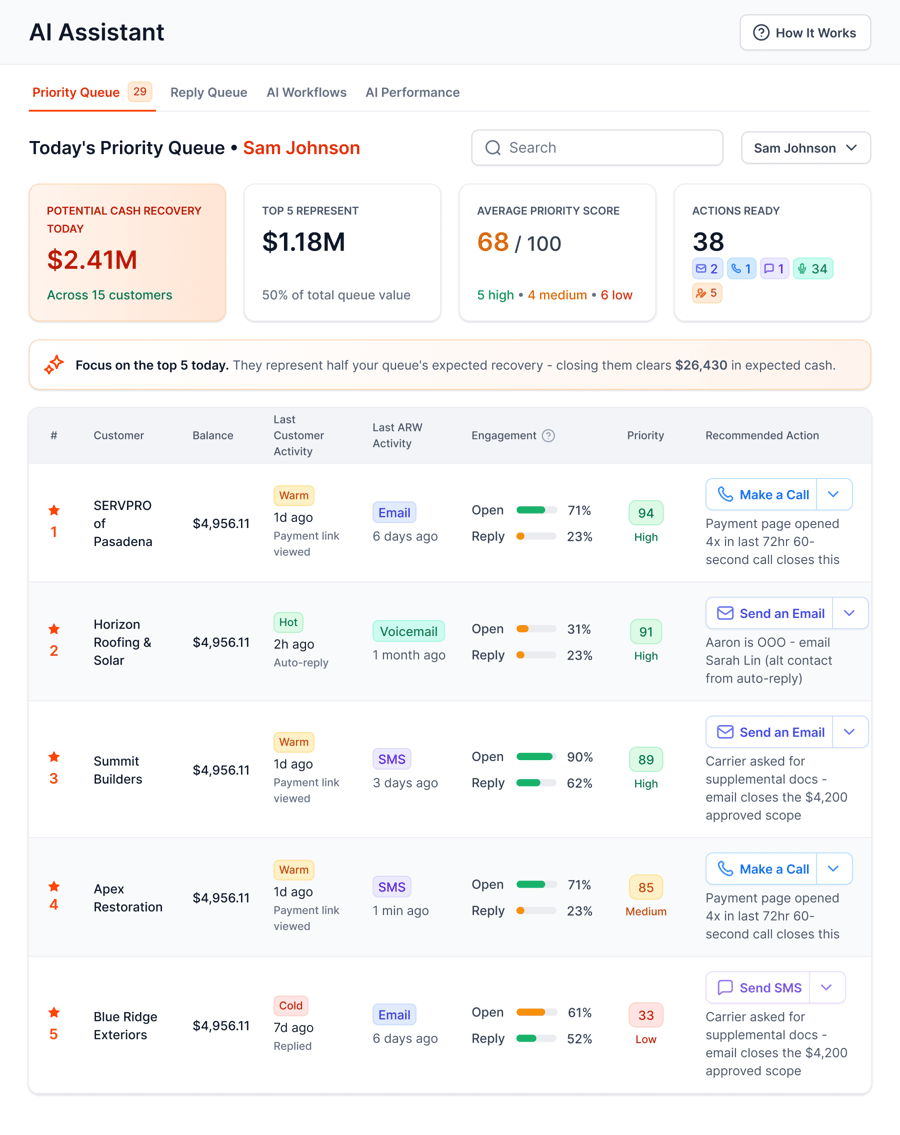
The Priority Queue shows who to contact today, so late invoices get attention early.
Contracts, schedules of values and pay app backup still need your team. Construction accounts receivable software like AR Workflow makes sure the follow-up after the invoice happens every time.
The most common causes are incomplete pay apps, missed billing cutoffs, unsigned change orders, slow approvals by the architect, owner or lender, pay-when-paid terms that push the owner's delay down the chain, retainage that nobody invoices, and customers with weak cash flow. Most of these can be prevented with clear contract terms and consistent billing habits.
Read the payment terms before you sign, learn the GC's billing cutoff and required documents, submit complete pay apps early, send conditional lien waivers with every request, get change orders signed before doing the work, confirm approval a few days after submitting, and keep your lien or bond notice deadlines on a calendar from day one.
Often, if the contract allows it and the rate complies with state law. Some prompt payment laws also allow interest on late payments for certain projects. Put the rate, when it starts and how it is calculated in your contract, show it on every invoice, and talk to a construction attorney about the limits that apply in your state.
Not while it is properly held under the contract. Retainage becomes late once the release conditions are met and it is still not paid. To keep it from turning into a late payment, track retainage by job with a release date, collect the closeout documents early, and invoice retainage the day it becomes releasable.
Every day a pay app sits unpaid, you are financing the job yourself through payroll, materials and sub payments. Getting paid on time shrinks the gap between what you spend and what you collect, reduces how much you lean on a line of credit, and makes it easier to pay your own subs and suppliers on time.
The federal Prompt Payment Act (31 U.S.C. 3901 to 3907) requires federal agencies to pay contractors on time or pay interest, and it requires prime contractors on federal construction jobs to pay their subs within 7 days of being paid. Most states have their own prompt payment laws for public projects, and some cover private work too. Deadlines and interest rates vary by state, so check with a construction attorney.
Related reading
Your receivables, not a feature tour.
Bring one overdue invoice or pay app to a demo and see what would be sent, to whom, and when.
Photos: Unsplash. This article is general information, not legal, tax or accounting advice. Lien, bond claim and prompt payment rules vary by state and by contract, so talk to a construction attorney about your situation.
Sam owned and ran three restoration companies for more than 14 years and collected over $100 million in receivables. He built AR Workflow in 2020 to give contractors the collections system he wished he'd had.

AI writes the emails, sends the texts, and leaves the voicemails. Your team handles the conversations that matter, and your cash keeps moving.
 Keep QuickBooksStart with one invoiceStay in control

 Log in