Texas mechanics lien laws in plain English: deadlines for primes, subs and suppliers, notice rules, home rules and how to file. Free deadline calculator.

Texas mechanics lien law gives contractors, subcontractors and suppliers a way to get paid when a customer won't pay for work on a property. But a lien only works if you send the right notices and file on time. Miss one step and you can lose the lien. This guide explains the Texas mechanics lien deadlines in plain English, with the law behind each rule.

Quick answer: Texas mechanics lien deadlines
Original contractor: 15th day of the 4th month (commercial) / 3rd month (residential) after the month the original contract was completed, terminated, or abandoned. Others: same months counted from their last furnishing. 'Residential' = a 1-4 unit home occupied by one of its owners; rentals use commercial deadlines. Retainage claims have their own deadline (§ 53.052(d) vs § 53.103 conflict; alert at the earlier 30-day date). All fixed-date deadlines roll past weekends/holidays (SB 929, eff. 2025-05-21, § 53.003(e)).
Last updated: November 23, 2026
This is not legal advice. Rules differ by state and change over time. We checked each rule below against the text of the Texas statute (Tex. Prop. Code ch. 53 (as amended by HB 2237, contracts on/after 2022-01-01); Tex. Const. art. XVI § 37) in November 2026. Read the current law or ask a Texas construction attorney before you file.
"Prime contractor" means you have a contract directly with the property owner. "Subcontractor" or "supplier" means you were hired by the prime contractor or by another sub. These rules are for private projects. Public projects use bond claims instead of liens.
| Rule | What Texas requires | Law |
|---|---|---|
| Preliminary notice: prime contractor | None. The notice of claim in 53.056 applies only to claimants other than the original contractor. | Tex. Prop. Code § 53.056(a) |
| Preliminary notice: subcontractor | Required for every tier below the original contractor. Send to the owner (or reputed owner) AND the original contractor, for each month with unpaid labor or materials. Deadline is the 15th day of the 3rd month after that month (non-residential) or the 15th day of the 2nd month (residential construction project). Use the statutory form in 53.056(a-2); an invoice may be attached. Deliver in person, by certified mail, or by a traceable private service with proof of receipt (53.003(b)). A deadline on a Saturday, Sunday or legal holiday moves to the next day that is none of those (53.003(e) as amended by SB 929). | Tex. Prop. Code §§ 53.056(a-1), (a-2); 53.003(b), (e) |
| Preliminary notice: supplier | Same as subs. For specially fabricated materials that were never delivered, count from the month normal delivery would have occurred. | Tex. Prop. Code § 53.056(a-1)(B) |
| Notice of intent to lien | There is no general notice of intent. Retainage claims need a separate notice under 53.057, but only for retainage not already covered by a 53.056 notice. A non-original claimant whose contract provides for retainage must send the statutory form to the owner and the original contractor by the EARLIER of: (1) 30 days after the claimant's own contract is completed, terminated or abandoned; or (2) 30 days after the original contract is terminated or abandoned. | Tex. Prop. Code § 53.057(a), (a-1) |
| Lien filing deadline: prime contractor | Non-residential: the 15th day of the 4th month after the month the original contractor's work was completed, terminated or abandoned. Residential construction project: the 15th day of the 3rd month after that month. Rolls forward if it falls on a Saturday, Sunday or legal holiday. | Tex. Prop. Code § 53.052(a)(1)-(2) |
| Lien filing deadline: subcontractor and supplier | Non-residential: the 15th day of the 4th month after the later of the month the claimant last provided labor or materials, or the month undelivered specially fabricated materials would normally have been delivered. Residential: the 15th day of the 3rd month, from the same trigger. Retainage-only claim (any project type): the 15th day of the 3rd month after the month the ORIGINAL contract was completed, terminated or abandoned (53.052(d)). | Tex. Prop. Code § 53.052(b), (c), (d) |
| Residential projects | Residential construction project: the 15th day of the 3rd month for BOTH roles. The original contractor counts from the month its work was completed, terminated or abandoned. Others count from the month of last furnishing. 'Residential' means a single-family house, duplex, triplex, quadruplex, or condo/co-op unit, owned by adult(s) and used or intended to be used as a dwelling by one of the owners. Rentals not occupied by an owner, and commercial properties, follow the non-residential (4th-month) rules. | Tex. Prop. Code §§ 53.052(a)(2), (c); 53.001(8)-(10) |
| Notice of completion: does it shorten the deadline? | No notice can shorten the 53.052 affidavit deadlines; the old 40-day owner shortcut was removed by HB 2237. An owner MAY file an affidavit of completion (53.106). It is prima facie evidence of the completion date. If it is filed more than 10 days after completion, the filing date becomes the completion date. This only binds claimants it was sent to: the original contractor and every claimant who sent a 53.056 or 53.057 notice, within 3 days after filing (or 10 days after the owner receives the notice, whichever is later). This date drives the original contractor's deadline, the retainage deadline in 53.052(d), and the 53.103 30-day reserved-funds deadline. | Tex. Prop. Code § 53.106(a)-(d) |
| Serving the owner after you file | Send a copy of the filed affidavit to the owner or reputed owner at the owner's last known business or residence address, no later than the 5th day after filing. A claimant that is not the original contractor must also send a copy to the original contractor within the same period. Delivery methods are those in 53.003(b): in person, certified mail, or a traceable private service with proof of receipt. Certified mail counts as complied with on deposit (53.003(c)). | Tex. Prop. Code §§ 53.055(a)-(b); 53.003(b)-(c) |
| Deadline to sue (enforce the lien) | Foreclosure suit must be filed by the first anniversary of the LAST DAY the claimant could have filed the lien affidavit. This is the same for residential and commercial. It can be extended to no later than the 2nd anniversary of the date the claimant ACTUALLY FILED the affidavit. That requires a written agreement with the then-current record owner, made before the 1-year period ends and recorded in the county where the lien is recorded. | Tex. Prop. Code § 53.158(a), (a-2) |
Here is each deadline for prime contractors, subcontractors and suppliers on a commercial job. Homes have some different rules in Texas. See the home rules below. "Prime" means you have a contract with the owner. Some deadlines change if the owner records a notice, so check the full rules below.
| Step | Prime contractor | Subcontractor | Supplier |
|---|---|---|---|
| Preliminary notice | Not required | By the 15th day of the 3rd month after the month of the unpaid work. | By the 15th day of the 3rd month after the month of the unpaid work. |
| Notice of intent to lien | Not required | Not required | Not required |
| File the lien | By the 15th day of the 4th month after the month the project is finished. | By the 15th day of the 4th month after the month of your last work or delivery. | By the 15th day of the 4th month after the month of your last work or delivery. |
| Serve a copy of the lien | Within 5 days after you file the lien. | Within 5 days after you file the lien. | Within 5 days after you file the lien. |
| Sue to enforce the lien | 1 year after the last day you could have filed the lien. A written deal with the owner can extend it to 2 years after you filed. | 1 year after the last day you could have filed the lien. A written deal with the owner can extend it to 2 years after you filed. | 1 year after the last day you could have filed the lien. A written deal with the owner can extend it to 2 years after you filed. |
Get your exact Texas dates
Enter your first and last day of work. Our free calculator shows the last day to send each notice, file your lien and sue.
Roofing, restoration and remodeling work on homes often has extra rules. In Texas:
Homestead requirements: (a) a written contract between the furnisher and the owner; (b) executed BEFORE any material is furnished or labor performed; (c) signed by both spouses if the owner is married; (e) filed with the county clerk. (d) An original contractor's compliant contract benefits its subs and suppliers. (f) The lien affidavit must carry, at the top in at least 10-point bold: 'NOTICE: THIS IS NOT A LIEN. THIS IS ONLY AN AFFIDAVIT CLAIMING A LIEN.' (g) The owner notice under Subchapter C must include the statutory 10%-reserve and withholding statement, or the homestead lien is invalid. Non-homestead residential projects get the shorter (2nd-month notice, 3rd-month lien) deadlines but none of these formalities.
Residential construction project: the 15th day of the 3rd month for BOTH roles. The original contractor counts from the month its work was completed, terminated or abandoned. Others count from the month of last furnishing. 'Residential' means a single-family house, duplex, triplex, quadruplex, or condo/co-op unit, owned by adult(s) and used or intended to be used as a dwelling by one of the owners. Rentals not occupied by an owner, and commercial properties, follow the non-residential (4th-month) rules.
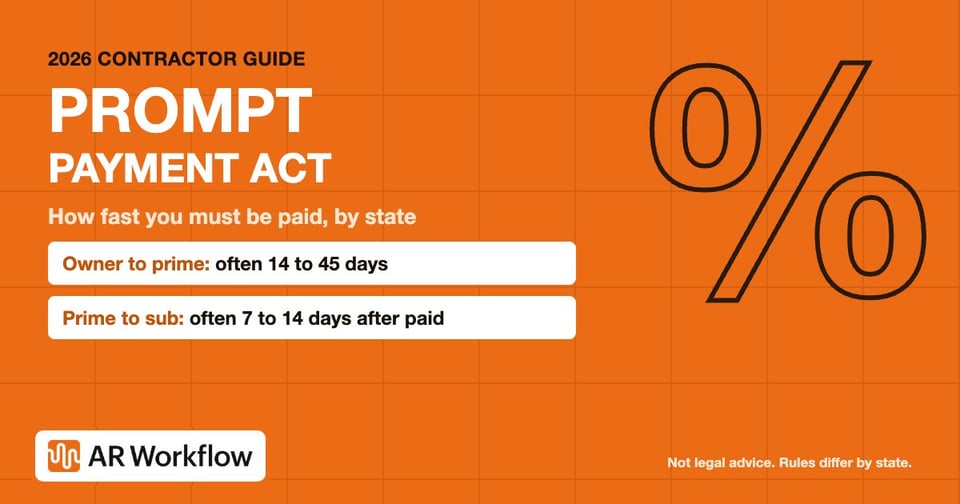
A prompt payment act sets how fast you must be paid. Before a lien, it is your first tool when a pay app is late. Here are the Texas rules.
| Rule | Private jobs | Public jobs |
|---|---|---|
| Owner pays the prime | 35 days after invoice | 31 days after invoice or goods (later) |
| Prime pays the sub | 7 days after prime is paid | 10 days after prime is paid |
| Late interest | 1.5% per month | Prime rate plus 1% |
Law: private: Tex. Prop. Code 28.001 to 28.010; public: Tex. Gov't Code 2251.001. Our plain-English summary of the ASA and Kegler Brown 2024 prompt pay chart. Check the statute before you rely on it.
See every state side by side in our prompt payment act rules by state.
A lien is a last resort. It costs time and money, and it can end the customer relationship. Most contractors get paid sooner with a clear follow-up plan:
Tools and related guides
Official law and forms: Many states print the lien form or notice wording right in the law. Read the Texas lien law and use the state form if it has one.
Prime contractors: Non-residential: the 15th day of the 4th month after the month the original contractor's work was completed, terminated or abandoned. Residential construction project: the 15th day of the 3rd month after that month. Rolls forward if it falls on a Saturday, Sunday or legal holiday. Subcontractors and suppliers: Non-residential: the 15th day of the 4th month after the later of the month the claimant last provided labor or materials, or the month undelivered specially fabricated materials would normally have been delivered. Residential: the 15th day of the 3rd month, from the same trigger. Retainage-only claim (any project type): the 15th day of the 3rd month after the month the ORIGINAL contract was completed, terminated or abandoned (53.052(d)).
Send any required notices first, then record your lien claim before the deadline and serve the owner. Prime contractors: 15th day of the 4th month after the month your work was completed. Subcontractors and suppliers: 15th day of the 4th month after the month of your last work or materials. Then sue to enforce it on time, or release it once you are paid. The step-by-step section above walks through each part.
Required for every tier below the original contractor. Send to the owner (or reputed owner) AND the original contractor, for each month with unpaid labor or materials. Deadline is the 15th day of the 3rd month after that month (non-residential) or the 15th day of the 2nd month (residential construction project). Use the statutory form in 53.056(a-2); an invoice may be attached. Deliver in person, by certified mail, or by a traceable private service with proof of receipt (53.003(b)). A deadline on a Saturday, Sunday or legal holiday moves to the next day that is none of those (53.003(e) as amended by SB 929).
There is no general notice of intent. Retainage claims need a separate notice under 53.057, but only for retainage not already covered by a 53.056 notice. A non-original claimant whose contract provides for retainage must send the statutory form to the owner and the original contractor by the EARLIER of: (1) 30 days after the claimant's own contract is completed, terminated or abandoned; or (2) 30 days after the original contract is terminated or abandoned.
Homestead requirements: (a) a written contract between the furnisher and the owner; (b) executed BEFORE any material is furnished or labor performed; (c) signed by both spouses if the owner is married; (e) filed with the county clerk. (d) An original contractor's compliant contract benefits its subs and suppliers. (f) The lien affidavit must carry, at the top in at least 10-point bold: 'NOTICE: THIS IS NOT A LIEN. THIS IS ONLY AN AFFIDAVIT CLAIMING A LIEN.' (g) The owner notice under Subchapter C must include the statutory 10%-reserve and withholding statement, or the homestead lien is invalid. Non-homestead residential projects get the shorter (2nd-month notice, 3rd-month lien) deadlines but none of these formalities.
Foreclosure suit must be filed by the first anniversary of the LAST DAY the claimant could have filed the lien affidavit. This is the same for residential and commercial. It can be extended to no later than the 2nd anniversary of the date the claimant ACTUALLY FILED the affidavit. That requires a written agreement with the then-current record owner, made before the 1-year period ends and recorded in the county where the lien is recorded.
On private jobs: owner pays the prime: 35 days after invoice; prime pays the sub: 7 days after prime is paid. On public jobs: owner pays the prime: 31 days after invoice or goods (later); prime pays the sub: 10 days after prime is paid. Check the statute for exceptions.
See mechanics lien deadlines for all 50 states
Get paid before it gets to a lien.
AR Workflow works with QuickBooks and follows up on every invoice for you, from the first friendly reminder to the final notice. Bring one overdue invoice to a demo and see what we would send, and when.
Sam owned and ran three restoration companies for more than 14 years and collected over $100 million in receivables. He built AR Workflow in 2020 to give contractors the collections system he wished he'd had.

AI writes the emails, sends the texts, and leaves the voicemails. Your team handles the conversations that matter, and your cash keeps moving.
 Keep QuickBooksStart with one invoiceStay in control

 Log in