Pennsylvania mechanics lien laws: deadlines for primes, subs and suppliers, notice rules, home rules and how to file. Free deadline calculator.

Pennsylvania mechanics lien law gives contractors, subcontractors and suppliers a way to get paid when a customer won't pay for work on a property. But a lien only works if you send the right notices and file on time. Miss one step and you can lose the lien. This guide explains the Pennsylvania mechanics lien deadlines in plain English, with the law behind each rule.
Quick answer: Pennsylvania mechanics lien deadlines
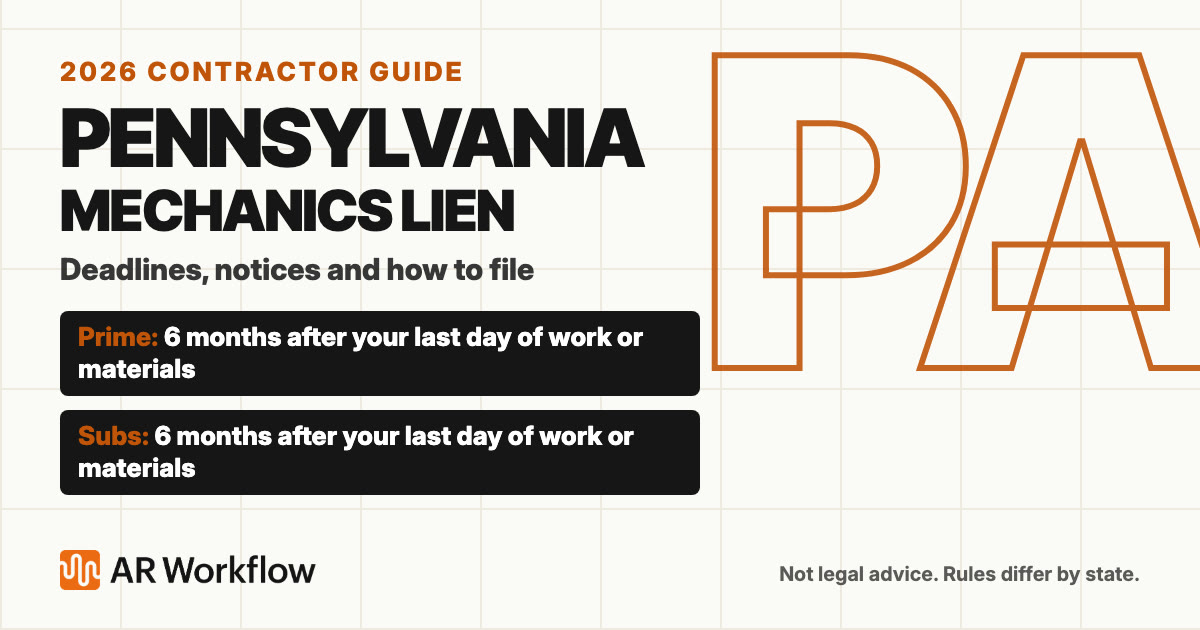
6 months after completion of the claimant's own work (§ 1502(a)(1)).
Last updated: November 23, 2026
This is not legal advice. Rules differ by state and change over time. We checked each rule below against the text of the Pennsylvania statute (49 P.S. §§ 1101–1902 (Mechanics' Lien Law of 1963)) in November 2026. Read the current law or ask a Pennsylvania construction attorney before you file.
"Prime contractor" means you have a contract directly with the property owner. "Subcontractor" or "supplier" means you were hired by the prime contractor or by another sub. These rules are for private projects. Public projects use bond claims instead of liens.
| Rule | What Pennsylvania requires | Law |
|---|---|---|
| Preliminary notice: prime contractor | None. Primes give no pre-lien notice. On a searchable project the owner, or a contractor as the owner's agent, files the Notice of Commencement. | 49 P.S. 1501.3(a) |
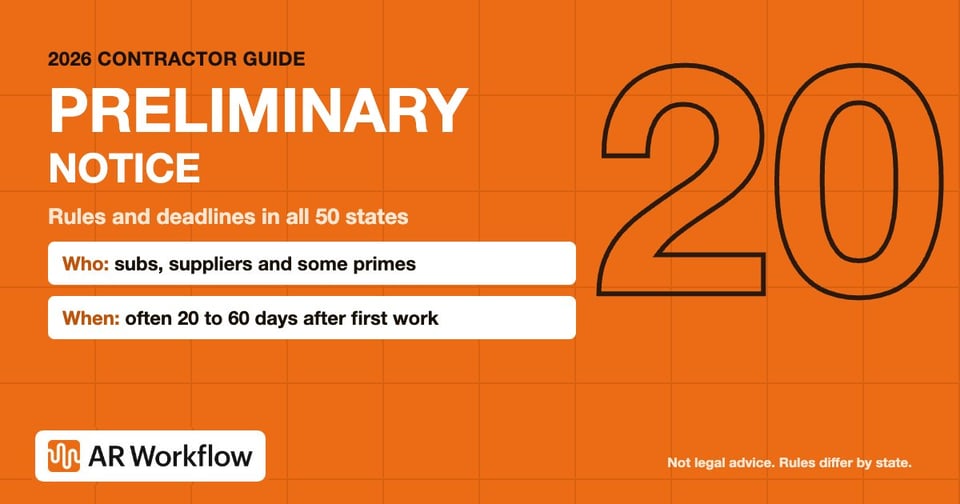
| Preliminary notice: subcontractor | Conditional. Required only on a 'searchable project' (costing at least $1,500,000) where a Notice of Commencement was filed AND posted. The sub must file a Notice of Furnishing in the State Construction Notices Directory within 45 days after first performing work or first delivering materials to the job site. If it fails to substantially comply, it forfeits the lien. | 49 P.S. 1201(18); 1501.3(b),(c) |
| Preliminary notice: supplier | Same as subs. A supplier to the prime or to a first-tier sub is a 'subcontractor' under 1201(5). A supplier to a materialman, and a sub-sub-sub not in privity with a contractor, has no lien. | 49 P.S. 1201(5) |
| Notice of intent to lien | Subs only, on both new construction and alterations/repairs. Give the owner formal written notice of intent at least 30 days BEFORE filing the claim. Not required when the claim is filed in response to a 1506 rule to file. The notice must state: claimant, contracting party, amount due, nature of the work, date of completion, and a property description. Service may be by first class, registered or certified mail, or as for a writ of summons; posting if neither can be done. | 49 P.S. 1501(b.1),(c),(d) |
| Lien filing deadline: prime contractor | File the claim with the prothonotary within 6 months after completion of the claimant's own work. Completion is the last labor or last material delivery required by the claimant's contract. | 49 P.S. 1502(a)(1); 1201(8) |
| Lien filing deadline: subcontractor and supplier | 6 months after completion of the sub's own work. SHORTENER: after the sub completes, the owner or contractor may file a rule to file. The sub must then file within 30 days after notice of the rule or be barred. | 49 P.S. 1502(a)(1); 1506 |
| Residential projects | Same 6 months for all property types. There is no separate residential deadline. | 49 P.S. 1502(a)(1) |
| Notice of completion: does it shorten the deadline? | None. The owner may file a directory Notice of Completion within 45 days of actual completion. By statute, courts may not consider it in deciding timing compliance. It never shortens any deadline. The only deadline shortener is the 1506 rule to file. | 49 P.S. 1501.4(a),(c),(d) |
| Serving the owner after you file | Serve the owner with written notice of the filing (court, term, number, date) within 1 month after filing. Service must be by an adult in the manner of a writ of summons in assumpsit, or by posting on a conspicuous part of the improvement if that cannot be done. Mail is NOT an allowed method. File the affidavit of service, or the owner's acceptance, within 20 days after service. Missing either deadline is ground to strike the claim. | 49 P.S. 1502(a)(2),(c) |
| Deadline to sue (enforce the lien) | Commence the action within 2 years from the date the claim was filed. The owner may extend this in writing. A verdict or judgment must then be obtained within 5 years of filing (excluding certain motion and appeal time), or the claim is wholly lost. | 49 P.S. 1701(b),(d) |
Here is each deadline for prime contractors, subcontractors and suppliers on a commercial job. Homes have some different rules in Pennsylvania. See the home rules below. "Prime" means you have a contract with the owner. Some deadlines change if the owner records a notice, so check the full rules below.
| Step | Prime contractor | Subcontractor | Supplier |
|---|---|---|---|
| Preliminary notice | Not required | Only in some cases: Within 45 days after your first day of work or delivery. | Only in some cases: Within 45 days after your first day of work or delivery. |
| Notice of intent to lien | Not required | At least 30 days before you file the lien. | At least 30 days before you file the lien. |
| File the lien | Within 6 months after your last day of work or delivery. | Within 6 months after your last day of work or delivery. | Within 6 months after your last day of work or delivery. |
| Serve a copy of the lien | Within 1 month after you file the lien. | Within 1 month after you file the lien. | Within 1 month after you file the lien. |
| Sue to enforce the lien | Within 2 years after you file the lien. | Within 2 years after you file the lien. | Within 2 years after you file the lien. |
Get your exact Pennsylvania dates
Enter your first and last day of work. Our free calculator shows the last day to send each notice, file your lien and sue.
Roofing, restoration and remodeling work on homes often has extra rules. In Pennsylvania:
(1) Minimum claim: more than $500 for ALL property types. NO $1,500 residential threshold exists in the Act: 1301 and 1201 contain no $1,500 figure. Likely confused with the $1,500,000 searchable-project threshold. (2) 1301(b) sub bar: a sub has no lien on residential property if ALL of these are true: the owner or tenant paid the full contract price to the contractor; the property is or will be the owner's (or the owner's tenant's) residence; and it is a single townhouse or a building of 1-2 dwelling units. (3) Waiver: on 'residential property' (1201(14): residential buildings of 3 stories or fewer, plus residentially zoned land), contractors and subs can waive liens by a signed writing. On non-residential property, waivers are void except to the extent of payment received, or for subs where the contractor posted a payment bond (1401).
Same 6 months for all property types. There is no separate residential deadline.
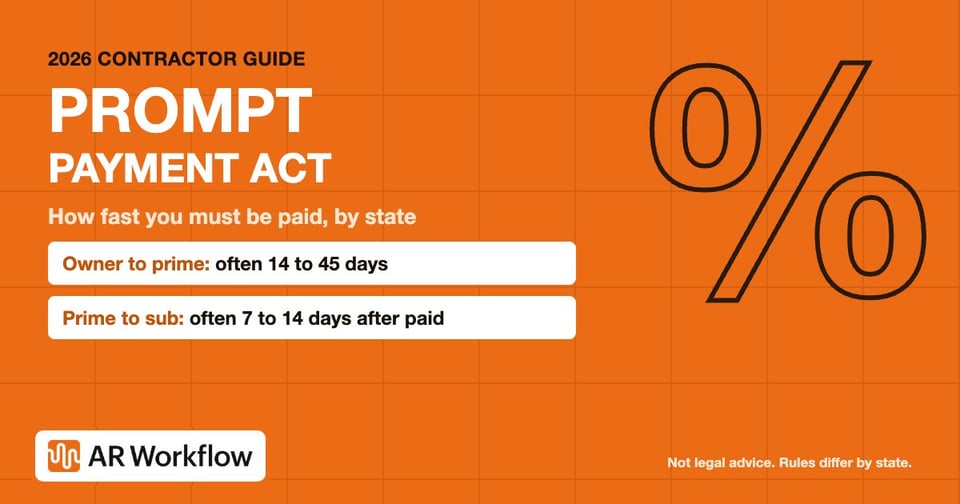
A prompt payment act sets how fast you must be paid. Before a lien, it is your first tool when a pay app is late. Here are the Pennsylvania rules.
| Rule | Private jobs | Public jobs |
|---|---|---|
| Owner pays the prime | 20 days after billing period or invoice | 45 days after invoice unless agreed |
| Prime pays the sub | 14 days after prime is paid | 14 days after prime is paid |
| Late interest | 1% per month | Overdue tax rate; plus 1% per month if bad faith |
Law: private: 73 P.S. 501 to 516; public: 62 Pa. C.S. 3931 to 3935. Limits: Not 6 or fewer homes built at once; not own property. Our plain-English summary of the ASA and Kegler Brown 2024 prompt pay chart. Check the statute before you rely on it.
See every state side by side in our prompt payment act rules by state.
A lien is a last resort. It costs time and money, and it can end the customer relationship. Most contractors get paid sooner with a clear follow-up plan:
Tools and related guides
Official law and forms: Many states print the lien form or notice wording right in the law. Read the Pennsylvania lien law and use the state form if it has one.
Prime contractors: File the claim with the prothonotary within 6 months after completion of the claimant's own work. Completion is the last labor or last material delivery required by the claimant's contract. Subcontractors and suppliers: 6 months after completion of the sub's own work. SHORTENER: after the sub completes, the owner or contractor may file a rule to file. The sub must then file within 30 days after notice of the rule or be barred.
Send any required notices first, then record your lien claim before the deadline and serve the owner. Prime contractors: 6 months after your last day of work or materials. Subcontractors and suppliers: 6 months after your last day of work or materials. Then sue to enforce it on time, or release it once you are paid. The step-by-step section above walks through each part.
Conditional. Required only on a 'searchable project' (costing at least $1,500,000) where a Notice of Commencement was filed AND posted. The sub must file a Notice of Furnishing in the State Construction Notices Directory within 45 days after first performing work or first delivering materials to the job site. If it fails to substantially comply, it forfeits the lien.
Subs only, on both new construction and alterations/repairs. Give the owner formal written notice of intent at least 30 days BEFORE filing the claim. Not required when the claim is filed in response to a 1506 rule to file. The notice must state: claimant, contracting party, amount due, nature of the work, date of completion, and a property description. Service may be by first class, registered or certified mail, or as for a writ of summons; posting if neither can be done.
(1) Minimum claim: more than $500 for ALL property types. NO $1,500 residential threshold exists in the Act: 1301 and 1201 contain no $1,500 figure. Likely confused with the $1,500,000 searchable-project threshold. (2) 1301(b) sub bar: a sub has no lien on residential property if ALL of these are true: the owner or tenant paid the full contract price to the contractor; the property is or will be the owner's (or the owner's tenant's) residence; and it is a single townhouse or a building of 1-2 dwelling units. (3) Waiver: on 'residential property' (1201(14): residential buildings of 3 stories or fewer, plus residentially zoned land), contractors and subs can waive liens by a signed writing. On non-residential property, waivers are void except to the extent of payment received, or for subs where the contractor posted a payment bond (1401).
Commence the action within 2 years from the date the claim was filed. The owner may extend this in writing. A verdict or judgment must then be obtained within 5 years of filing (excluding certain motion and appeal time), or the claim is wholly lost.
On private jobs: owner pays the prime: 20 days after billing period or invoice; prime pays the sub: 14 days after prime is paid. On public jobs: owner pays the prime: 45 days after invoice unless agreed; prime pays the sub: 14 days after prime is paid. Check the statute for exceptions.
See mechanics lien deadlines for all 50 states
Get paid before it gets to a lien.
AR Workflow works with QuickBooks and follows up on every invoice for you, from the first friendly reminder to the final notice. Bring one overdue invoice to a demo and see what we would send, and when.
Sam owned and ran three restoration companies for more than 14 years and collected over $100 million in receivables. He built AR Workflow in 2020 to give contractors the collections system he wished he'd had.

AI writes the emails, sends the texts, and leaves the voicemails. Your team handles the conversations that matter, and your cash keeps moving.
 Keep QuickBooksStart with one invoiceStay in control

 Log in