Massachusetts mechanics lien laws: deadlines for primes, subs and suppliers, notice rules, home rules and how to file. Free deadline calculator.

Massachusetts mechanics lien law gives contractors, subcontractors and suppliers a way to get paid when a customer won't pay for work on a property. But a lien only works if you send the right notices and file on time. Miss one step and you can lose the lien. This guide explains the Massachusetts mechanics lien deadlines in plain English, with the law behind each rule.

Quick answer: Massachusetts mechanics lien deadlines
Two filings. Notice of Contract: earliest of 60 days after a recorded notice of substantial completion, 90 days after a recorded notice of termination, or 90 days after last work. Statement of Account: 90 / 120 / 120 days on the same triggers (§§ 2, 4, 8). For subs, 'last work' is the last work by anyone under the prime contract; the app should default to the sub's own last day (earlier, safer). Sunday/holiday deadlines roll to the next business day (c. 4 § 9); Saturdays do not.
Last updated: November 23, 2026
This is not legal advice. Rules differ by state and change over time. We checked each rule below against the text of the Massachusetts statute (M.G.L. c. 254, §§ 1–33) in November 2026. Read the current law or ask a Massachusetts construction attorney before you file.
"Prime contractor" means you have a contract directly with the property owner. "Subcontractor" or "supplier" means you were hired by the prime contractor or by another sub. These rules are for private projects. Public projects use bond claims instead of liens.
| Rule | What Massachusetts requires | Law |
|---|---|---|
| Preliminary notice: prime contractor | None. The prime files a Notice of Contract (s.2) within the windows in the decision table. | M.G.L. c.254 s.2 |
| Preliminary notice: subcontractor | Optional, cap-protective Notice of Identification. Sent only by claimants without a direct contract with the original contractor, to the original contractor, within 30 days of commencing work, by certified mail RRR. If missed, the lien is capped and NOT lost. First-tier subs: none. | c.254 s.4 |
| Preliminary notice: supplier | Same as prelim_sub for suppliers to subs. Suppliers directly to the prime: none. | c.254 s.4 |
| Notice of intent to lien | No NOI. Two recorded filings: Notice of Contract (s.2/s.4), then Statement of Account (s.8). Subs must also give the owner actual notice of the Notice of Contract filing. | c.254 ss.2, 4, 8 |
| Lien filing deadline: prime contractor | Model two deadlines. Notice of Contract: earliest of 60 days after NSC recorded, 90 days after NOT recorded, or 90 days after last work. Statement of Account: earliest of 90, 120 or 120 days on the same triggers. The single '90 days' value fits only the Notice of Contract. The binding 'perfection' date is the Statement of Account (120 days by default). | c.254 ss.2, 8 |
| Lien filing deadline: subcontractor and supplier | Same 60/90/90 (Notice of Contract) and 90/120/120 (Statement) windows. The last-work trigger runs from the last work by the prime 'or anyone claiming by, through or under him', meaning last work on the whole prime contract, not only the sub's own. Default the app to the sub's own last day (the earlier, safer date) and let the user override with project completion. | c.254 ss.4, 8 |
| Residential projects | No separate residential deadline. Same tables apply to owner-occupied homes. | c.254 ss.2, 4, 8 |
| Notice of completion: does it shorten the deadline? | A recorded NSC shortens Notice of Contract to 60 days and Statement to 90 days, both from NSC recording. A recorded NOT sets 90 and 120 days from its recording. The clock runs from recording, not from service. If an NSC is recorded while the claimant is still working, the shortened clock still runs. | c.254 ss.2A, 2B, 2, 4, 8 |
| Serving the owner after you file | Subs: actual notice to the owner of the Notice of Contract filing is a condition of the lien. The lien is capped at the original-contract balance as of that notice, so send it promptly by certified mail RRR. Primes: no owner service step. Statement of Account: no owner service found in the s.8 text as read. | c.254 s.4 |
| Deadline to sue (enforce the lien) | Civil action within 90 days after filing the Statement of Account (s.11). Record an attested copy of the complaint within 30 days of commencing the action (s.5), or the lien dissolves. | c.254 ss.11, 5 |
Here is each deadline for prime contractors, subcontractors and suppliers on a commercial job. Homes have some different rules in Massachusetts. See the home rules below. "Prime" means you have a contract with the owner. Some deadlines change if the owner records a notice, so check the full rules below.
| Step | Prime contractor | Subcontractor | Supplier |
|---|---|---|---|
| Preliminary notice | Not required | Not required | Optional: Within 30 days after your first day of work or delivery. |
| Notice of intent to lien | Not required | Not required | Not required |
| File the lien | Within 90 days after your last day of work or delivery. | Within 90 days after your last day of work or delivery. | Within 90 days after your last day of work or delivery. |
| Serve a copy of the lien | Not required | Give the owner actual notice of the Notice of Contract filing. | Give the owner actual notice of the Notice of Contract filing. |
| Sue to enforce the lien | Within 90 days after you file the lien. | Within 90 days after you file the lien. | Within 90 days after you file the lien. |
Get your exact Massachusetts dates
Enter your first and last day of work. Our free calculator shows the last day to send each notice, file your lien and sue.
Roofing, restoration and remodeling work on homes often has extra rules. In Massachusetts:
No dwelling-specific lien deadlines. ss.2 and 4 require a written contract. For owner-occupied 1-4 unit homes, c.142A s.2 home-improvement contract requirements apply to the underlying contract (registered HIC).
No separate residential deadline. Same tables apply to owner-occupied homes.
Example: A subcontractor's last day of work on a Massachusetts job was Monday, March 2, 2026. With a 90-day deadline from the last day of work, count 90 days forward: the lien must be filed by Sunday, May 31, 2026. Don't wait for the last day. Set a reminder a few weeks earlier, and check whether a notice of completion or other rule in the table above changes your clock.
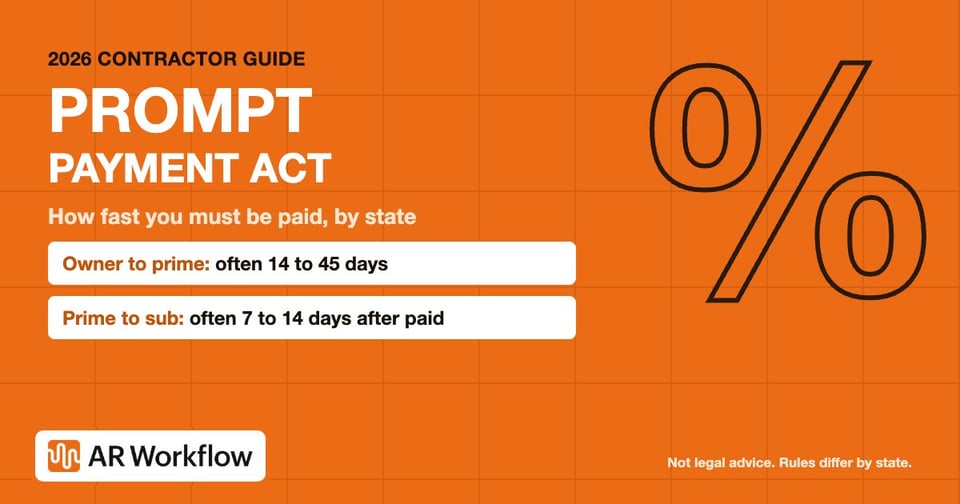
A prompt payment act sets how fast you must be paid. Before a lien, it is your first tool when a pay app is late. Here are the Massachusetts rules.
| Rule | Private jobs | Public jobs |
|---|---|---|
| Owner pays the prime | 15 days to OK plus 45 days to pay | 15 or 30 days after invoice |
| Prime pays the sub | 7 more days for each lower tier | Right after prime is paid |
| Late interest | No rate in law; 12% added to judgments | Fed rediscount rate plus 3% |
Law: private: Mass. Gen. Laws ch. 149 sec. 29E; public: Mass. Gen. Laws ch. 30 sec. 39F; 39G; 39K. Limits: Only jobs over $3M; not 4 or fewer homes. Our plain-English summary of the ASA and Kegler Brown 2024 prompt pay chart. Check the statute before you rely on it.
See every state side by side in our prompt payment act rules by state.
A lien is a last resort. It costs time and money, and it can end the customer relationship. Most contractors get paid sooner with a clear follow-up plan:
Tools and related guides
Official law and forms: Many states print the lien form or notice wording right in the law. Read the Massachusetts lien law and use the state form if it has one.
Prime contractors: Model two deadlines. Notice of Contract: earliest of 60 days after NSC recorded, 90 days after NOT recorded, or 90 days after last work. Statement of Account: earliest of 90, 120 or 120 days on the same triggers. The single '90 days' value fits only the Notice of Contract. The binding 'perfection' date is the Statement of Account (120 days by default). Subcontractors and suppliers: Same 60/90/90 (Notice of Contract) and 90/120/120 (Statement) windows. The last-work trigger runs from the last work by the prime 'or anyone claiming by, through or under him', meaning last work on the whole prime contract, not only the sub's own. Default the app to the sub's own last day (the earlier, safer date) and let the user override with project completion.
Send any required notices first, then record your lien claim before the deadline and serve the owner. Prime contractors: 90 days after your last day of work or materials. Subcontractors and suppliers: 90 days after your last day of work or materials. Then sue to enforce it on time, or release it once you are paid. The step-by-step section above walks through each part.
Optional, cap-protective Notice of Identification. Sent only by claimants without a direct contract with the original contractor, to the original contractor, within 30 days of commencing work, by certified mail RRR. If missed, the lien is capped and NOT lost. First-tier subs: none.
No NOI. Two recorded filings: Notice of Contract (s.2/s.4), then Statement of Account (s.8). Subs must also give the owner actual notice of the Notice of Contract filing.
No dwelling-specific lien deadlines. ss.2 and 4 require a written contract. For owner-occupied 1-4 unit homes, c.142A s.2 home-improvement contract requirements apply to the underlying contract (registered HIC).
Civil action within 90 days after filing the Statement of Account (s.11). Record an attested copy of the complaint within 30 days of commencing the action (s.5), or the lien dissolves.
On private jobs: owner pays the prime: 15 days to ok plus 45 days to pay; prime pays the sub: 7 more days for each lower tier. On public jobs: owner pays the prime: 15 or 30 days after invoice; prime pays the sub: right after prime is paid. Check the statute for exceptions.
See mechanics lien deadlines for all 50 states
Get paid before it gets to a lien.
AR Workflow works with QuickBooks and follows up on every invoice for you, from the first friendly reminder to the final notice. Bring one overdue invoice to a demo and see what we would send, and when.
Sam owned and ran three restoration companies for more than 14 years and collected over $100 million in receivables. He built AR Workflow in 2020 to give contractors the collections system he wished he'd had.

AI writes the emails, sends the texts, and leaves the voicemails. Your team handles the conversations that matter, and your cash keeps moving.
 Keep QuickBooksStart with one invoiceStay in control

 Log in