Connecticut mechanics lien laws: deadlines for primes, subs and suppliers, notice rules, home rules and how to file. Free deadline calculator.

Connecticut mechanics lien law gives contractors, subcontractors and suppliers a way to get paid when a customer won't pay for work on a property. But a lien only works if you send the right notices and file on time. Miss one step and you can lose the lien. This guide explains the Connecticut mechanics lien deadlines in plain English, with the law behind each rule.
Quick answer: Connecticut mechanics lien deadlines
Lien certificate recorded within 90 days after ceasing work (§ 49-34).
Last updated: November 23, 2026
This is not legal advice. Rules differ by state and change over time. We checked each rule below against the text of the Connecticut statute (Conn. Gen. Stat. §§ 49-33 to 49-40; Home Improvement Act § 20-429) in November 2026. Read the current law or ask a Connecticut construction attorney before you file.
"Prime contractor" means you have a contract directly with the property owner. "Subcontractor" or "supplier" means you were hired by the prime contractor or by another sub. These rules are for private projects. Public projects use bond claims instead of liens.
| Rule | What Connecticut requires | Law |
|---|---|---|
| Preliminary notice: prime contractor | None. The original contractor gives no notice. Its only optional step is to lodge an affidavit with the town clerk within 15 days after commencing, which entitles it to receive subs' 49-35 notices. | Conn. Gen. Stat. 49-35(a) |
| Preliminary notice: subcontractor | Subs and suppliers not in privity with the owner serve written notice of intent to claim a lien on the owner (and on the original contractor, if it lodged the 15-day affidavit). Window: any time after commencing and no later than 90 days after ceasing work. The notice and return of service must be returned no later than 30 days after the 49-34 certificate is filed. Exempt: a sub whose contract with the original contractor is in writing and has been assented to in writing (the statute does not say by whom; v3 says the GC, other readings say the owner; AMBIGUOUS, so the app should default to requiring the notice). | Conn. Gen. Stat. 49-35(a) |
| Preliminary notice: supplier | Same as sub (the 49-35 notice within 90 days after ceasing). | Conn. Gen. Stat. 49-35(a) |
| Notice of intent to lien | The 49-35 notice is the notice of intent. One document may serve as both the 49-35 notice and the 49-34 service (per Levelset, citing H&S Torrington v. Lutz). Service methods: in-hand or abode service if in town; on the agent if out of town; else registered/certified mail; publication if mail is returned unclaimed. | Conn. Gen. Stat. 49-35(a) |
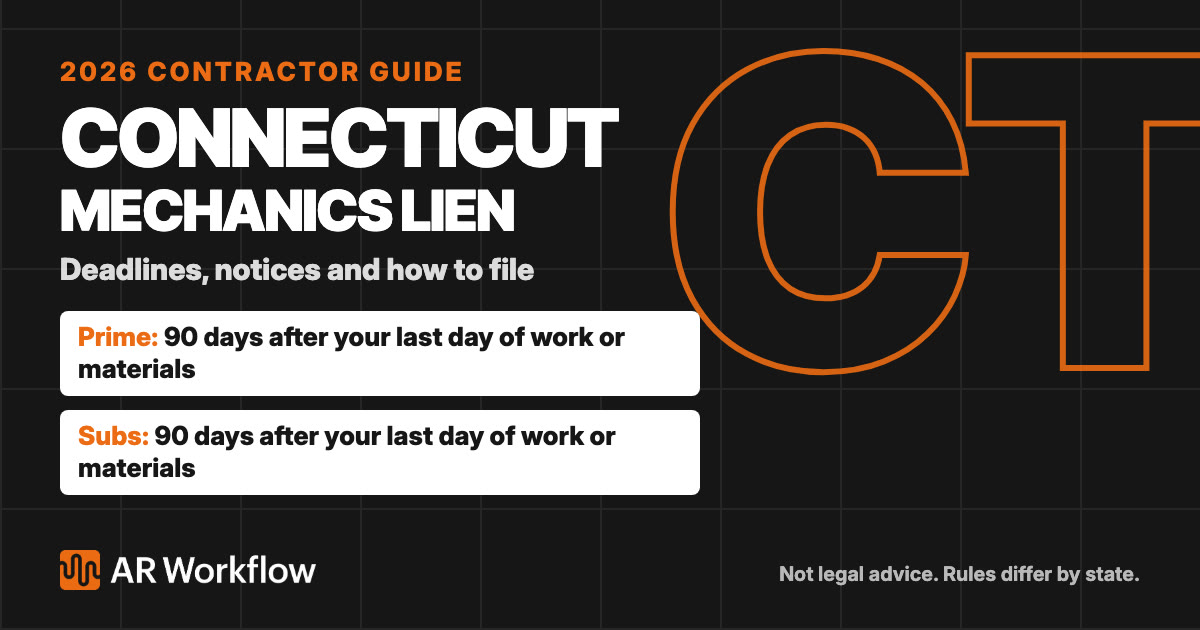
| Lien filing deadline: prime contractor | Lodge the sworn lien certificate with the town clerk within 90 days after ceasing to perform services or furnish materials. | Conn. Gen. Stat. 49-34 |
| Lien filing deadline: subcontractor and supplier | Same 90 days after ceasing. | Conn. Gen. Stat. 49-34 |
| Residential projects | Same 90 days. Chapter 847 has no residential variant. | Conn. Gen. Stat. 49-33, 49-34 |
| Notice of completion: does it shorten the deadline? | None. No notice of commencement, completion or demand mechanism shortens the 90-day or 1-year periods. The owner may apply to discharge or reduce the lien under 49-35a; after final disposition, the 60-day alternative in 49-39 can apply. | Conn. Gen. Stat. 49-34, 49-39 |
| Serving the owner after you file | No later than 30 days after lodging, serve a true and attested copy of the certificate on each owner, using the 49-35 methods. | Conn. Gen. Stat. 49-34 |
| Deadline to sue (enforce the lien) | The lien expires 1 year after it is perfected, unless within 1 year from the recording date the claimant commences a foreclosure action (complaint, cross-complaint or counterclaim) AND records a notice of lis pendens. Alternatively, within 60 days of final disposition of a 49-35a application, whichever is later. Tolled from the date of validation under 49-37a (bond substitution). | Conn. Gen. Stat. 49-39 |
Here is each deadline for prime contractors, subcontractors and suppliers on a commercial job. Homes have some different rules in Connecticut. See the home rules below. "Prime" means you have a contract with the owner. Some deadlines change if the owner records a notice, so check the full rules below.
| Step | Prime contractor | Subcontractor | Supplier |
|---|---|---|---|
| Preliminary notice | Not required | Not required | Not required |
| Notice of intent to lien | Not required | Only in some cases: Within 90 days after your last day of work or delivery. | Only in some cases: Within 90 days after your last day of work or delivery. |
| File the lien | Within 90 days after your last day of work or delivery. | Within 90 days after your last day of work or delivery. | Within 90 days after your last day of work or delivery. |
| Serve a copy of the lien | Within 30 days after the lien is recorded. | Within 30 days after the lien is recorded. | Within 30 days after the lien is recorded. |
| Sue to enforce the lien | Within 1 year after the lien is recorded. | Within 1 year after the lien is recorded. | Within 1 year after the lien is recorded. |
Get your exact Connecticut dates
Enter your first and last day of work. Our free calculator shows the last day to send each notice, file your lien and sue.
Roofing, restoration and remodeling work on homes often has extra rules. In Connecticut:
Lien statute: no residential variant. Home Improvement Act 20-429(a): a home improvement contract is not 'valid or enforceable against an owner' unless it is in writing, signed by owner and contractor, and contains the entire agreement, the transaction date, the contractor's name, address and registration number, notice of cancellation rights (ch. 740), starting and completion dates, and an entity-history disclosure. It must also be entered into by a registered contractor or salesman. Changes must be in writing and signed. A noncompliant prime generally cannot foreclose a lien against the homeowner (Burns v. Adler, 2017: lien foreclosure count reversed). Exceptions: (1) the homeowner's bad faith, which does not apply when the dispute is genuinely caused by the contractor's noncompliance; (2) 20-429(f) quantum meruit when the contractor complied with specified elements and denial would be inequitable. A sub's lien is NOT barred by the GC's HIA noncompliance (136 Conn. App. 184 annotation).
Same 90 days. Chapter 847 has no residential variant.
Example: A subcontractor's last day of work on a Connecticut job was Monday, March 2, 2026. With a 90-day deadline from the last day of work, count 90 days forward: the lien must be filed by Sunday, May 31, 2026. Don't wait for the last day. Set a reminder a few weeks earlier, and check whether a notice of completion or other rule in the table above changes your clock.
A prompt payment act sets how fast you must be paid. Before a lien, it is your first tool when a pay app is late. Here are the Connecticut rules.
| Rule | Private jobs | Public jobs |
|---|---|---|
| Owner pays the prime | 30 days after invoice | 45 days after good claim (state) |
| Prime pays the sub | 30 days after prime is paid | 30 days after prime is paid |
| Late interest | 1% per month | State Short Term Fund yield |
Law: private: Conn. Gen. Stat. 42-158i to 42-158j; public: Conn. Gen. Stat. 4a-71 to 4a-75; 49-41a to 49-41c. Our plain-English summary of the ASA and Kegler Brown 2024 prompt pay chart. Check the statute before you rely on it.
See every state side by side in our prompt payment act rules by state.
A lien is a last resort. It costs time and money, and it can end the customer relationship. Most contractors get paid sooner with a clear follow-up plan:
Tools and related guides
Official law and forms: Many states print the lien form or notice wording right in the law. Read the Connecticut lien law and use the state form if it has one.
Prime contractors: Lodge the sworn lien certificate with the town clerk within 90 days after ceasing to perform services or furnish materials. Subcontractors and suppliers: Same 90 days after ceasing.
Send any required notices first, then record your lien claim before the deadline and serve the owner. Prime contractors: 90 days after your last day of work or materials. Subcontractors and suppliers: 90 days after your last day of work or materials. Then sue to enforce it on time, or release it once you are paid. The step-by-step section above walks through each part.
Subs and suppliers not in privity with the owner serve written notice of intent to claim a lien on the owner (and on the original contractor, if it lodged the 15-day affidavit). Window: any time after commencing and no later than 90 days after ceasing work. The notice and return of service must be returned no later than 30 days after the 49-34 certificate is filed. Exempt: a sub whose contract with the original contractor is in writing and has been assented to in writing (the statute does not say by whom; v3 says the GC, other readings say the owner; AMBIGUOUS, so the app should default to requiring the notice).
The 49-35 notice is the notice of intent. One document may serve as both the 49-35 notice and the 49-34 service (per Levelset, citing H&S Torrington v. Lutz). Service methods: in-hand or abode service if in town; on the agent if out of town; else registered/certified mail; publication if mail is returned unclaimed.
Lien statute: no residential variant. Home Improvement Act 20-429(a): a home improvement contract is not 'valid or enforceable against an owner' unless it is in writing, signed by owner and contractor, and contains the entire agreement, the transaction date, the contractor's name, address and registration number, notice of cancellation rights (ch. 740), starting and completion dates, and an entity-history disclosure. It must also be entered into by a registered contractor or salesman. Changes must be in writing and signed. A noncompliant prime generally cannot foreclose a lien against the homeowner (Burns v. Adler, 2017: lien foreclosure count reversed). Exceptions: (1) the homeowner's bad faith, which does not apply when the dispute is genuinely caused by the contractor's noncompliance; (2) 20-429(f) quantum meruit when the contractor complied with specified elements and denial would be inequitable. A sub's lien is NOT barred by the GC's HIA noncompliance (136 Conn. App. 184 annotation).
The lien expires 1 year after it is perfected, unless within 1 year from the recording date the claimant commences a foreclosure action (complaint, cross-complaint or counterclaim) AND records a notice of lis pendens. Alternatively, within 60 days of final disposition of a 49-35a application, whichever is later. Tolled from the date of validation under 49-37a (bond substitution).
On private jobs: owner pays the prime: 30 days after invoice; prime pays the sub: 30 days after prime is paid. On public jobs: owner pays the prime: 45 days after good claim (state); prime pays the sub: 30 days after prime is paid. Check the statute for exceptions.
See mechanics lien deadlines for all 50 states
Get paid before it gets to a lien.
AR Workflow works with QuickBooks and follows up on every invoice for you, from the first friendly reminder to the final notice. Bring one overdue invoice to a demo and see what we would send, and when.
Sam owned and ran three restoration companies for more than 14 years and collected over $100 million in receivables. He built AR Workflow in 2020 to give contractors the collections system he wished he'd had.

AI writes the emails, sends the texts, and leaves the voicemails. Your team handles the conversations that matter, and your cash keeps moving.
 Keep QuickBooksStart with one invoiceStay in control

 Log in